
Structural Latency Protocols in High Load Engineering Environments
Structural latency protocols enforce hardware setpoints by shedding excess load and propagating backpressure upstream when queues saturate under heavy load.

Load
When incoming demand exceeds execution capacity, systems running under continuous ingress develop predictable operational latency. Capacity in these environments forms a firm physical boundary defined by memory allocations, available threads, and hardware setpoints. Below concurrency limits, response times remain predictable; past them, systems divert processing energy from serving requests to managing queues.
Latency increases as a direct consequence of queue growth.
Load-transferring architectures pass pressure upstream unless stopped by an explicit boundary. In unthrottled systems, incoming packets pile up in volatile memory, increasing queue depth alongside round-trip time. Telemetry can make this look like an intermittent software bug, but the underlying mechanics are simple: setpoints dictate maximum safe concurrency, and work halts once resources run out.
An unstated capacity bound converts excess incoming packet rate into immediate background processing drift.
Concurrency limits in high-throughput systems mark real physical boundaries. When queued worker tasks exceed available CPU cores, context switching consumes available cycles and reduces total throughput. Operating above saturation means spending more time swapping execution state than finishing units of work.
Concurrency Saturation and Setpoint Drift
Saturation fundamentally changes how ingress volume relates to throughput. Below saturation, response times stay steady as incoming load varies. Once queues fill to capacity, every added request increases processing latency across all active channels, causing visible spikes in error rates and longer response tails.
Without explicit load-shedding mechanisms, sustained overload exhausts system resources entirely. Memory buffers expand until garbage collection cycles consume remaining worker threads, triggering systemic failure and dropping service availability for dependent upstream systems.
Channel
Communication pathways across distributed environments reflect system state through latency patterns and ping intervals. Under nominal conditions, steady transmission rhythms indicate operational headroom. When worker nodes run low on local resources, transmission intervals widen automatically, letting upstream nodes infer availability from these delays without explicit status messages.
Priority signaling keeps critical control traffic moving alongside standard payloads. High-load setups separate administrative telemetry from user data streams to prevent queue starvation during saturation events. Running a dedicated out-of-band channel ensures essential control signals reach their destination even when primary pathways hit queue limits.
Silence inside an unmonitored backchannel communicates the precise exhaustion of operational headroom.
Automated failover systems use the signal-to-silence ratio on telemetry feeds as a primary health metric. Remote nodes evaluate packet arrival timestamps to monitor the status of distant cluster members.
Transmission Latency and Priority Routing
Channel health reflects performance across underlying execution layers. Monitoring systems watch distinct transmission profiles to distinguish routine delays from terminal node failure.
- Heartbeat Silence Duration indicates the exact window between expected node check-ins before upstream router tables drop the destination route.
- Out-Of-Band Interrupt Signal bypasses standard execution queues to force immediate worker thread preemption during memory pressure events.
- Payload Packet Spacing reveals worker thread queue depth by recording jitter across sequential response frames.
- Backchannel Degradation Indicator exposes localized resource contention before error rates surface in public ingress points.
Upstream services treat widening response gaps as a direct signal of reduced remote capacity. These delays notify service owners that a downstream dependency can no longer handle traffic at its agreed velocity.
Buffer
Queue management determines whether a system absorbs sudden traffic spikes or suffers cascading failure. Memory buffers hold payload descriptors during brief worker pool saturation, smoothing short surges into manageable execution queues. Bounded queues protect memory by setting firm drop limits on unprocessed requests, while unbounded buffers preserve initial packets at the cost of hidden memory risks.
Consider a high-density distributed system handling ten thousand concurrent client connections. Two edge nodes receive matching ingress bursts of fifteen thousand requests per second against a downstream capacity of eight thousand operations per second. Node A uses drop-head shedding, instantly dropping old queue items when storage limits trip.
Node B uses tail-blocking wait queues, holding connections open while waiting for worker capacity.
| Protocol Strategy | Tail Latency Impact | Memory Footprint | Failure Mode |
|---|---|---|---|
| Drop-Head Shedding | Bounded at configured timeout threshold | Static allocation locked at setpoint | Predictable payload rejection at ingress |
| Tail-Blocking Wait Queue | Unbounded exponential growth | Dynamic growth up to kernel crash | Cascading timeout across caller dependencies |
| Dynamic Rate Throttling | Linear degradation aligned with load | Proportional allocation with upper cap | Adaptive request rejection based on telemetry |
Node A keeps response times steady for accepted traffic by rejecting excess load at the boundary. Node B experiences immediate memory growth, raising tail latency across all connected callers and causing upstream timeouts. Setting explicit queue bounds protects core processing threads by turning away unmanageable traffic at the perimeter.
When thread pools reach max concurrency, additional caller retries multiply systemic overhead without advancing work.

Queue Shedding Mechanisms under Heavy Volume
Under heavy sustained load, drop-head protocols discard older buffered items to make space for incoming requests. This prioritizes newer traffic on the assumption that older callers may have already timed out. Conversely, tail-drop protocols reject new incoming items once buffer allocation fills, protecting work already in queue.
Enforcing a hard maximum queue depth maintains memory stability, trading away complete payload delivery to protect system memory.

Valve
Throttling protocols act as safety valves in high-load systems, regulating flow across boundaries. State-gated throttling halts packet processing automatically when internal telemetry reports resource saturation, operating without input from caller preferences. Decision-gated mechanisms rely on manual or scripted policy toggles, requiring external triggers to adjust throughput.
System state reflects physical resource conditions, such as available memory, CPU utilization, and I/O wait times. Operational fluctuations show up in surface metrics like temporary request spikes or elevated ping delays. Rate limits tied directly to system state protect underlying hardware before resources run out entirely.
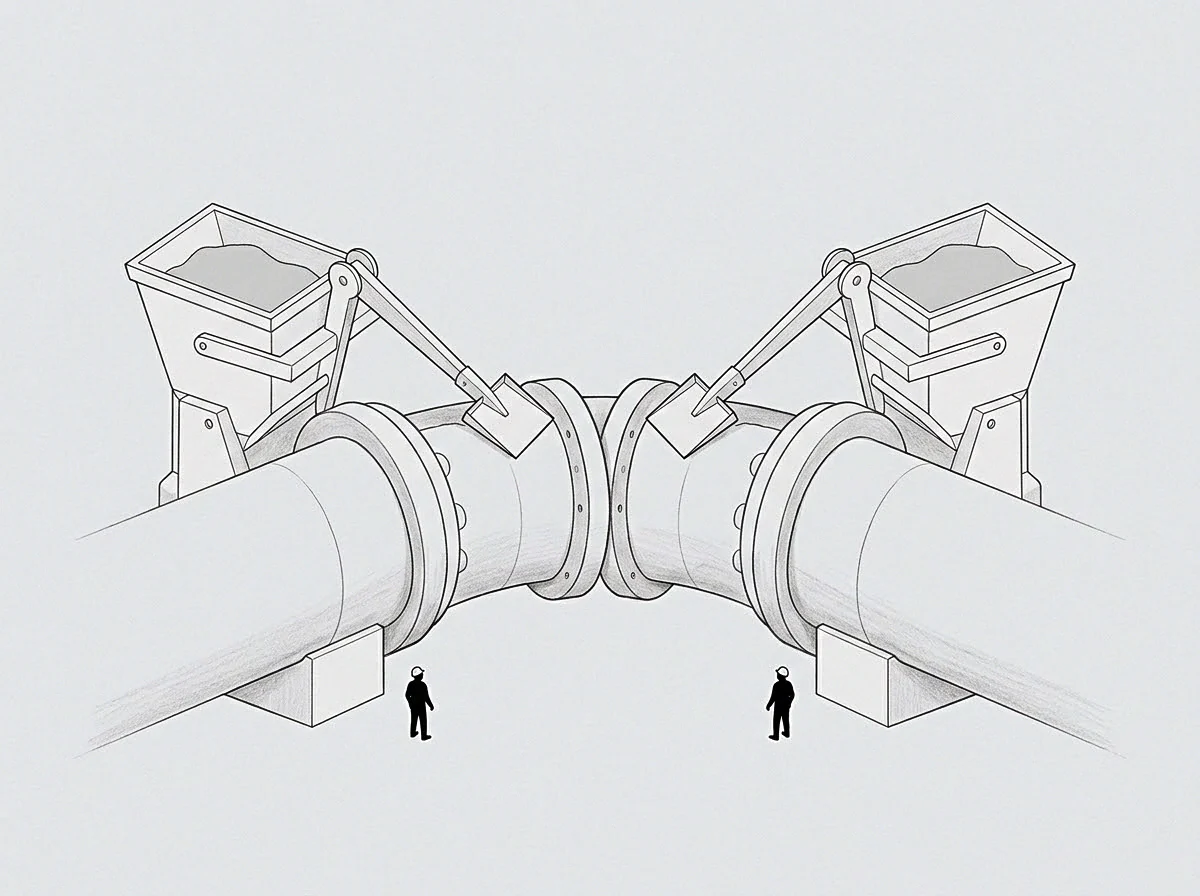
When Does Backpressure Convert to System Silence?
Backpressure builds upstream whenever a downstream valve restricts intake. Receiving nodes issue flow-control signals instructing senders to slow down or halt traffic generation. If upstream senders ignore these instructions, the receiving valve drops incoming network connections to safeguard local memory.
State-gated throttling halts execution automatically when telemetry signals memory pressure regardless of operator preference.
Unhandled backpressure leads to dropped connections, buffer overflows, and thread pool starvation. Effective valve configurations calibrate operational setpoints against actual physical bounds rather than expected traffic estimates. Establishing firm, state-gated limits protects hardware automatically.

Margin
Operating margins establish the physical distance between routine cluster load and hardware capacity. High-load architectures rely on explicit headroom metrics to navigate unscheduled volume spikes, failover events, or worker node failures. When load consumes this margin, latency protocols transition from routine optimization to basic survival modes.
Unmanaged backpressure forces upstream systems to absorb the cost of downstream saturation. When limits remain unstated, calling systems only discover actual capacity bounds through connection timeouts and dropped frames. Setting explicit boundaries with rate limits and timeout contracts passes queue management back to incoming traffic sources.
- Define explicit concurrency boundaries based on physical memory limits rather than average request volume expectations.
- Implement state-gated rate limiting protocols directly at network ingress boundaries to reject unscheduled burst load instantly.
- Configure aggressive upstream request timeouts to prevent worker pool lockup during localized downstream saturation events.
- Isolate operational administrative pathways from payload traffic wires to preserve cluster telemetry during emergency shedding cycles.
Calculating headroom requirements around peak telemetry data rather than average workload metrics ensures structural stability. When demand reaches hardware limits, backpressure protocols enforce controlled degradation paths to protect core functions.