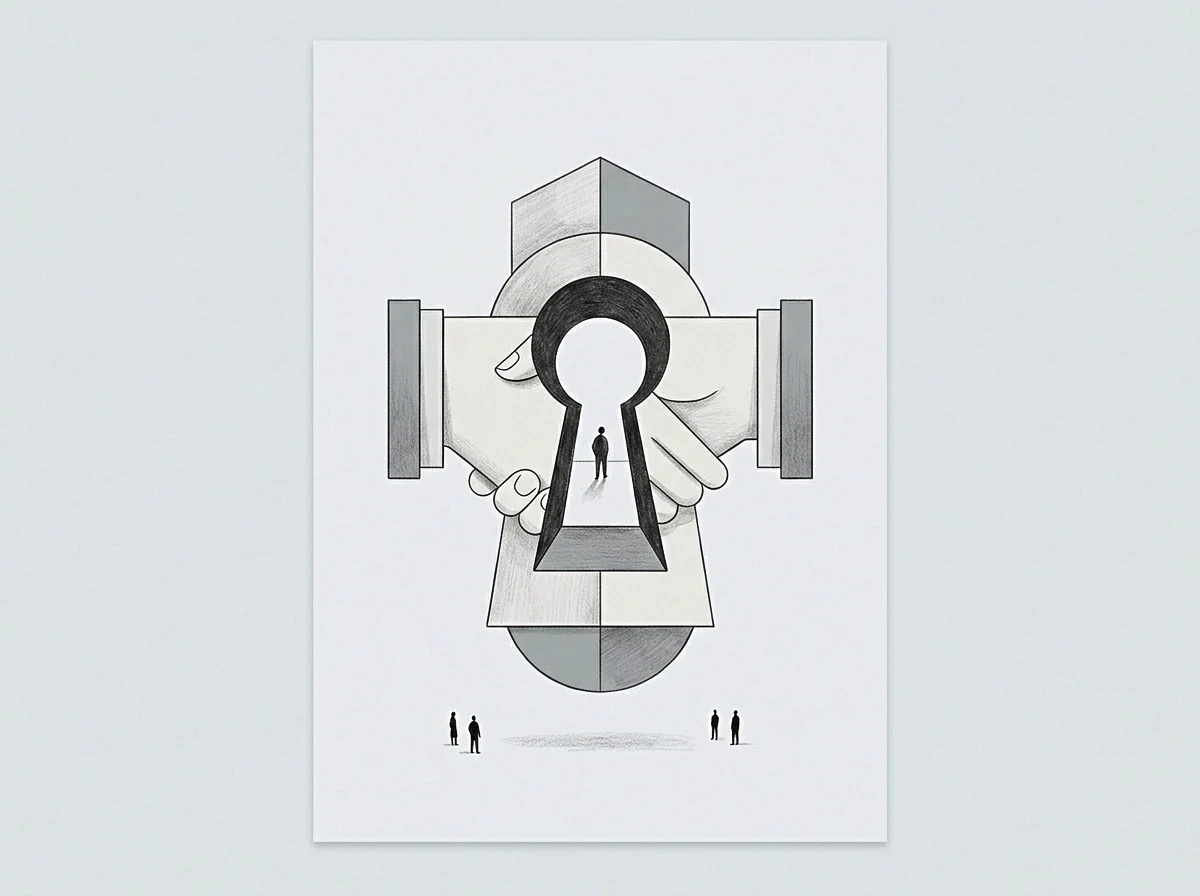
The brain budgets regulation as if a reliable other is present. Self-regulation alone is the expensive mode and proximity is the cheap one, which is why people attach to a stable person’s state and read the borrowed calm as their own. A regulator proven under load attracts more load.
Unexamined working models of unilateral holding convert peer calmness into threat signals, preventing somatic down-regulation during shared co-regulation protocols.
A stated operational limit forces distributed problem resolution by halting the passive metabolic absorption of collective threat by a single steady colleague.
Borrowed calm functions as an energetic subsidy that depletes the allocator while allowing surrounding teams to operate without registering structural risk.
Earned security updates backward working models through repeated experiences of reliable co-regulation, redistributing executive metabolic load to shared baseline infrastructure.
Solitary leadership forces the brain to budget survival alone, driving sustained neuroendocrine elevation that depletes tissue until systemic buffers exist.
Executive concurrency limits emerge from biological working memory constraints when organizations offload systemic regulatory demands onto an isolated leader.
Local co-regulation capacity expands only when experienced leads absorb peripheral nervous system load through physical presence and explicit intake limits.
Structural authority blocks bilateral regulation by forcing lower ranks into threat monitoring, requiring explicit separation of evaluation from presence.
Asymmetrical executive teams stabilize when the primary regulator converts unspoken physiological holding into explicit structural limits and measured latency.
Rebuilding relational receptors across power asymmetry requires external peers who share structural parity without holding financial or operational leverage.
Prolonged solitary responsibility forces the brain to budget regulation without social damping, locking neural circuits into autonomous threat appraisal.
Structured decompression protocols isolate high sympathetic arousal during re-entry, preventing allostatic load transfer and domestic co-regulation friction.
Autonomic depletion during home transitions occurs when external operational demands suddenly vanish, exposing unmasked sympathetic exhaustion before parasympathetic deceleration can engage.
Prolonged operational isolation forces human autonomic nervous systems from low-cost shared baseline regulation into high-cost continuous individual threat monitoring.
Solo leadership elevates neural metabolic expenditure because self-regulation lacks the physiological load sharing provided by direct coregulating proximity.
Coregulation rebuilding requires transitioning from solitary neural budgeting to reciprocal presence that distributes metabolic loads across trusted bodies.
Six fields, each writing its own terms
The terms are written where they belong. Each field holds three desks, and every entry a desk writes raises the terms it uses, each term given a meaning, a mechanism and the places it appears. The record on these pages stays first person and hand made; the fields grow the nomenclature.