
Deriving Mechanical Cutoff Triggers From Rolling Sleep Deficits And Cognitive Latency
Cumulative sleep loss increases cognitive latency, forcing automated cutoff triggers to revoke approval authority before decision failure occurs.

Drain
A founder sits before three open terminals at three in the morning, reviewing code commits while cumulative rest loss degrades processing speed to levels matching legal alcohol intoxication. The physical body remains stationary in the chair, yet operational capacity drops continuously. Every decision made in this window carries an unacknowledged tax.
Complex problem solving degrades first, followed by working memory retention and risk assessment accuracy. The operator experiences a false sense of clarity, assuming that deliberate focus compensates for physiological exhaustion.
Physiological recovery follows non-linear pathways. A single night of restricted rest alters circadian amplitude, but consecutive nights of partial deprivation compound into a persistent functional deficit. The metabolic cost of maintaining alertness under chronic restriction demands elevated cortisol output, which masks underlying fatigue.
Errors accumulate. Capacity drops.

Cumulative Load Across Rolling Windows
Chronic rest deficit accumulates across rolling seventy-two-hour windows rather than single nocturnal cycles. When rest drops below six hours per night over three consecutive cycles, the brain exhibits involuntary attentional lapses known as microsleeps. These lapses last from several hundred milliseconds to several seconds, during which external stimuli fail to register.
System architecture decisions executed during these windows frequently contain structural flaws that surface only during production incidents weeks later.
The system experiences load transfer failure when the operator attempts to regulate personal availability through sheer effort. Willpower operates as an unsustainable control mechanism. As fatigue deepens, the internal monitor that assesses performance degradation fails entirely, leaving the operator blind to their own declining latency metrics.

Why Does Subjective Awareness Fail Under Debt?
An individual operating under rest loss loses the capacity to evaluate cognitive impairment accurately. Self-assessment neural circuits suffer the same performance degradation as executive execution channels. The baseline shifts.
The physiological mechanism driving this perceptual disconnect involves degraded functional connectivity between the prefrontal cortex and the amygdala. The operator misinterprets high autonomic arousal as cognitive readiness. The signal fades.
Consequently, internal self-regulation fails precisely when intervention becomes most urgent.
An operator working on four hours of sleep reads their own speed as normal while their error rate doubles.
External structural cutoffs provide the only reliable intervention when internal awareness degrades. Without pre-committed parameters, an exhausted leader continues approving operational changes long after executive function has fallen below safe thresholds. Whether an impaired operator can ever recognize their own degradation before system failure occurs remains unresolved by physiological monitoring alone.
Lag
Measuring response delay yields precise data regarding executive impairment. Simple psychomotor reaction time tests expose degraded alertness long before complex reasoning completely breaks down. Latency compounds.
Cognitive latency manifests as a delayed response interval between input signal arrival and operational execution. In high-stakes environments, a delay increase of two hundred milliseconds correlates directly with catastrophic oversight rates. Tracking these intervals creates an objective baseline for state evaluation.

Quantifying Cognitive Processing Speed
Systematic assessment requires monitoring specific performance variables across active work cycles. Processing delay expands exponentially as rolling rest deficits mount. The calculation stops.
The following table illustrates the direct correlation between accrued rest deficits, measured psychomotor response delays, error probability rates, and the required operational threshold actions.
| Rest Deficit Window | Response Delay | Error Rate Shift | Operational Action |
|---|---|---|---|
| 0 to 4 Hours | Baseline (+0 to 50 ms) | 1.0x (Standard) | Full Authorization Held |
| 4 to 8 Hours | Moderate (+50 to 150 ms) | 2.5x Increase | Secondary Sign-off Active |
| 8 to 12 Hours | Severe (+150 to 300 ms) | 5.0x Increase | Execution Privileges Revoked |
| 12+ Hours | Critical (+300+ ms) | 10.0x Increase | Mandatory System Lockout |

State Variables Against Subjective Mood
Operational readiness relies on physiological state variables rather than temporary emotional baseline assessments. Mood represents an uninformative output signal, whereas state functions as the precise transfer mechanism dictating input processing.
- Baseline response speed measures the interval between stimulus presentation and execution.
- Cognitive headroom defines the remaining working memory allocation available for emergency intervention.
- Lapse frequency records the occurrences of microsleeps lasting longer than five hundred milliseconds.
- Target error probability calculates the statistical likelihood of procedural oversight during complex sequences.
Evaluating state through these hard variables removes subjective negotiation from governance decisions. The data reflects physical reality regardless of perceived motivation or urgency.
Cognitive latency degrades executive function predictable by the hours of sleep deficit accrued over a rolling seventy-two-hour window.
When response delays lengthen, decision authority shrinks to simple pre-approved actions.

Valve
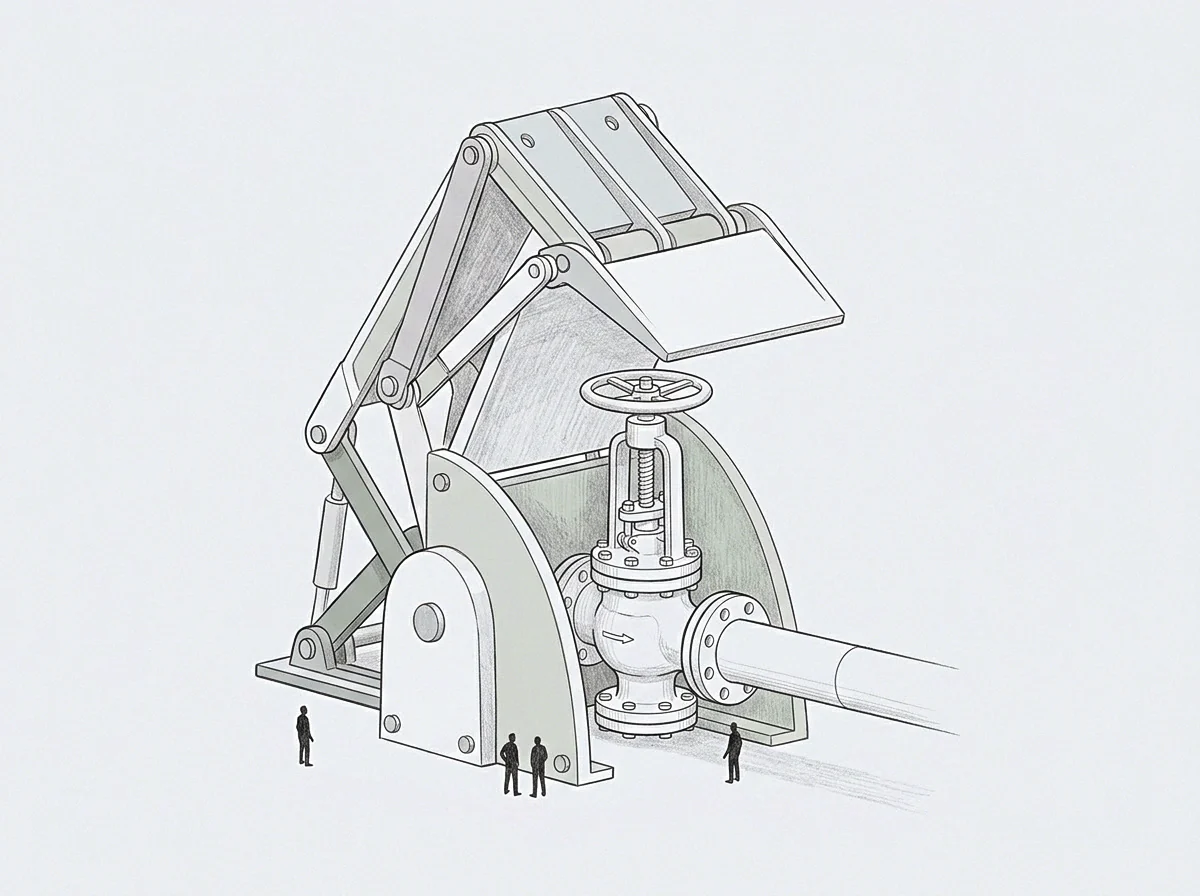
Automated circuit breakers prevent impaired operators from authorizing critical system modifications. Human operators routinely override personal fatigue warnings when project pressures escalate. A mechanical cutoff acts as an impersonal structural wall, intercepting commands before execution occurs.
Designing effective circuit breakers requires establishing hard parameters that trigger automatically upon threshold breach. The cutoff holds. These parameters remove human negotiation from the safety loop, enforcing operational pauses regardless of external emergency claims.

Designing Hard Circuit Breakers
Circuit breaker integration depends on real-time telemetry inputs gathered from operator activity. Keystroke dynamics, response latency during routine checks, and commit error frequency supply continuous data streams. When telemetry signals cross pre-set limits, access privileges revoke instantly.
The system enforces a state-gated act parameter, preventing specific high-risk operations whenever physiological indicators show acute degradation. No amount of conscious intent can override a state-gated lock once triggered. Authority transfers automatically to a pre-designated alternate seat or enters a delayed execution queue.
Automated Throttling Systems
Automated throttling limits incoming operational requests during periods of confirmed cognitive impairment. Reducing information throughput preserves system stability while executive capacity recovers. The rule decides.
Throttling protocols restrict high-risk approvals while permitting low-risk routine maintenance. This selective gating prevents complete operational paralysis while securing core infrastructure against catastrophic oversight.
A mechanical cutoff transfers the burden of decision from an impaired regulator to a pre-stated operational rule.
Relying on willpower during severe sleep debt leads to catastrophic operational error and total system collapse.

Wire
Consider an operational incident scenario involving two infrastructure engineering leads during a continuous ninety-six-hour system migration. Primary authorization belongs to an operator who has logged twelve hours of rest deficit over the preceding two days. Live monitoring detects significant cognitive decay during a critical database schema change.
Execution protocols dictate an immediate transfer of deployment authority. The window closes. The process unfolds according to pre-established mechanical rules rather than interpersonal negotiation.
- Operator logs six hours of cumulative rest debt over two consecutive cycles.
- Psychomotor vigilance monitoring registers a forty percent delay in decision speed.
- Automated telemetry triggers a forced shift handoff to the secondary operator.
- The secondary operator assumes full approval authority until baseline metric recovery occurs.

Execution Protocol Under Live Conditions
The primary operator attempts to retain access, citing deep contextual knowledge of the active deployment script. The system denies authorization requests based strictly on recorded latency metrics. Load shifts elsewhere.
The secondary operator accepts administrative control without interpersonal friction because the transfer was executed by code rather than subjective judgment. The seat empties.

Load Transfer to Prescribed Limits
Automated load distribution ensures system integrity remains uncompromised by human physical limits. Prescribed limits dictate exactly when, how, and where administrative responsibility shifts.
Removing manual discretion protects both the organization and the individual operator from the fallout of impaired decision-making. The system maintains baseline stability through objective governance rules.
When reaction times slow beyond baseline, authorization authority transfers to the designated secondary role.
The system took authorization off the desk before any damage was done.

Mark
Operational governance requires explicit terms stated clearly long before acute stress events occur. Stated limits define the precise boundary where individual responsibility ends and structural protection begins. The limit stands.
Availability is derived entirely from clear position statements and explicit operational costs. When counterparties understand that availability stems from mechanical rules rather than personal preference, negotiation pressure vanishes. The wall remains.
The system halts.

Stated Terms in Operational Governance
Governing documents must contain explicit clauses defining mandatory rest windows and objective cognitive latency cutoffs. Stating these parameters formally establishes an unyielding boundary that survives emergency pressures.
A mechanical cutoff clause revokes approval authority automatically whenever cumulative rest debt exceeds twelve hours over forty-eight hours.