
Structural Failure Modes Of Unstated Authority Constraints In High Volume Operational Expansion
Unstated authority constraints fail during operational expansion because surging volume exceeds founder regulatory capacity, causing decision latency and systemic paralysis.

Surge
Four operational queues stall at midnight while forty transactions sit unparsed on an operator screen. The founder remains away from the console, and the team halts processing because nobody holds explicit written permission to approve variances over five thousand dollars. The organization expanded throughput by three hundred percent over ninety days, yet the decision architecture remained anchored to informal verbal passes established when the entire staff sat in one room.
Operational volume breaks unstated limits. What functioned as intuitive co-regulation during low-volume operations becomes an impassable bottleneck when throughput accelerates.
A load-transferring system pushes against its regulator until it encounters a boundary that holds independent of the regulator’s personal presence. In early-stage operations, authority boundaries exist as implicit setpoints held within the founder’s active perception. Operators sense these tacit boundaries through daily contact, modifying action based on real-time feedback.
Operational expansion severs this continuous feedback loop by multiplying the number of concurrent transactions beyond the founder’s cognitive setpoint. The baseline load exceeds personal monitoring capacity. When unstated authority constraints encounter high transaction volume, the operational queue stops moving entirely.

Capacity Constraints In Implicit Regulatory Loops
Control systems theory demonstrates that any feedback loop relying on a single central processor encounters a concurrency limit when input frequency outpaces processing speed. Tacit authority models require operators to route ambiguous edge cases back to the founder for manual clearance. Volume surges convert rare edge cases into continuous operational streams.
The queue length grows exponentially while processing speed remains linear, creating severe structural latency.
State governs performance while mood remains an irrelevant output. In an expanding enterprise, the internal state of the authority system depends on clear setpoints rather than emotional posture. Operators facing unstated constraints experience high ambiguity regarding decision safety.
This ambiguity triggers operational paralysis, as the perceived personal cost of an unauthorized breach outweighs the organizational cost of systemic delay.
When operational input frequency exceeds central processing capacity, tacit governance loops default directly to systemic stagnation.
The Accumulation Of Structural Decision Latency
Decision latency accumulates silently across every thread of an expanding business. An operator waiting four hours for an informal approval delays downstream fulfillment, pushing vendor handoffs into subsequent operational windows. The queue stalls.
The delay stems from authority architecture rather than individual worker capability.
When authority constraints remain implicit, operators substitute founder availability for functional clearance. The ping becomes the universal operational currency. Every micro-decision generates a query signal sent upward, transforming the founder’s primary communication channel into a high-friction bottleneck.
The constant pinging reflects a missing structural wall rather than operator incompetence.
Failure to define explicit fiscal and operational boundaries forces the organization to pay for structural ambiguity through lost operational velocity, inflated transaction cycle times, and widespread operator paralysis.

Wedge
Divergence between operator execution and founder expectations creates an operational wedge during periods of rapid volume growth. The operator assumes that silent delegation implies full decision authority up to the point of active intervention. The founder assumes that unstated boundaries remain self-evident to any competent professional.
The operational queue stalls under the weight of this false equivalence.
Research in social baseline theory establishes that human systems conserve energy by offloading regulatory burdens onto reliable structural anchors. When structural anchors are missing, the cognitive cost of operating rises sharply for every participant. In corporate scaling, an unstated limit acts as a shifting target.
Operators expend energy anticipating founder reactions rather than executing tasks against fixed parameters.

Divergence Between Tacit Expectations And Operating Realities
Tacit boundaries rely on shared context that vanishes during rapid team expansion. Newly hired operators bring execution habits from external systems, interpreting structural silence as permission. The founder interprets the resulting independent actions as organizational overreach or policy violations.
The error signal spikes instantly.
This dynamic creates a destructive operational pattern. The founder responds to unauthorized operator actions by retroactively asserting control, pulling authority backward without formalizing new limits. Operators respond by withholding further independent action, escalating every minor choice to the central console.
Velocity drops to zero.

Operational Metrics Across Governance Regimes
Evaluating operational metrics across contrasting governance models reveals how implicit limits actively degrade systemic performance during scaling phases.
| Performance Metric | Implicit Authority Structure | Explicit Stated Terms |
|---|---|---|
| Decision Latency | High; scales exponentially with transaction volume | Low; bounded by local execution parameters |
| Error Signal Frequency | Continuous micro-queries via unstructured pings | Discrete exceptions routed by automated thresholds |
| Delegate Autonomy | Low; state-gated by founder real-time presence | High; decision-gated within stated fiscal parameters |
| Capacity Ceiling | Fixed to founder personal monitoring capacity | Decoupled from central executive processing limits |
The tabulated metrics demonstrate that structural efficiency requires formal parameter definition. Implicit structures lock capacity to personal monitoring capability, whereas stated terms allow throughput to scale independently of executive availability.
The team cannot execute effectively when every action requires reading executive mood instead of following clear operating terms.

Valve
Authority limits act as operational valves, regulating the flow of capital, commitment, and organizational risk. Unstated valves leak continuously or lock shut unpredictably under pressure. High-volume operational expansion acts as a hydraulic stress test, exposing every unstated boundary across the enterprise.

How Does Decision Latency Compound Under Tacit Boundaries?
Decision latency compounds through nested dependencies across operational threads. Consider an enterprise scaling its logistics operations from fifty to five hundred fulfillments daily. The logistics manager encounters a supplier price increase of three percent.
Under explicit authority terms, any variance under five percent falls within local authorization. Execution continues immediately.
Under tacit authority constraints, the manager lacks explicit fiscal boundaries. The manager pauses the procurement process to seek informal founder confirmation. The query sits in an unread inbox for twelve hours.
Meanwhile, warehouse staff wait for raw materials, downstream shipping schedules miss carrier booking windows, and customer support receives three hundred delayed-delivery inquiries. A three percent price variance transforms into a systemic operational stoppage due to missing boundary architecture.
Tacit authority failures follow predictable structural trajectories within high-volume environments:
- Authority threshold paralysis occurs when operators halt transaction throughput at arbitrary points due to uncertainty regarding executive financial risk tolerance.
- Informal override collapse emerges when verbal instructions contradict historical operational precedents, destroying operator trust in decision stability.
- Regulatory load transfer forces the central executive to spend all available energy resolving low-level operational queries rather than strategic positioning.
- Covert compliance accounting develops when staff build shadow authorization channels to bypass ambiguous central bottlenecks.
A stated operational term removes the requirement for real-time executive authorization across routine functional variances.

Worked Dynamics Of Operational Throughput Systems
To examine the structural mechanism, consider two commercial scaling arrangements operating under identical market demand and capital allocations over a six-month growth spurt.
In the first arrangement, assume two co-founders scale customer onboarding without defining explicit contractual approval limits for custom enterprise terms. The lead operator closes twelve enterprise deals in month one, each carrying minor custom service-level modifications. By month three, transaction volume reaches sixty deals monthly.
The co-founders discover that custom service commitments exceed engineering capacity. They retroactively freeze all pending deals and institute a mandatory executive review for every contract. Processing time per contract balloons from two days to twenty-eight days.
Sales reps stop submitting custom deals entirely, revenue flattens, and four senior operators resign due to perceived structural micromanagement.
In the second arrangement, assume the same initial baseline, but the co-founders establish explicit boundary conditions before scaling volume. Contracts containing service-level variances under ten percent and contract values below fifty thousand dollars pass directly to local operational sign-off. Any deal exceeding these parameters routes automatically to a scheduled executive committee meeting held twice weekly.
Contract processing time remains stable at three days across the entire expansion phase. Engineering capacity is planned against known variance caps, and operational volume increases sixfold without executive intervention.
Operators decide according to standing terms when those terms are explicit, flat, and visible across all channels.
A simple rule governs operational throughput: explicit authority constraints increase velocity by converting permission requests into parameter checks.

Mesh
Transitioning an expanding operation from tacit governance to a structural mesh requires replacing personal authorization loops with objective state parameters. The organization shifts from evaluating worker intentions to validating transaction boundaries against explicit terms. State-gated acts replace mood-dependent approvals.
A state-gated act requires specific environmental conditions to proceed, independent of executive deciding power. For instance, an automated order processing pipeline requires verified inventory state and cleared credit authorization. Once these parameters hold, execution occurs automatically.
Decision-gated acts, conversely, rely on subjective human authorization. High-volume expansion fails when decision-gated acts dominate routine operational flows.

Transition From Mood Based Authorization To State Parameters
When an enterprise operates under implicit authority constraints, approval depends heavily on executive mood and immediate cognitive headroom. An operator presenting a risk variance on a calm morning receives a pass; the same operator presenting the same variance after an executive crisis encounters resistance. This variance destroys operational predictability.
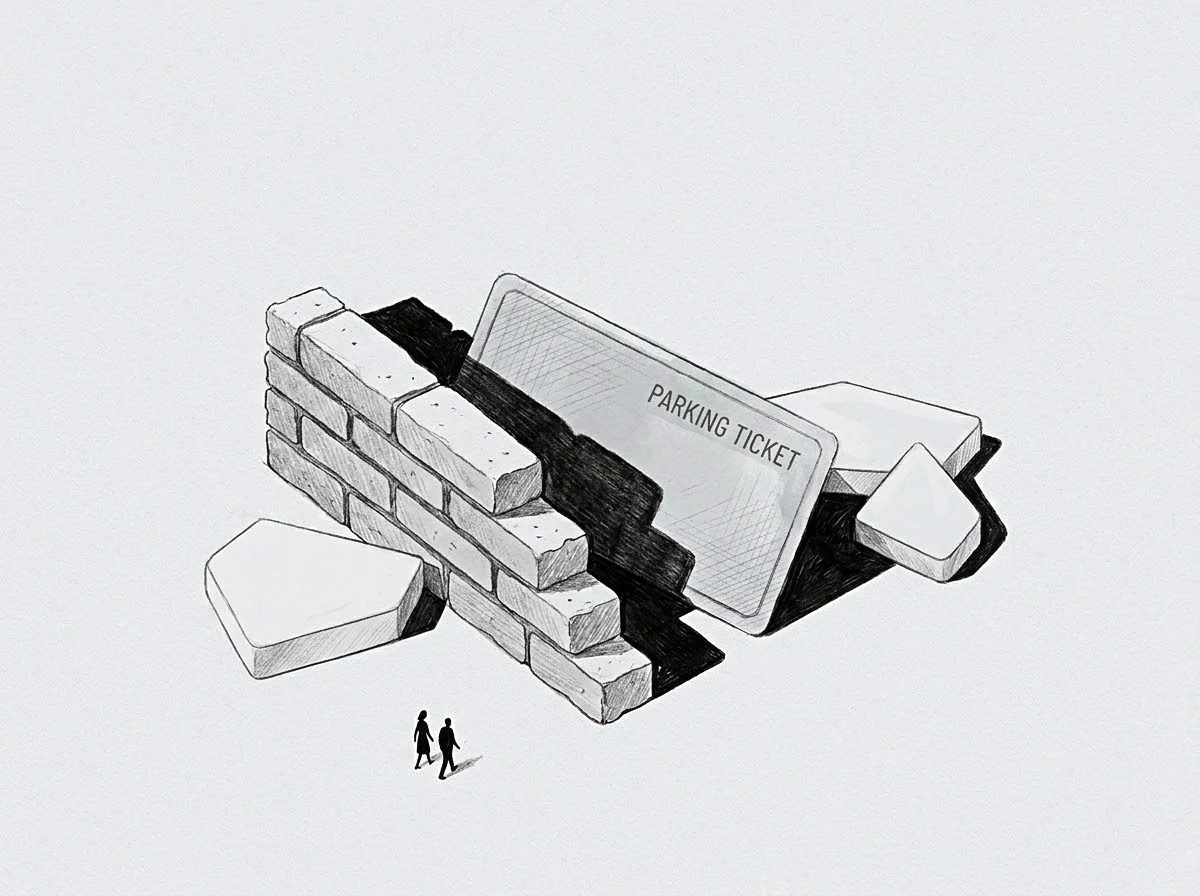
Replacing mood with state requires mapping every routine transaction to explicit financial and legal parameters. The wall stands firm. The operator no longer asks whether the founder is receptive; the operator checks whether the proposed action fits within the stated operational term.

Sequential Protocol For Establishing Stated Boundary Limits
Establishing explicit structural limits requires systematic extraction of tacit executive knowledge into formal operational parameters.
- Audit historical transaction queries to identify the exact points where operators stalled execution to ask for informal executive clearance.
- Define explicit financial thresholds, commitment durations, and operational risk boundaries for every functional seat within the organization.
- Document stated authority terms in a centralized repository accessible to all operational personnel at all times.
- Establish exception handling protocols that define precisely how, when, and to whom out-of-bounds requests escalate.
- Decouple operational execution from real-time executive availability by routing routine variances through automated rule structures.
State-gated execution decoupling operational flow from executive availability stabilizes throughput across volume surges.
The stated parameter clause changes local authority from an informal privilege granted by executive mood into an objective operational boundary.

Hinge
Long-term systemic stability relies on maintaining structural walls between functional seats. An unstated boundary is an open dynamic line that invites constant testing, forcing the founder to act as a human dam against operational overflow. The founder regulated for others through expansion periods until personal capacity reached baseline ceiling.
Stating the limit once establishes a structural wall that withstands operational pressure without continuous executive monitoring.
Stress tests in fluid dynamics demonstrate that pressure spikes bypass loose couplings and rupture weak joint seals downstream. Organizational expansion behaves identically. Surging transaction volume bypasses ambiguous verbal guidelines, concentrating structural pressure on the weakest operational joints until execution collapses.

Systemic Stability Under High Volume Load Transfer
In load-transferring systems, establishing explicit limits transfers operational responsibility cleanly to local delegates. The operator who holds a clearly defined boundary operates with high autonomy and low ambiguity. The ping signal fails when parameters are clear, because the signal is no longer required to validate action safety.
Settled research in occupational physiology confirms that sustained regulatory overload severely impairs executive cognitive flexibility and long-range decision quality. Executive capacity is a finite biological parameter. Offloading routine operational validation to explicit structural terms preserves executive capacity for strategic positioning and systemic risk management.
These physiological findings rely primarily on cross-sectional field studies of corporate managers operating under high chronic workload, backed by lab-based cognitive depletion trials. The findings hold reliably across diverse organizational contexts. The model would face revision only if empirical longitudinal data demonstrated that executive cognitive capacity expanded infinitely in direct proportion to transaction input volume, a premise contradicted by all established biological models of human fatigue.

The Persistence Of Operational Capacity Thresholds
Organizations often mistake authority formalization for bureaucratic stagnation, fearing that explicit boundaries destroy early-stage operational agility. The evidence demonstrates the inverse. Explicit boundaries define the safe operating envelope, allowing personnel to move at full speed within clear limits without fear of retroactive executive override.
Systemic capacity expands only when operational authority transforms from personal permission into explicit structural architecture.
When operational expansion pushes volume beyond human monitoring limits, does the enterprise establish explicit terms to govern execution, or does it permit unstated authority constraints to silently throttle throughput until the system halts?