
Measuring Co-Regulation Limits Across Executive Leadership During Capital Scarcity
Capital scarcity accelerates executive exhaustion by converting financial buffer deficits into unsustainable interpersonal baseline borrowing across leadership dyads.

Gate
Four executive messaging channels stay active past midnight during the ninth week of a capital search. The chief executive holds thirty-four days of operating cash in primary accounts. Downside financial models show payroll insolvency occurring in six weeks unless external investment closes or operational expenditures drop by forty percent.
Department heads send continuous queries regarding budget commitments, hiring freezes, and strategic revisions. Each message seeks confirmation that baseline operational assumptions remain stable under mounting financial pressure.
Social baseline theory shows that human nervous systems conserve metabolic energy by sharing threat monitoring with reliable peers. Physical proximity and psychological predictability allow individuals to offload regulatory effort onto a perceived anchor. During severe capital contraction, organizational risk buffers disappear.
Where financial reserves previously absorbed uncertainty, collapsing cash reserves transfer administrative pressure straight into human physiological systems. Executive leaders then try to maintain operational focus by drawing regulation from available peers.
Social baseline borrowing lowers physiological expenditure only while the anchor maintains uncompromised parasympathetic headroom.
Consider an executive team of four individuals holding eleven unresolved strategic threads without explicit rules governing communication hours. The vice president of operations demands daily realignment meetings to manage personal threat responses. The chief technology officer sends late-night messages containing micro-pivots to soothe anxiety over team retention.
The primary regulator absorbs these incoming distress signals while suppressing internal autonomic arousal. Operational bandwidth decays as metabolic resources shift from high-level decision-making to maintaining interpersonal stability.
The secondary operator expects the executive anchor to provide unbroken stability regardless of external cash pressure.

Cap
The human brain budgets metabolic expenditure assuming social baseline support is continuously accessible. Relying on self-regulation alone is the most metabolically expensive mode of neural operation. When an executive operates without reliable baseline support from peers, total allostatic load rises sharply.
Capital scarcity compounds this burden by introducing persistent external threat cues that demand constant cognitive filtering.
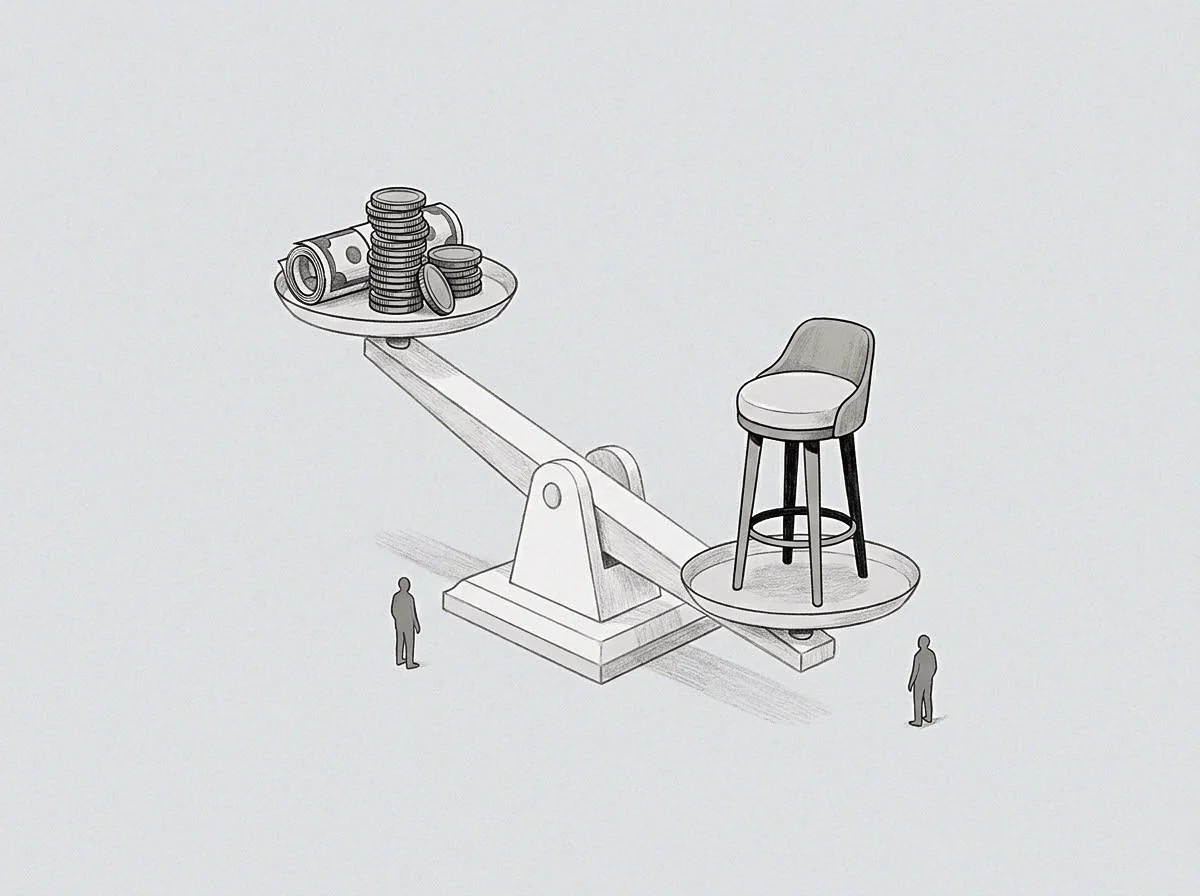
Metabolic Economy of Social Proximity
In baseline conditions, shared threat monitoring distributes neural processing costs across the leadership team. Capital contraction disrupts this economy, increasing individual threat perception while shrinking the emotional headroom of every team member. Executives seek to replenish depleted internal calm by attaching to a stable peer state, creating a regulatory transfer where one partner borrows calm from another to sustain cognitive executive function.
Borrowed calm carries a real physiological cost in energy and attention. The person providing the baseline state must actively down-regulate sympathetic nervous system activation triggered by a partner’s distress. When multiple executives simultaneously attempt to draw baseline stability from a single leader, that leader hits a strict physiological concurrency limit.
The capacity to receive support stays empty while outgoing regulatory subsidies deplete remaining metabolic reserves.

Concurrency Boundaries in Executive Dyads
Threat signals elevate heart rate variability. Executive leadership teams experience systemic breakdown when incoming distress signals exceed the primary regulator’s capacity. Under sustained financial threat, the physiological cascade of regulatory decay follows a predictable sequence.
- Capital reduction increases threat monitoring across department heads, elevating baseline sympathetic nervous system activity.
- Executive leaders interact more frequently with the primary baseline holder to lower their personal allostatic load.
- The central baseline holder absorbs incoming emotional volatility while suppressing autonomic distress markers to maintain team stability.
- Saturated baseline channels force residual emotional distress back onto department heads, triggering defensive communication and operational paralysis.
An executive holding multiple concurrent threat threads cannot maintain baseline stability indefinitely without receiving external regulatory support. Silence often signals regulatory overload. When internal metabolic limits are exceeded, executive function degrades, leading to impulsive strategic shifts or complete decision avoidance.
The unresolved condition remains whether an executive team can systematically restore baseline capacity without expanding financial runway or introducing external regulatory anchors.

Metric
Tracking co-regulation capacity across an executive committee requires observing subtle behavioral markers before cognitive performance deteriorates. Standard performance metrics measure output, whereas regulatory metrics track physiological and relational capacity. Measuring baseline decay involves monitoring communication patterns, response latencies, and thread density across executive interaction channels.

Tracking Allostatic Transfer Across Channels
During capital scarcity, communication channels experience a surge in low-priority messages driven by underlying emotional distress rather than operational necessity. This surge represents an attempt to establish baseline contact with peers. Spikes in message frequency coupled with decreased message clarity indicate that team members are seeking co-regulation rather than technical guidance.
Unanswered ping volume measures incoming baseline demand rather than operational urgency.
A shift in response latency provides an early quantitative indicator of regulatory exhaustion. When an executive reaches their baseline limit, initial over-responsiveness turns abruptly into extended latency or sudden withdrawal. This transition marks the point where internal autonomic suppression fails, forcing the individual into defensive isolation to prevent complete metabolic depletion.

Which indicators signal systemic co-regulation exhaustion?
Systemic regulatory failure manifests through specific, observable shifts across leadership communication channels.
Emotional tone variance increases as allostatic load accumulates. Leaders lose the ability to modulate vocal pitch, written tone, and facial expressiveness during high-stakes reviews. Smooth operational coordination dissolves into rigid positioning or abrupt disengagement.
Spotting these early markers allows teams to intervene before strategic decision quality breaks down under capital pressure.
Failing to measure and respect co-regulation limits leads directly to erratic strategy, fractured executive alignment, and widespread burnout across critical decision-making roles.

Grid
Different executive roles bear distinct co-regulation obligations during periods of capital scarcity. The chief executive officer frequently serves as the central baseline anchor for internal teams while facing severe threat cues from investors and board members. The chief operating officer coordinates process demands alongside interpersonal buffer demands, while the chief financial officer manages quantified threat models that generate persistent cognitive load.

Role Variance in Baseline Transfer
Financial stress amplifies interpersonal threat detection. As operational runway shortens, asymmetric baseline expectations emerge between roles. The table below outlines how regulatory loads distribute across core executive positions during acute capital constraint.
| Executive Role | Primary Baseline Function | Regulatory Load Source | Primary Decay Signal |
|---|---|---|---|
| Chief Executive Officer | Primary external and internal anchor | Investor threat filtering and strategy stabilization | Sudden channel withdrawal or hyper-reactive direction changes |
| Chief Operating Officer | Cross-functional process balancer | Interdepartmental friction and operational alignment | Micro-management spikes and obsessive protocol enforcement |
| Chief Financial Officer | Quantified risk holder | Cash solvency modeling and resource allocation pressure | Rigid transactional tone and loss of relational flexibility |

Asymmetric Demand Distribution
Unbounded availability impairs executive clarity. Stable regulators attract additional stress threads from across the enterprise, compounding their internal workload. The executive who maintains calm during board reviews draws double the requests for private alignment hours before midnight.
Concentrating this emotional demand onto a single individual accelerates local regulatory breakdown.
The executive who stays steady during board reviews draws double the requests for private alignment hours before midnight.
Structural baseline failure modes emerge when roles operate without explicit interaction limits during crisis periods.
- Baseline hoarding occurs when an executive monopolizes joint alignment meetings to process personal uncertainty rather than resolve operational dependencies.
- Template mismatch arises when an operator expects emotional validation from a financial officer offering only quantitative risk assessments.
- Unbounded regulation develops when a steady executive accepts continuous incoming distress pings without establishing clear communication windows.
An executive team cannot spend more emotional calm than its primary anchors physically generate.

Bound
Managing co-regulation limits during capital scarcity requires structural constraints that limit incoming distress pings and preserve cognitive function. Relying on willpower to suppress sympathetic arousal under chronic threat inevitably fails. Operational boundaries create the physical and temporal space needed to maintain baseline stability.

Structural Availability Limits
Stable regulators attract additional stress threads. Establishing explicit communication windows protects executive baseline capacity. Asynchronous communication protocols reduce real-time baseline borrowing, forcing department heads to process operational challenges independently before seeking peer validation.
A stated limit on availability converts implicit emotional load into visible operational prioritizing.
Setting explicit limits on messaging forces team members to clarify their operational needs. Emergency escalation pathways must be separated strictly from routine updates. When availability is bounded, incoming thread density drops, allowing primary regulators to restore internal cognitive headroom.

Updating Internal Working Templates
Long-term resilience requires updating internal regulator templates across the executive tier. Leaders who historically operated on inverted regulatory models, regulating themselves solely by regulating others, must develop earned security through structured self-soothing and bounded relational reliance. Earned security requires repeated baseline stability.
The difference over time between a fragile executive team and a resilient one lies in transitioning from unstated baseline borrowing to explicit, bounded co-regulation agreements. By implementing structured availability limits, diagnostic tracking, and role-specific baseline budgets, executive teams preserve critical function through severe capital scarcity without destroying trust or personal health.
Including explicit communication latency windows in executive agreements turns unstated emotional reliance into transparent operational coordination.