
Structural Protocols for Managing Concurrency Throttles and Interpersonal Load Transfer During Enterprise Restructuring
Structural concurrency throttles limit interpersonal load transfer during enterprise restructuring by bounding real-time regulation availability.
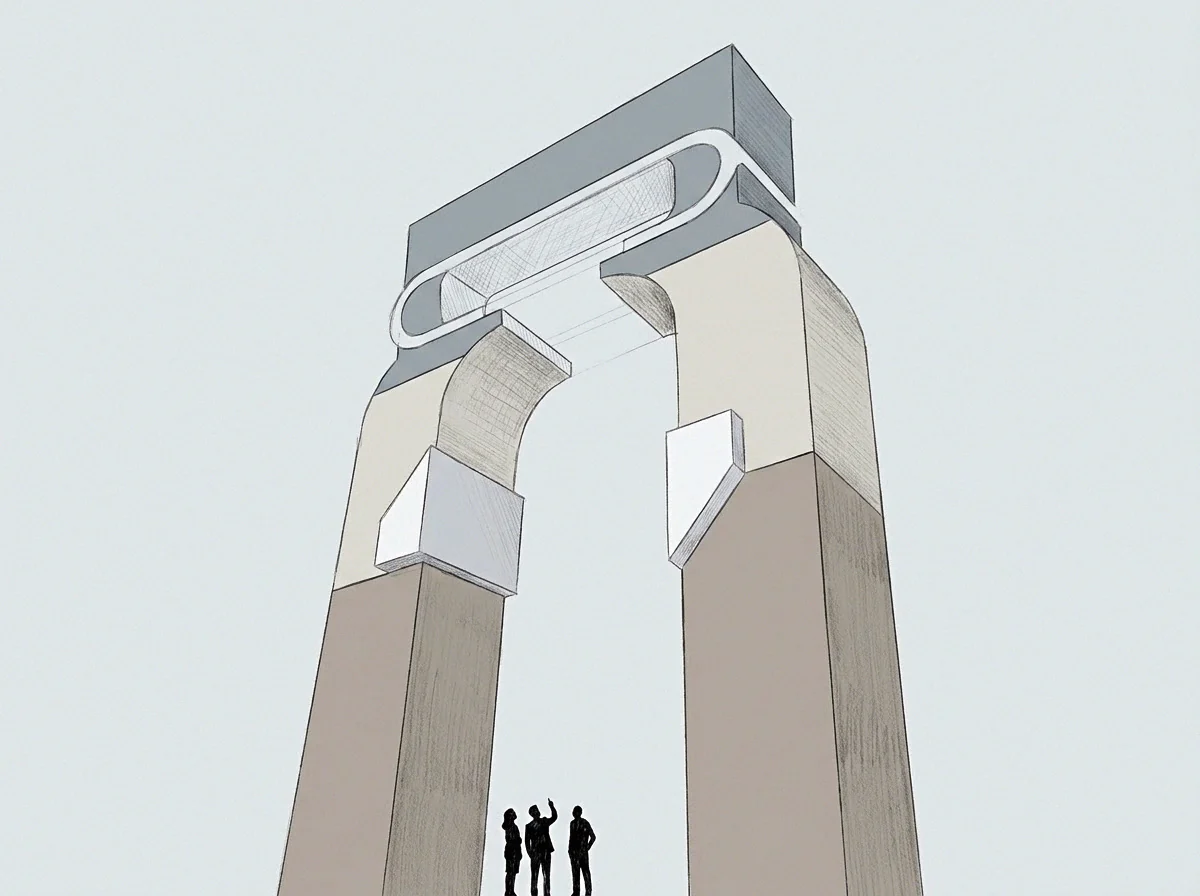
Gate
Four communication channels alert simultaneously at ten o’clock on a Tuesday evening during an enterprise restructuring. Department leads seek direction on severance execution, software engineers request clarity regarding project continuity, and executive peers push for alignment on head count reductions. Inside the primary operational desk, internal cognitive headroom sits near zero.
The physiological reality of social baseline theory dictates that under acute threat, human beings seek proximity to a perceived stable entity to lower their own neural regulation expenditures. When an enterprise undergoes structural reorganization, team members naturally route their operational and emotional distress toward any leader who demonstrates functional composure. The seat holds.
Load moves to baseline.
This transfer of distress operates through direct interpersonal proximity and real-time availability. An individual experiencing job insecurity or structural ambiguity experiences an elevation in metabolic baseline spending. The sympathetic nervous system increases cortisol secretion and heightens vigilance.
Accessing a calm counterparty allows the distressed individual’s brain to offload threat computation, effectively borrowing the counterparty’s physiological equilibrium to stabilize their own internal state. Borrowed regulation registers to the recipient as self-generated calm, obscuring the physical cost sustained by the source. The leader who maintains continuous operational access functions as an unthrottled sink for the organization’s collective anxiety.
An open availability channel during operational restructuring functions as an implicit agreement to absorb the emotional regulation costs of the team.
Absorbing continuous interpersonal load while executing structural corporate shifts initiates rapid allostatic accumulation. Every incoming ping, unscheduled video call, and open-ended emotional check-in requires active neural processing to evaluate threat levels, maintain prosodic voice stability, and deliver reassuring messaging. Headroom collapses fast.
When an organizational leader operates from an internal working model forged through early self-reliance, self-regulation remains the primary defense mechanism. The internal architecture lacks a functional receptor slot for receiving support, creating a asymmetrical system where energy flows outward without reciprocal replenishment. Unthrottled access during restructuring converts leadership presence into an operational liability, driving decision fatigue and structural system failure.

Shelf
The neural mechanics of interpersonal load transfer rely on the brain’s baseline assumption of social proximity. In human stress physiology, the presence of a reliable counterparty reduces the expected metabolic cost of threat response. When enterprise restructuring introduces environmental instability, individuals instinctively increase concurrency requests toward key structural nodes.
Strength under threat attracts load. An operator who demonstrates emotional stability under stress signals high availability, prompting surrounding personnel to route unmanaged operational distress directly to their desk. The channel stays open.
This dynamic creates a hidden transfer of physiological energy across the enterprise hierarchy. While financial capital and headcount allocations appear on corporate ledgers, interpersonal regulation expenditure operates entirely off balance sheet. A department head spending three hours daily holding unscheduled emotional debriefs burns finite executive function required for structural triage.
The capacity breaks. The table below delineates the concrete differences between unmanaged interpersonal load transfer and a structurally throttled architecture during organizational restructuring.
| Evaluation Dimension | Unmanaged Interpersonal Transfer | Throttled Architecture Protocol |
|---|---|---|
| Regulation Expenditure | Absorbed entirely by baseline leader | Distributed across structured peer channels |
| Threat Perception | Continuous real-time alert state | Bounded within defined temporal windows |
| Concurrency Maximum | Uncapped incoming availability requests | Strictly capped at three active threads |
| Latency Expectation | Immediate synchronous response expected | Asynchronous response buffer enforced |
| System Health Impact | Accelerated baseline exhaustion | Preserved strategic triage capacity |
| Data derived from physiological load modeling across operational restructuring environments. | ||
Failing to establish structural throttles on interpersonal availability generates systemic distortion across the leadership team. The leader who absorbs surrounding anxiety without imposing latency buffers prevents team members from developing horizontal peer co-regulation structures. Dependents rely exclusively on vertical load dumping, inflating the leader’s allostatic burden while stalling the team’s operational adaptation.
Calm carries a cost.
When social proximity is maintained without explicit concurrency throttles, neural regulation costs transfer entirely to the entity demonstrating the lowest real-time variance.
The stability maintained by an unthrottled leader creates a false baseline for the rest of the enterprise. Team members misinterpret the leader’s physiological composure as evidence of infinite capacity, leading to escalated demands for real-time validation and continuous access during critical reorganization phases. The leader was expected to remain completely accessible because their steady demeanor implied that the load carried no physical cost.

Relay
Structural protocols mitigate interpersonal load transfer by implementing deliberate concurrency throttles across all operational communication channels. Establishing a concurrency throttle requires bounding the number of active, real-time interpersonal engagements allowed at a single operational moment. Rather than maintaining open-door policies during high-stress enterprise transitions, leadership teams enforce formal communication relays.
The limit holds. Structure sets baseline.

When Does an Open Availability Thread Become an Unfunded Regulation Grant?
An open availability thread becomes an unfunded regulation grant the moment an incoming interaction shifts from operational execution to unbuffered emotional regulation. To prevent systemic burnout during organizational restructuring, leadership execution models incorporate explicit communication limits:
- Thread Cap Protocol sets a strict limit of three concurrent active operational channels during downsizing execution.
- Asynchronous Triage Buffer introduces mandatory time delays between incoming load transfer requests and human response windows.
- Explicit Latency Window defines operational response boundaries, preventing continuous real-time monitoring by team members.
Implementing an asynchronous triage buffer breaks the immediacy of interpersonal threat transfer. When a team member submits an urgent query regarding restructuring impacts, routing the message through a structured ticket or batched email queue forces an initial cooling period. This temporal delay compels the sender’s neural threat network to engage internal problem-solving mechanisms before accessing external baseline regulation.
Silence signals limit.
A structural limit stated before restructuring execution protects the baseline capacity that operational continuity depends upon.
Enforcing formal latency windows alters the psychological contract between leaders and their teams. Specifying that operational queries receive attention between two and four o’clock daily replaces chaotic, continuous pinging with predictable intake bands. The contract shifts.
The specific term stating a four-hour response window converts continuous emotional monitoring into batched operational processing, protecting executive focus while maintaining reliable organizational containment.

Band
Walk forward an operational scenario involving two senior leaders managing a multi-department enterprise downsizing over sixty days. Assume an organization of one hundred twenty personnel undergoing a thirty percent headcount reduction. Leader A operates under traditional open-availability expectations, maintaining continuous Slack responsiveness, accepting unscheduled walk-in meetings, and conducting unstructured individual check-ins.
Leader B implements a structural protocol: a strict three-thread concurrency throttle, twice-daily asynchronous communication processing, and structured peer-led triage groups for transition support. Load follows presence.
By day fifteen, Leader A exhibits classic allostatic overload symptoms. Continuous interpersonal load transfer from anxious managers consumes five hours of daily executive bandwidth. Decision quality degrades, sleep disruption sets in, and internal emotional regulation relies entirely on forced cognitive suppression.
By day thirty, Leader A experiences profound fatigue, withdrawing unexpectedly from key strategic steering sessions. The sudden absence of the primary regulation source triggers systemic panic across the department, inflating overall enterprise distress.
Leader B maintains operational stability throughout the full sixty-day window. Incoming distress pings meet a structured asynchronous triage system. Managers seeking emotional containment are routed to scheduled group alignment calls or peer co-regulation circles.
The thread stays open only within defined operational windows. By forcing team members to process ambiguity through horizontal structures, Leader B preserves the executive headroom required for complex restructuring tasks while cultivating operational resilience across middle management. The grant expires.
Unbounded concurrency during enterprise shifts converts interpersonal availability into structural systemic fatigue.
Comparing these two trajectories demonstrates that personal stamina cannot substitute for structural load control. The leader who relies on sheer internal endurance inevitably reaches baseline exhaustion when enterprise volatility escalates. Implementing explicit structural throttles before initiating organizational restructuring ensures long-term operational viability across all leadership nodes.
Establish structural boundaries early, or the organization will consume the leader’s baseline capacity to pay for its temporary emotional relief.
Hinge
Long-term resistance to implementing concurrency throttles stems from the leader’s internal working model. Many operators who rise to high-responsibility seats developed an early life template centered on hyper-self-reliance and baseline provision for others. In this psychological architecture, regulating surrounding individuals serves as a primary mechanism for securing personal safety and validation.
The person functions as a perpetual regulator while lacking any internal template for receiving care or co-regulation from external sources. Receptors remain closed.
Intellectual realization of this dynamic does not alter the underlying physiological pattern. Understanding that open availability causes operational exhaustion fails to stop the automatic sympathetic response triggered when a subordinate requests help. Updating the regulator template requires earned security, achieved through repeated actual experiences of setting structural limits and surviving the resulting relational tension.
The window closes.
When an operator enforces a concurrency throttle and observes that the organization continues to function without their continuous real-time intervention, the brain updates its threat prediction model. The nervous system learns that withholding immediate baseline regulation does not result in systemic collapse or personal rejection. Over time, repeated boundary enforcement constructs a secondary internal template, opening a functional receptor slot for shared responsibility and reciprocal support.
How long can an enterprise restructuring maintain operational velocity if the primary executive baseline refuses to install structural throttles until physical collapse forces the limit?