
Calculating Key Person Discount Factors In Centralized Corporate Governance
Centralized corporate governance depresses enterprise value through a key person discount factor derived from authority concentration and transferability rates.

Seat
Corporate authority attaches to formal positions, but operational capability often rests with a single person. When an enterprise concentrates technical knowledge, primary client relationships, and sovereign decision rights in one executive, the corporate structure functions as a thin shell over personal labor. Financial buyers and institutional lenders identify this during due diligence, applying a key person discount factor to baseline enterprise value against the risk that the individual departs.
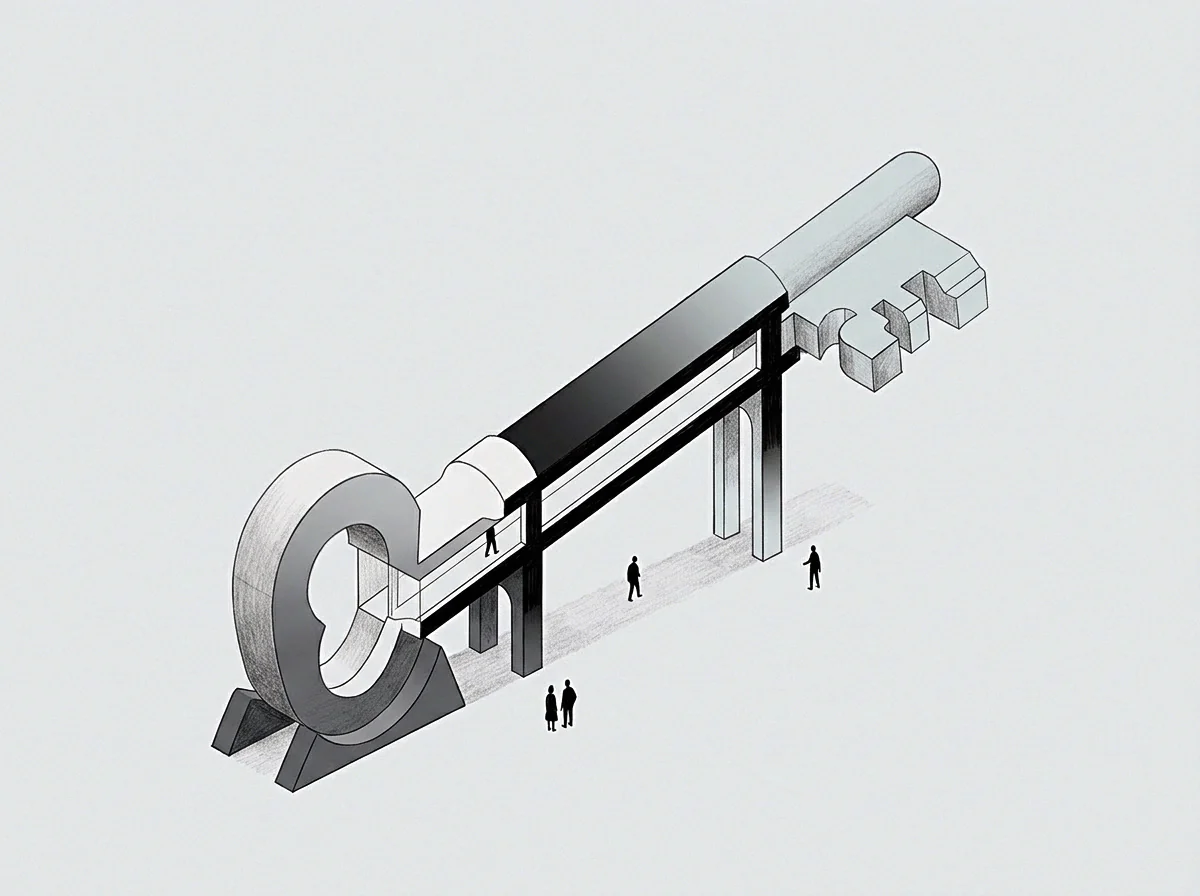
Concentrated Executive Control
Under centralized governance, non-routine decisions route through a single office. Approvals for capital expenditures, key hires, product roadmaps, and contract terms bottleneck at one desk. That concentration speeds up early execution, but it leaves the business fragile as it grows.
Because institutional investors look for operational continuity, a company with no autonomy below the executive tier sees its reported earnings valued as temporary returns on personal labor.
When operational knowledge lives in a single individual, corporate governance functions as a recording instrument rather than a steering mechanism.

Structural Vulnerability In Board Oversight
In a highly centralized company, the board often ends up ratifying operational decisions rather than directing them. Information asymmetry between the primary operator and outside directors limits oversight; the board cannot easily reassign strategic work when no second layer of management holds the background knowledge to run it. Institutional investors assessing this setup cut baseline discounted cash flow projections accordingly.
Failing to separate company operations from an executive’s personal involvement exposes the business to steep pricing penalties during capital events, cutting market capitalization through an unmitigated key person discount factor.

Metric
Valuation analysts assess qualitative governance concentration through concrete operational metrics: revenue attribution, technical process ownership, debt relationship dependency, and operational transferability.

Quantifying Key Person Reliance
The discount on enterprise value reflects what it costs to replace institutional knowledge. Valuation models measure dependency partly through the share of active accounts tied personally to the founder. If account retention relies on personal relationships instead of commercial contracts, modeled churn rises sharply once that founder leaves.
| Governance Profile | Operational Dependency | Transferability Index | Discount Range |
|---|---|---|---|
| High Centralization | Strategic decisions and core revenue bound to single executive | Below 0.30 | 20% to 35% |
| Moderate Decentralization | Delegated regional authority with centralized product vision | 0.30 to 0.70 | 10% to 19% |
| Fully Distributed Board Control | Institutional processes, documented workflows, cross-trained leadership | Above 0.70 | 0% to 9% |

Transferability Scoring Model
The transferability index tracks how easily an incoming executive can run the existing strategy without eroding gross margins. Analysts score process documentation, middle management tenure, and secondary vendor relationships on a scale from zero to one. Lower scores point to heavy operational friction, where stabilizing the company after a transition requires meaningful capital expenditures.
Loan covenants that include an explicit key person clause raise borrowing spreads by two hundred basis points whenever the transferability index drops below zero point forty.

Formula
Deriving the key person discount factor brings the transferability index into standard cost of capital and cash flow capitalization formulas. Models either raise the equity discount rate or take a direct percentage cut against final enterprise value.

How Does Concentrated Authority Reduce Enterprise Value?
Valuation discounts enter corporate finance models along two main paths. Allocators can lift the weighted average cost of capital by adding a key person risk premium to the cost of equity, or analysts can trim percentage points straight from baseline EBITDA multiples when figuring terminal value.
A valuation multiple decays in direct proportion to the operational steps that require manual authorization from an unreplaced founder.

Mathematical Multiple Reductions
Applying the discount factor adjusts baseline calculations across several operational inputs:
- Revenue concentration factor scales the discount based on the percentage of gross margin directly bound to individual client relationships.
- Proprietary workflow lock measures the expense required to rebuild technical architectures that lack documentation outside one lead engineer.
- Capital provider covenant reflects interest rate surcharges triggered automatically by executive departure clauses.
A baseline valuation model computes adjusted enterprise value using the core formula:
Adjusted Enterprise Value = Unadjusted Enterprise Value (1 – Key Person Discount Factor)
Where the Key Person Discount Factor (KPDF) is expressed as:
KPDF = (Baseline Risk Weight Revenue Concentration) + (0.5 (1 – Transferability Index))
Assuming an unadjusted value of fifty million dollars, a baseline risk weight of zero point twenty-five, a revenue concentration of zero point sixty, and a transferability index of zero point thirty, the resulting factor equals zero point five zero, reducing the adjusted enterprise value accordingly.
Institutional investors must weigh founder reliance differently when core operational trade secrets remain unpatented and undocumented.

Clause
Governance mechanisms adjust the discount by building structural protections directly into charters, employment agreements, and shareholder contracts. Boards use these covenants to enforce operational handoffs well before liquidity events take place.

Contractual Key Person Protections
Equity investors use contractual terms to counter executive centralization. Key person clauses require founders to set up operating committees, document core workflows, and link equity vesting to verifiable transition milestones.
Staggered equity vesting tied to knowledge transfer milestones reduces the key person discount rate by twelve percentage points at transaction close.

Succession Protocol Staging
A binding succession framework reduces key person discounts across both debt and equity markets.
- Execution of key person life and disability insurance policies assigned directly to enterprise debt obligations.
- Formal mapping of decision rights through a delegated operational matrix approved by independent directors.
- Implementation of a two-year transition covenant with equity retention penalties for unscheduled executive exit.
Subordinated debt providers insist on immediate board expansion upon any unexcused sixty-day executive absence.

Yield
Valuation yield reflects how markets price executive concentration. Separating day-to-day execution from an individual leader builds durable equity value, narrowing the key person discount toward zero as decision-making disperses.

Capital Pricing Impact
Companies with distributed management command higher multiples across public and private markets. Strategic acquirers pay full value for businesses that run uninterrupted post-acquisition, largely removing the governance haircut when operational authority is genuinely shared.
Equity buyers price centralized authority as an immediate liability, while distributed execution commands the valuation multiplier of an institution.

Post Mitigation Valuation Trajectory
Sustained valuation growth depends on steadily unwinding governance bottlenecks. Over regular reporting cycles, investment committees track how executive dependency declines; as secondary managers assume independent authority, pricing moves away from single-operator exposure toward institutional reliability.
Institutional capital rewards systems that survive the removal of their architect.