
Calibrating Organizational Escalation Boundaries Against Prefrontal Slot Exhaustion Under Compounding Load
Prefrontal slot exhaustion occurs when unstructured operational escalations transfer complexity upward, consuming executive working memory capacity under compounding load.

Capacity
Four operational threads sit unresolved on a screen at midnight while the biological system responsible for synthesizing them operates at absolute ceiling. Human prefrontal architecture maintains a strictly constrained active working memory space, historically quantified between four and seven discrete information slots under baseline conditions. When continuous systemic pressure elevates circulating cortisol and epinephrine, this active working memory space contracts to two or three operational slots.
Operational escalations arriving without pre-filtered parameters force the executive layer to process raw ambiguity directly within these remaining slots.
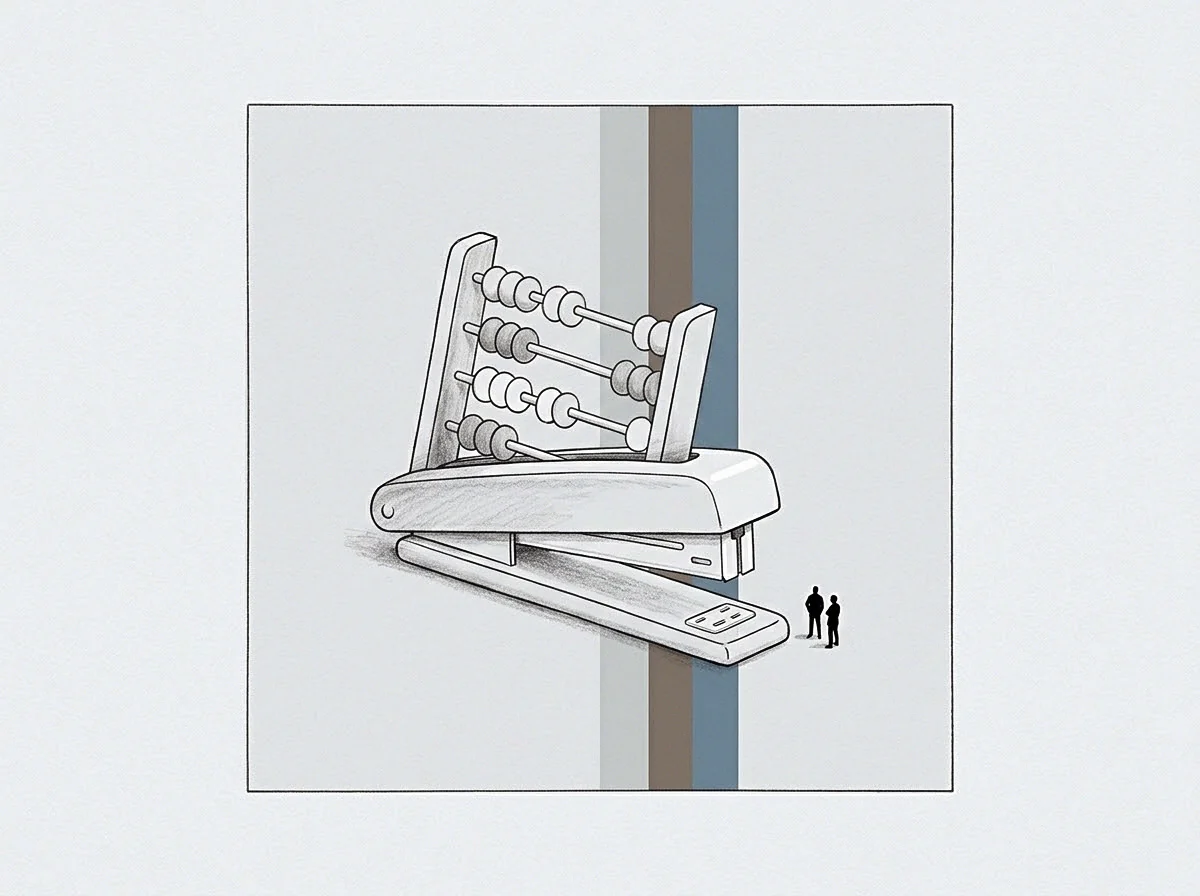
Working Memory Constraints Under Continuous Allostatic Load
The prefrontal cortex functions as a linear processor holding active variables in immediate awareness to evaluate trade-offs, forecast outcomes, and render decisions. Under sustained organizational expansion, incoming operational interruptions consume these working memory allocations faster than cognitive processing can clear them. The slot empties slowly.
When incoming task volume exceeds the clearance rate, cognitive headroom drops to zero, inducing a state of acute prefrontal slot exhaustion.
Physiological stress mechanisms deliberately down-regulate prefrontal processing to favor rapid, automated subcortical response pathways. This neural recalibration impairs complex pattern recognition, reduces risk evaluation depth, and severely degrades emotional self-regulation. An executive operating with exhausted working memory slots routinely mistakes cognitive overload for strategic failure or depressive apathy, altering operational direction when the underlying issue is purely structural slot saturation.
Executive prefrontal slots clear only when ambiguity is removed prior to escalation.

The Anatomy of Prefrontal Slot Depletion
Every unstandardized escalation forces the receiving seat to perform three distinct prefrontal operations: identifying the core problem within noisy operational data, determining the implicit options available, and selecting an action path. Each operation occupies a working memory slot for the duration of the review. When four operational teams simultaneously escalate unformatted problems, the total required slot allocation instantly exceeds available prefrontal bandwidth.
Compounding operational load creates a systemic back-pressure where open loops remain active across multiple calendar days. The biological cost of holding unresolved loops in working memory generates continuous allostatic load, impairing physiological recovery cycles during sleep and further lowering prefrontal slot availability for subsequent operational shifts. Capacity determines the output.
Unmanaged slot depletion ultimately causes systemic operational paralysis across all subordinate teams, as executive decision bottlenecks delay dependent technical, financial, and organizational workflows.

Routing
Organizations operating without stated boundary conditions develop an organic tendency to transfer operational complexity upward. Lower operational seats minimize their own cognitive expenditure by passing ambiguous events directly to the primary regulator seat. Load seeks the path of least resistance.

Default Load Transfer to the Central Regulator
Upward load transfer operates through a basic economic mechanism within organizational structures. Resolving an ambiguous operational issue at Tier 1 demands significant cognitive energy, time, and potential personal risk from an operator. Escalating the same issue to an executive seat transfers the cognitive burden entirely, allowing Tier 1 operators to maintain open capacity at the expense of executive slot exhaustion.
Without hard structural filters, the central regulator becomes the default garbage collector for systemic ambiguity. This arrangement appears functional to peripheral team members because the executive seat consistently resolves incoming items, reinforcing the behavioral pattern across the organization.
- Unfiltered direct messaging creates immediate working memory context switches that reset prefrontal operational focus, costing up to twenty minutes of cognitive recovery time per interruption.
- Open-ended options queries require the executive seat to construct solution sets from scratch rather than evaluating structured recommendations prepared by operating leads.
- Real-time status updates deliver low-value informational noise that consumes active attention slots without offering actionable decision points for the receiving seat.
- Premature threshold breaches route minor operational anomalies upward before local tier resolution mechanisms have been fully executed by responsible leads.

Implicit Routing and the Ping Cascade
The primary signal mechanism for upward load transfer is the asynchronous message ping. Each incoming notification triggers an involuntary orienting reflex that temporarily captures an active working memory slot. The ping demands an immediate stance.
Ambiguity inflates cognitive cost.
When communication channels lack explicit escalation protocols, operational pings arrive continuously across fragmented applications. The resulting scatter forces the executive to maintain continuous vigil, preventing deep focus and draining prefrontal reserves through rapid context switching.
When an operational team encounters an ambiguous decision, they routinely state that escalating the issue directly to the executive seat represents the fastest path to clarity for the project.

Post
A physical boundary object stops incoming load regardless of the biological state of the person holding the seat. Stating explicit escalation rules creates a structural barrier that forces operational teams to format, filter, and resolve issues locally before reaching executive capacity. The limit stands as a wall.

Does operational volume force prefrontal slot depletion?
Operational volume alone does not deplete working memory capacity when escalation boundaries are defined strictly by system state parameters. Prefrontal exhaustion occurs specifically when operational volume carries high ambiguity that requires real-time executive interpretation. Structuring incoming data into standardized schemas converts qualitative problem-solving into simple quantitative pattern matching.
When operational parameters are explicit, subordinate teams process routine variances locally using pre-approved decision trees. Escalation occurs only when an event breaches defined financial, legal, or operational thresholds, keeping daily volume strictly decoupled from executive slot usage.
Hard boundary conditions preserve cognitive headroom regardless of raw operational volume.

State Gated Boundaries Against Decision Fatigue
State-gated boundaries establish strict conditional requirements that an issue must satisfy before crossing into the executive domain. Decision-gated acts, by contrast, rely on human discretion to determine whether an escalation is necessary, failing predictably when subordinate operators experience stress or uncertainty.
A functional state-gated boundary requires subordinate leads to submit three specific elements with every escalation: a precise problem definition, two viable resolution options with cost estimates, and a recommended action. Escalations missing any of these three elements are rejected immediately without executive review, transferring the formatting burden back to the originating seat.
The boundary shifts the weight.

Protocol
Standardizing escalation pathways requires a clear operational taxonomy that defines capacity allocations, latency expectations, and resolution rights across every tier of the organization. Establishing these parameters eliminates continuous real-time negotiation over priority and access.

Tier Architecture and Latency Allocation
Designing an escalation architecture requires explicit trade-offs between decision speed, operational accuracy, and cognitive capacity preservation. Tier 1 seats process high-frequency, low-ambiguity tasks with immediate real-time response targets. Tier 2 seats handle cross-functional trade-offs and moderate ambiguity within structured hourly windows.
The central executive seat reserves prefrontal capacity exclusively for strategic anomalies that break established operating bounds.
Terms filter incoming signals. The regulator seat remains full.
| Operational Tier | Ambiguity Level | Required Escalation Payload | Allowed Escalation Channel | Target Response Latency |
|---|---|---|---|---|
| Tier 1 (Frontline Leads) | Deterministic / Zero | Standard Operating Metric Variance | Automated Dashboard / System Log | Real-time (Immediate) |
| Tier 2 (Operational Managers) | Bounded Operational Variance | Root Cause Analysis with Proposed Options | Asynchronous Task Queue | 4 to 8 Hours |
| Tier 3 (Executive Regulator) | Unbounded Strategic Anomaly | Structured Memorandum with Single Stance | Scheduled Daily Escalation Window | 24 to 48 Hours |

Comparative Transfer Functions Across Escalation Tiers
Implementing structured escalation protocols alters how information moves through an organization during high-stress periods. The sequence below outlines the progression required to transform an unstructured operational emergency into a capacity-preserving resolution sequence.
- The originating lead identifies an operational variance that exceeds standard Tier 1 financial or technical decision authority limits.
- The lead executes all local remediation playbooks and logs the specific points of failure within the internal tracking system.
- The lead prepares an escalation payload containing the quantitative impact, two mitigation options, and a primary recommendation.
- The payload enters the Tier 2 asynchronous processing queue, triggering a scheduled notification during designated manager review hours.
- If the issue exceeds Tier 2 boundaries, the manager summarizes the trade-offs and places the structured memorandum into the executive review daily window.
- The central regulator selects an option during the dedicated slot, returning a single deterministic decision to the execution queue.
Execution follows clear rules. State dictates performance.
Systemic capacity expands when response latency is intentionally stretched to force local problem resolution.
Implementing an explicit 24-hour response latency condition on non-critical executive escalations forces subordinate teams to resolve minor operational bottlenecks independently, permanently reducing total incoming volume by up to forty percent.

Shift
Reclaiming executive prefrontal capacity under continuous operational load requires moving from responsive regulation to structural design. The central regulator seat cannot protect its working memory through effort alone. The biological constraints of human neural hardware remain fixed regardless of strategic necessity or operational urgency.

Reallocating Structural Load to Preservative Systems
Transitioning an organization away from real-time executive reliance requires enforcing absolute communication silence in primary work channels during reserved deep-focus blocks. Asynchronous task queues replace immediate direct messaging as the default operational interface. When operational teams understand that real-time pings will not yield faster decisions, they naturally adapt by improving the quality and thoroughness of written escalation payloads.
Availability is not an open door or a continuous signal. Availability is a calculated output derived from the stated cost of executive interruption, the explicit position held by the seat, and the strict adherence to defined state boundaries across all subordinate tiers.

Sustained Execution Through Hard Boundaries
When hard escalation boundaries are enforced consistently over extended operational cycles, the organization undergoes a fundamental cultural shift. Subordinate leads build internal problem-solving capacity, operational documentation becomes accurate out of necessity, and executive working memory slots remain unencumbered by daily noise.
The founder or executive operates with preserved prefrontal headroom, maintaining the cognitive capital necessary to navigate high-stakes strategic anomalies, evaluate complex external risks, and ensure long-term structural viability. The operational boundaries stand firmly, protecting cognitive capacity from the endless push of compounding systemic load.