
Operational Load Transfer Mechanisms and Capacity Boundaries Across Fast Growing Corporate Structures
Fast-growing corporate structures transfer operational load to responsive executives until explicit structural boundaries redirect coordination overhead.

Valve
Incoming demands flow directly toward whoever has proven most responsive. When corporate growth outpaces formal governance, operational pressure travels paths of least resistance rather than clear reporting lines. An experienced executive takes on urgent questions, unassigned escalations, and cross-functional friction because absorbing them immediately lowers local volatility.
This pattern acts as an informal shock absorber across the organization. The broader consequence goes unrecorded on balance sheets: the executive becomes an unmetered channel for unresolved organizational ambiguity.
Control theory defines a relief valve as a mechanical device that opens at a predetermined setpoint to bleed pressure from a closed circuit. In fast-growing corporate structures, human attentional reserves serve this exact function without the protection of a physical threshold. Taking on unresolved coordination tasks creates a false operational smoothness across adjacent teams.
Because this dampening happens silently, peripheral operators notice that escalations yield immediate resolutions without financial or procedural penalties. This dynamic establishes an escalating intake feedback loop.
A load-transferring system increases its volume of routing toward any node that absorbs inputs without imposing an explicit transaction friction.
Each absorbed escalation reinforces the informal route. An operator seeking an exception learns that direct petitioning bypasses clearance delays, shortening operational cycle times for that specific actor while increasing the total cognitive queue held by the central executive. The transaction appears costless to the sender, who records a rapid decision while the organization logs an executed task and the executive records an unmeasured reduction in remaining attentional headroom.
Without a structural impediment, load transfers continue until the human node experiences complete throughput saturation.
When operational volume exceeds biological recovery rates, the dampening node switches from active synthesis to blunt filtering. Unanswered communications accumulate in messaging channels. Critical approvals stall behind low-value operational inputs that arrived earlier in the queue.
Structural actors misinterpret this latency as personal disorganization, attempting to correct the delay through secondary pings across alternative messaging tools. These secondary pings consume additional bandwidth, accelerating the collapse of the node they intend to prompt.
The unstated capacity boundary guarantees that the system tests the person rather than the structural design.
Buffer
Attentional capacity operates under finite physiological constraints governed by metabolic replenishment. During early-stage expansion, founders and senior executives treat working hours as elastic shock absorbers capable of expanding indefinitely to accommodate organizational growth. This assumption violates allostatic load realities.
The human nervous system maintains operational stability through physical regulation, balancing resource expenditures against baseline recovery. When structural demands remain elevated across multi-quarter intervals, baseline physiology resets at an unstable, highly reactive setpoint known as an allostatic state.
Cognitive Bandwidth Depletion Under Unbounded Scaling
Working memory handles between three and five distinct high-context problems concurrently before operational error rates spike. As an enterprise doubles headcounts, the number of potential interpersonal communication channels scales quadratically. The executive attempting to mediate these connections experiences severe contextual fragmentation.
Switching between strategic resource allocations, personnel grievances, and tactical supplier exceptions incurs continuous cognitive reorientation penalties. Laboratory studies of uninterrupted focus confirm that returning to deep analytical processing after an incidental interruption takes substantial time. Constant routing interruptions reduce analytical output to disjointed reactions, leaving systemic problems unaddressed.
| Horizon Phase | Primary Load Transfer Conduit | Capacity Failure Indicator | Stabilization Mechanism |
|---|---|---|---|
| Early Formation | Direct verbal petitioning of central executive | Executive calendar saturation past ten hours daily | Establishment of bounded operational authority limits |
| Mid Acceleration | Proliferation of asynchronous cross-team pings | Message response latency exceeding seventy-two hours | Explicit communication routing protocols and queues |
| Scaled Expansion | Structural escalation of cross-department ambiguities | Deferred capital decisions and strategic avoidance | Formal separation of policy design from tactical execution |
The operational buffer vanishes when daily inputs equal maximum human processing output. A resilient system maintains deliberate reserve capacity to absorb unexpected shocks. Fast-growing structures routinely run executive capacity at peak saturation during normal operating conditions.
Under these parameters, any non-routine friction, such as a regulatory audit or executive departure, precipitates operational gridlock.
Operational headroom declines toward zero whenever everyday administrative throughput requires uninterrupted peak exertion from executive personnel.
Executives experiencing sustained overload lose emotional and cognitive flexibility. State dictates the transfer function between an incoming event and the resulting organizational act. When nervous system states reflect chronic threat signaling due to sustained sleep debt and continuous inputs, executive actions become defensive.
Decision-making shifts from broad risk evaluation to immediate threat neutralization, resulting in abrupt vetoes, administrative micro-management, and premature operational curtailments.
Leaving capacity margins unbuffered produces systemic brittleness that shatters the moment an unpredictable macro disruption intersects everyday operations.

Threshold
A stated limit operates as a rigid wall within the operating topology of a growing business. Systems do not respect implied intentions, personal exhaustion, or private appeals for restraint. A load-transferring architecture pushes against human regulators until it contacts an immutable impediment that refuses to yield.
When a leader pleads fatigue, the organization interprets the communication as an elastic resistance that additional urgency can overcome. When a leader states an explicit transactional boundary backed by structural immobility, the system redirects its operational cargo elsewhere.

Can Unstated Capacity Absorptions Be Reversed Safely?
Recovering absorbed capacity requires converting tacit personal accommodations into codified contractual terms. This intervention destabilizes teams accustomed to frictionless operational subsidies. The process requires navigating structural friction.
- Stated operational boundaries establish explicit functional domains beyond which the executive accepts zero unmediated escalations, terminating open-door policies that degrade attentional coherence.
- Transaction cost introduction imposes formal diagnostic briefs and clear justification gates on requests seeking executive intervention, discouraging frivolous petitions.
- Asynchronous batch cadence replaces continuous, real-time message monitoring with disciplined assessment intervals, resetting organizational expectations regarding response times.
- Delegated decision charters grant downstream managers definitive clearance parameters with zero escalation requirements, shifting systemic load permanently downward.
The installation of these boundaries provokes structural resistance across the enterprise. Mid-level personnel accustomed to executive intervention experience the sudden immobility as an operational obstacle. Friction rises during the introductory phase.
Petitions that formerly slipped through informal backchannels bounce against unambiguous clearance requirements. The system tests the threshold to determine whether the boundary is an immutable structural wall or an emotional posture that yields under repeated appeals.
A stated boundary holds only when the cost of bypassing the rule exceeds the effort of executing the delegated decision locally.
Maintaining a boundary requires tolerating localized operational failures. If an executive steps into an active workflow to prevent a downstream operational misstep, the threshold dissolves instantly. The team observes that escalating a crisis pierces the boundary, reinforcing the habit of upward load transference.
Structural separation demands allowing subordinate units to experience the direct operational costs of their own execution mistakes.
The formal agreement states that any operational escalation lacking a proposed solution and verified budget trade-off returns immediately unreviewed.
Partition
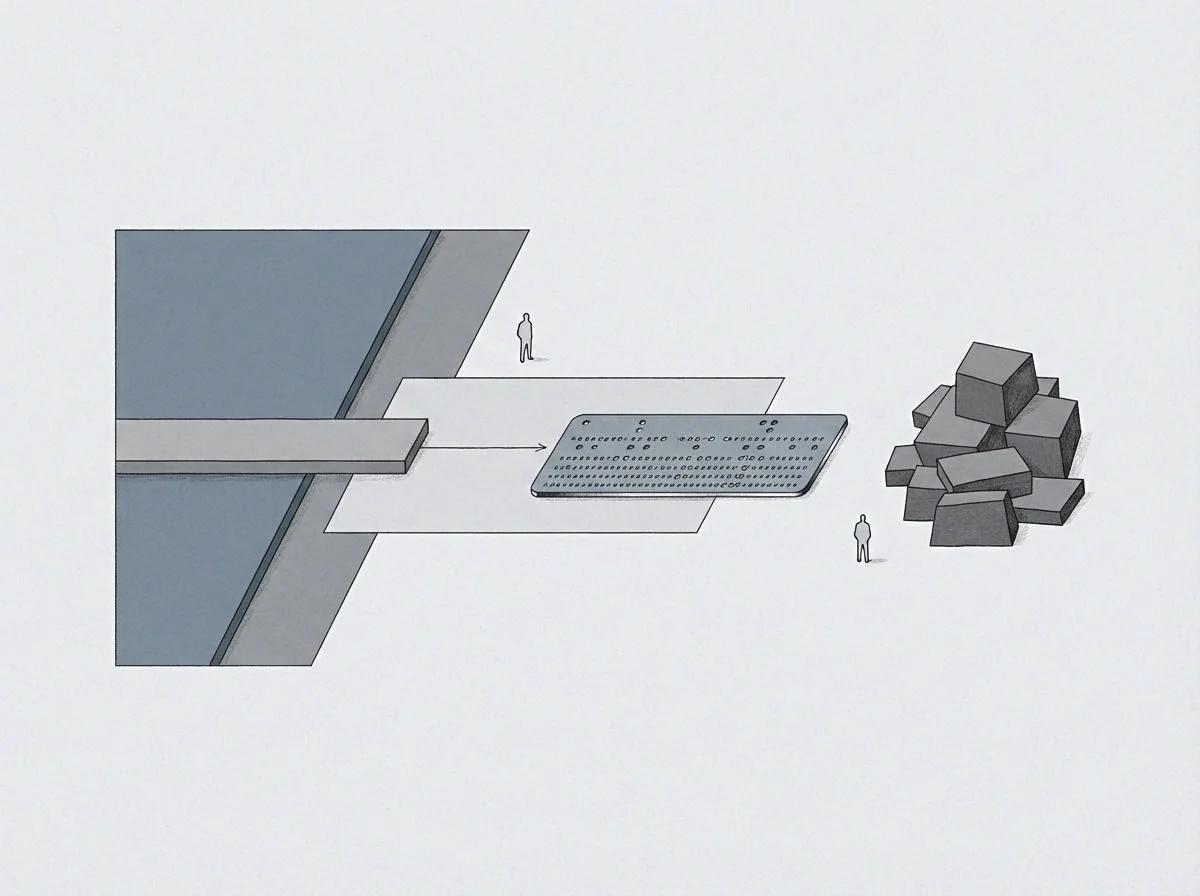
High-growth organizations survive operational strain by compartmentalizing governance layers. Without clean structural bulkheads, localized execution crises flood directly into strategic design seats. Fast-growing entities routinely compromise future positioning by pulling executive attention into present crises.
A functional partition isolates distinct operational domains, containing containment failures within designated organizational perimeters.
Architectural Isolation of Execution From Governance
Separating daily tactical execution from long-term capital allocation requires formal institutional mechanics. In the absence of deliberate architectural barriers, high-frequency operational signals systematically displace low-frequency strategic evaluation. The urgency of immediate operational fires commands human attention more readily than distant strategic investments.
Dividing these domains demands distinct operational rhythms, distinct personnel, and distinct reporting artifacts. Tactical operations require brief daily feedback loops, high-velocity coordination meetings, and tight exception monitoring. Strategic governance requires multi-week deliberation intervals, uninterrupted reading periods, and insulation from routine customer complaints.
When an enterprise forces both functions into a single executive seat, tactical firefighting wins every single time.
Separating immediate operational triage from long-range institutional governance prevents daily administrative crises from consuming capital allocation bandwidth.
Creating functional partitions forces downstream managers to build local problem-solving capacity. When an operational unit cannot transfer its coordination overhead to executive sponsors, it must design lateral interfaces with adjacent departments. These lateral links establish a durable operational mesh.
The enterprise matures from a star-topology centered entirely around an overburdened individual into an autonomous operational structure.
If escalations are blocked at this level, an operational unit cannot hit its quarterly targets without executive sign-off.

Surge
Growth spikes disrupt standard operational equilibria with sudden volumes of unexpected demand. An unpredicted capital raise, rapid enterprise adoption, or sudden competitive retreat can increase transaction volumes by an order of magnitude within a single fiscal quarter. During these surges, the operational pressure threatens to overrun established procedural bounds.
When organizational procedures fail to handle volume spikes, unstructured pressure flows back toward central executive nodes.
Managing an operational surge requires predefined shock-absorbing protocols rather than ad-hoc heroics. The natural impulse of an ambitious leadership team involves expanding personal exertion to bridge the operational deficit. This choice exhausts personnel reserves before the operational volume normalizes.
A disciplined corporate structure implements pre-negotiated capacity throttles.
Capacity throttling preserves core institutional integrity by deliberately shedding non-critical operational commitments. When total demand exceeds available processing capacity, the organization restricts client onboarding, suspends ancillary product development, or extends standard service-level agreements. These actions protect the internal architecture from catastrophic operational failure.
Throttling acknowledges that absorbing infinite operational pressure degrades all existing commitments equally.
The enterprise must distinguish between productive operational stress that expands organisational capacity and destructive allostatic load that degrades the underlying structural capital. Productive load resolves into institutional routines, automated tools, and permanent operational hires. Destructive load dissipates into chronic personal exhaustion, executive churn, and degraded decision-making across the firm.
The long-term durability of the company depends on establishing structural limits before operational volume enforces biological ones.
How does a governing board distinguish between healthy structural load testing and the irreversible depletion of executive capacity during periods of exponential corporate expansion?