
Structural Mechanics Of Executive Decision Filtering In Expanding Operations
Executive decision filtering transfers operational load from central leadership to structural rules by defining explicit authority thresholds during expansion.
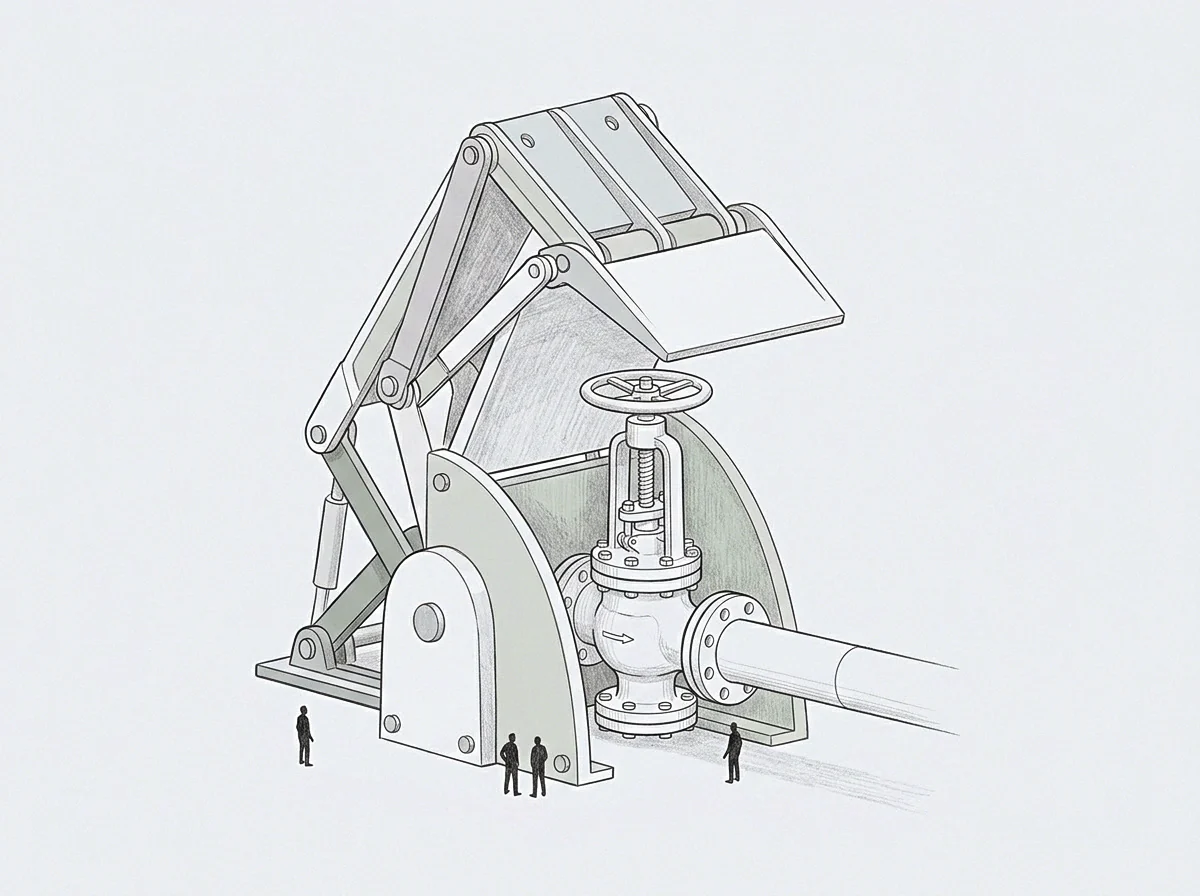
Mesh
Four distinct operational threads arrive at midnight on the desk of an executive leading a regional expansion. One seeks pricing approval for an enterprise contract outside standard margin bands. Another reports staffing shortages at a new fulfillment hub.
The remaining two bring an unrated vendor compliance risk and an internal reporting dispute between logistics and accounting. Every message carries identical urgency because the expanding organization maintains no structural filter beneath the executive seat. Without defined operational boundaries, anomalies escalate straight to the top.
When an operation expands from a single operational node to multiple concurrent sites, decision volume grows superlinearly against headcount. Physical executive capacity stays fixed while inputs multiply. Lacking a mechanical filter to categorize, route, or decline incoming requests, the desk becomes an uncontrolled routing hub where decisions stall in queues and create artificial drag across growing units.
Operational expansion increases incoming signal volume while executive processing capacity remains structurally constant.
The breakdown of an expanding operation rarely traces back to faulty executive assessment; it originates in how inputs are routed. Early-stage enterprises depend on high-bandwidth, direct oversight, with founders evaluating exceptions one by one. As nodes multiply, that centralized processing breaks down.
Supervisory control research shows human operators experience exponential error rate spikes once incoming decision streams exceed four to six concurrent channels. Expansion inevitably forces a shift from personal oversight to mechanical filtering.
An executive acting as the primary decision filter introduces two major failure modes into the enterprise. Operational units pause while waiting for sign-off, bleeding momentum across the field, while decision quality deteriorates as cognitive fatigue cuts into analytical precision. Local teams simply assume every unrated exception belongs on the executive desk until an alternative route is drawn.

Triage
Building a decision architecture for expanding operations requires a clear distinction between filtering mechanisms. Organizations routinely conflate administrative gatekeeping with deterministic filtering. Gatekeeping leans on assistants or middle managers screening messages by perceived importance, whereas deterministic filtering sets explicit, pre-defined parameters that automatically process, route, or reject incoming requests before they consume executive attention.

Structural Properties of Decision Filtering Modes
To preserve execution speed without losing operational control, expanding enterprises implement structural filters that function independently of executive presence.
| Filtering Mode | Latency Profile | Distortion Risk | Executive Load Impact |
|---|---|---|---|
| Administrative Gatekeeping | High queue delays during operational spikes | High distortion through subjective interpretation | Moderate reduction in raw message volume |
| Exception Delegation | Low delay for standard operational bounds | Moderate distortion focused on boundary edge cases | Significant load transfer to regional managers |
| Deterministic Thresholds | Near zero processing latency across all units | Zero subjective distortion of parameter rules | Maximum reduction in executive decision overhead |
Setting deterministic thresholds turns decision filtering into an automated asset. Rather than evaluating commercial requests individually, leadership defines clear operational parameters. Requests inside the boundaries clear automatically at the local level; those exceeding them hit a structural stop and route directly to designated functional owners alongside packaged diagnostic data.
A decision filter reduces executive cognitive load only when the rejection criteria are evaluated before the input reaches the seat.
Moving from discretionary review to parameter-based filtering restructures how operational staff interact with leadership. Instead of bringing open-ended problems upward for direction, teams operate within established ranges, filing structured exception reports only when variables breach tolerance. When filtering relies on informal discretion rather than explicit parameters, the problem inevitably defaults upward to the executive.

Seat
Consider an expanding logistics enterprise scaling from two central warehouses to sixteen regional distribution centers over an eighteen-month period. Two founders handle executive decisions across all facilities, with operational requests doubling every six months. In the early stages, both founders directly evaluate carrier agreements, software vendor integrations, facility leases, and local compensation bands.
By month twelve, incoming requests hit eighty submissions a week, and executive turnaround slows from four hours to five days. Regional managers begin holding back requests, postponing facility launches, or committing capital without authorization to keep schedules moving. The executive seat turns into the primary bottleneck.
Parameters of the Worked Scenario
To break the backlog, leadership establishes clear operational boundaries across three primary vectors: financial exposure, operational commitments, and policy deviations. Contracts under two hundred thousand dollars carrying standard net-thirty terms execute at the regional director level without executive sign-off. Facility leases fitting pre-approved cost-per-square-foot templates require only local legal clearance, while hiring within established compensation bands processes automatically through regional human resources.
Research in organizational cognitive dynamics demonstrates that explicit boundary parameters can reduce executive decision volume by up to seventy percent while accelerating local operations. Studies tracking managerial load in expanding commercial operations show executive precision sharpens substantially when daily decisions are capped below ten discrete items. These findings reflect direct observations of executive performance in middle-market industrial operations.
The core conclusion holds as long as cost structures remain predictable; sudden systemic market shocks demand immediate threshold recalibration.
An unstated decision threshold forces operational teams to substitute executive escalation for structural authority.
The principal cost in executive attention and hours when explicit structural filters are missing is the dilution of high-level focus. When day-to-day noise floods the executive office, capital allocation, strategic positioning, and structural risk management lose ground to localized friction. Unfiltered expansion drains cognitive bandwidth, eroding the precision required for systemic decisions.

Conduit
The channels carrying information from operational nodes to the executive seat govern both the speed and accuracy of decision filtering. Expanding operations often stumble because communication pathways feed raw, unstructured noise straight into leadership. Functional filtering requires structured intake that formats raw operational data into standardized decision packages prior to escalation.
Under a standardized intake model, any issue escalating to executive review must provide four compulsory components: the specific threshold breach, the projected financial impact range, two viable local resolution options with risk assessments, and the regional lead’s recommended action. Submissions lacking any of these four elements are rejected automatically by protocol before touching the executive desk.
- Permeable Escalation Rules allow routine variance to bypass regional leads when unit financial baselines are left undefined for local teams.
- Asymmetric Information Channels force executive intervention when mid-level managers lack the unit margin visibility needed to navigate trade-offs autonomously.
- Implicit Approval Defaults turn executive silence into operational paralysis across growing units whenever non-response protocols are missing.
Supervisory control research in high-consequence settings confirms that structured intake protocols reduce total operator processing time by more than sixty percent. Drawn from studies of operations teams in aerospace and nuclear facilities where rapid signal triage preserves system stability, the findings apply cleanly to commercial enterprises once local staff are trained in structured intake formats.
Silence functions as a decision filter only when operational protocols state in advance that non-response constitutes approval.
A well-built conduit shields executive capacity while keeping operations in motion. By setting default outcomes for unaddressed items, an organization eliminates systemic gridlock. Adding an explicit non-escalation clause pushes local operational responsibility directly back to the department head.

Latch
In mechanical engineering, a pressure latch vents system buildup automatically once fluid forces exceed structural limits, requiring no intervention from a central operator. Decision architectures employ an identical mechanism in executive workflows to absorb volume spikes without overwhelming leadership.
An operational latch serves as an automatic circuit breaker. When incoming decision rates exceed processing capacity, pre-set protocols engage. If executive turnaround on capital expenditure requests exceeds forty-eight hours during expansion peaks, for example, authority drops automatically to local managers for any expenditure under fifty thousand dollars.

Where Does the Filtering Obligation Land Under Load?
The burden of filtering belongs on the incoming channel rather than the executive receiver. Just as industrial relief valves protect central turbines by discharging excess pressure at the perimeter, operational structures should absorb localized volatility at the business-unit level before fluctuations can accumulate into central executive overload.

Uncertainty in Automated Latches
The precise threshold where automated latches should trigger remains debated in management literature. Field research offers conflicting guidance on whether authority should transfer based on queue duration or raw message volume. Given this uncertainty, an operator sets conservative volume triggers, validates them during routine operating cycles, and adjusts limits against observed error rates in regional execution.
It remains uncertain whether automated, rule-based latches can preserve operational alignment when ambient market volatility outpaces historical parameters.

Yield
The defining metric of an executive decision filter is enterprise yield: the ratio of operational speed to executive energy expended. An organization that scales operational volume while holding executive decision volume flat achieves high structural yield, though maintaining that performance demands ongoing calibration of the filtering infrastructure.
As operational units mature, local leadership gains deeper contextual familiarity, allowing authority thresholds to widen over time. Executive leadership reviews threshold performance quarterly, raising local decision caps where units demonstrate stability and tightening them where error rates rise. The filtering framework remains dynamic, shifting alongside local operational capability.
By establishing explicit thresholds, enforcing structured intake conduits, deploying deterministic latches, and treating executive bandwidth as a finite resource, expanding organizations preserve clarity and execution speed during growth. Scale ceases to compromise executive function once filtering mechanisms absorb routine volume automatically, reserving central leadership for core strategic choices.