

Structural Governance Interventions for Throttled Executive Teams Facing Relational Drift
Structural governance interventions replace reactive bilateral negotiations with bounded decision rights and gated queues to prevent relational collapse.
Structural governance interventions replace reactive bilateral negotiations with bounded decision rights and gated queues to prevent relational collapse.

Early venture leadership preserves decision capacity by gating operational intake, parking open loops, and treating working memory as a bounded structural resource.

A mechanical capacity threshold rejects incoming operational requests automatically once active execution slots reach a predetermined physical concurrency cap.

Restoring physiological headroom requires strict gating of active operational loops to reduce allostatic wear across unbalanced partner structures.

Stated operational intake limits convert incoming channel load into structured queue latency rather than internal cognitive depletion.
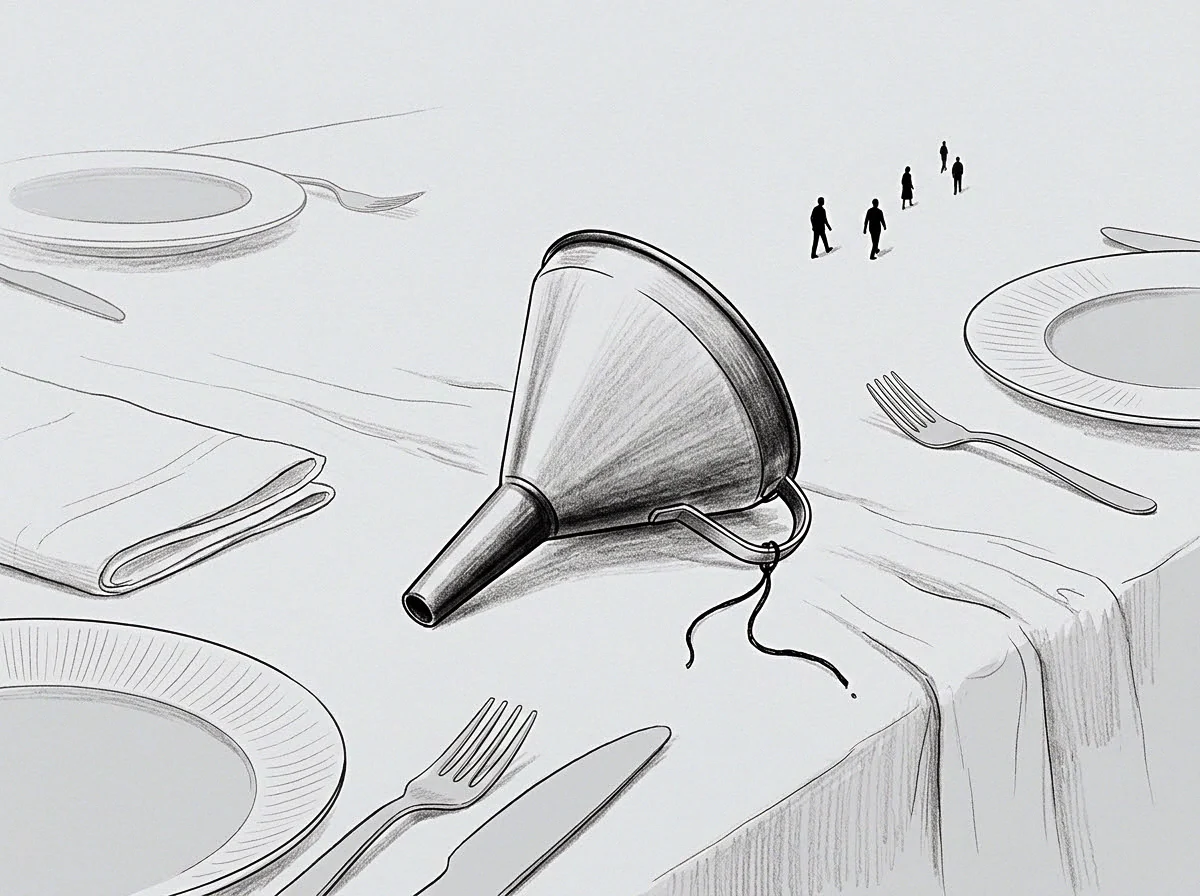
Executive decision filtering transfers operational load from central leadership to structural rules by defining explicit authority thresholds during expansion.

Quantifying concurrency limits and autonomic thresholds protects executive decision fidelity by capping active loops and restoring parasympathetic baseline.

Stated priority limits keep operational requests out of executive headroom by converting personal availability into explicit, system-enforced boundaries.
The terms are written where they belong. Each field holds three desks, and every entry a desk writes raises the terms it uses, each term given a meaning, a mechanism and the places it appears. The record on these pages stays first person and hand made; the fields grow the nomenclature.