
Executive Capacity Degradation Under Chronic Asynchronous Decision Queues
Continuous asynchronous decision queues saturate working memory slots, elevating allostatic load and throttling executive throughput.
Node
Asynchronous Thread Accumulation and Working Memory Saturation
At eleven o’clock on a Tuesday night, four chat applications, two document review channels, and an engineering tracking board remain active on the primary display. Twenty-seven distinct decisions sit in pending states, each waiting for executive sign-off, prioritization, or strategic clarification. The executive calendar for the week shows long blocks of uninterrupted time, suggesting ample room for deep analytical work.
External observers interpret the lack of scheduled meetings as open operational capacity.
Asynchronous communication platforms eliminate temporal friction from decision routing. Team members dispatch requests at the moment of operational need, transferring pending logic directly onto executive displays. Without explicit intake filters, incoming items populate active working memory.
Human cognitive architecture maintains a constrained number of active operational slots. When incoming decision requests exceed this limit, unaddressed items persist as open cognitive loops. The inbox remains full.
Open loops consume memory. Each pending decision retains a background allocation of executive attention, even when the executive attempts to focus on primary tasks. As the volume of unresolved input grows, cognitive fragmentation accelerates.
The executive switches focus between disparate operational domains every few minutes, attempting to resolve quick items while leaving complex issues unresolved.
- Continuous thread polling forces attention to cycle through unresolved items repeatedly across the working day.
- Ambiguous ownership terms leave decision authority divided between originators and approvers, stalling execution while consuming cognitive energy.
- Unbounded request scope converts simple operational queries into broad strategic debates that demand extensive background reconstruction.
- Asynchronous latency compounding delays downstream operational dependencies, increasing the total volume of follow-up inquiries sent to leadership.
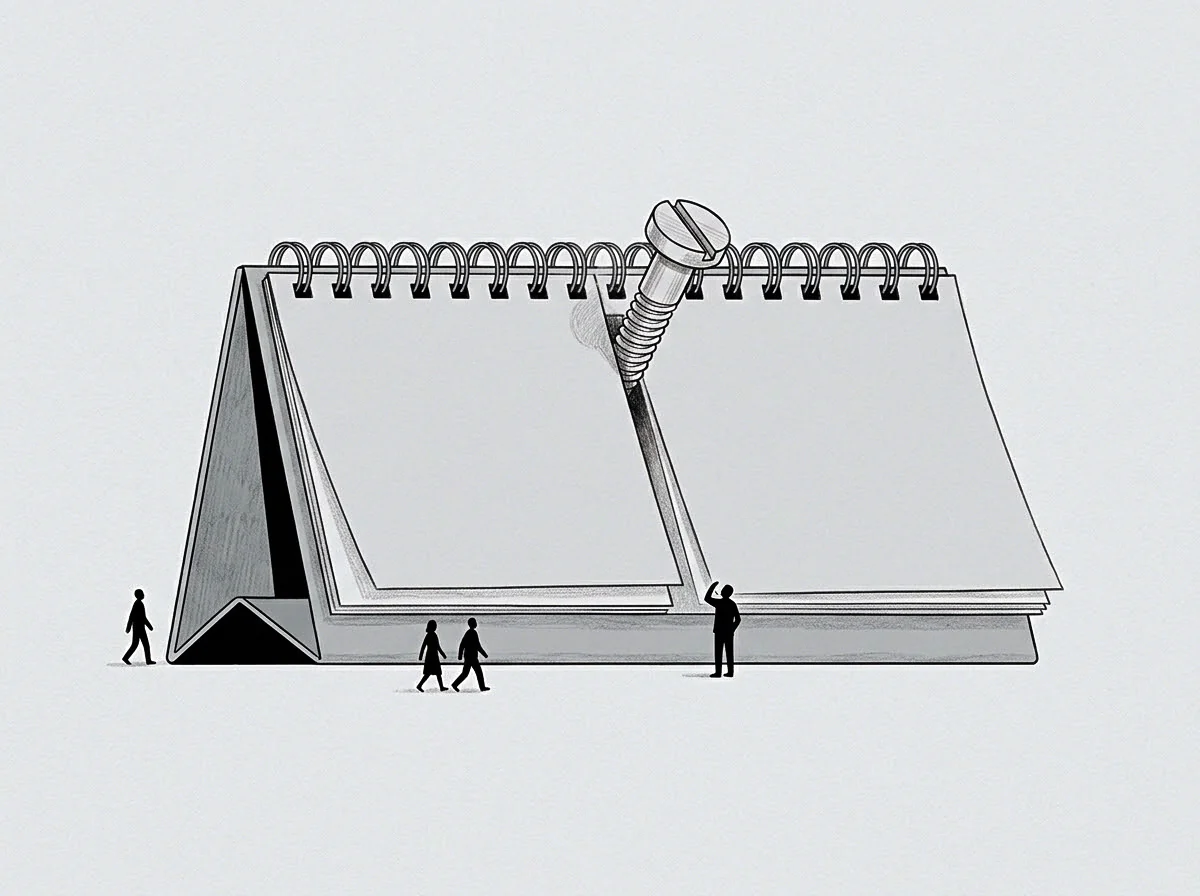
The calendar hides load when asynchronous decision requests bypass scheduled meeting blocks.

The Illusion of Calendar Availability
Organizational tracking tools count hours spent in synchronous meetings as active workload while treating non-meeting hours as free capacity. This metric misrepresents executive strain in modern remote and hybrid structures. An empty calendar block often conceals dozens of concurrent decision requests scattered across multiple channels.
Unbounded channels generate noise.
When operational teams see open calendar space, they treat the executive as fully available for asynchronous routing. Requests arrive continuously, assuming that non-meeting hours provide immediate processing bandwidth. The resulting influx saturates the executive working memory capacity long before the workday concludes.
Context switching incurs latency. The response is delayed because the decision is still sitting in the channel awaiting approval.

Friction

Allostatic Load and Systemic Throttling
Stress physiology defines allostatic load as the cumulative physiological wear resulting from chronic adaptation to ongoing environmental demands. When decision queues stream continuously without temporal boundaries, the human neuroendocrine system remains in sustained regulatory activation. The brain responds to sustained cognitive saturation by initiating protective downshifts in processing velocity.
Executive slots are finite.
Systemic throttling operates as a protective mechanism within saturated human architecture. Rather than structural collapse, throttling intentionally slows down executive response rates to preserve judgment accuracy under high cognitive strain. Processing speed declines while error detection mechanisms attempt to maintain baseline fidelity.
Throttling protects system integrity. External observers frequently misinterpret this reduced responsiveness as emotional detachment, lack of engagement, or depressive withdrawal.
When allostatic load exceeds physiological recovery limits, executive systems initiate processing downshifts to preserve judgment fidelity.

Distinguishing Throttled Capacity from Functional Failure
Clinical diagnostic criteria for depression center on pervasive loss of interest, flat affect, and persistent despair across all life domains. Executive capacity throttling presents differently under careful physiological reading. A throttled executive continues to process high-priority items with accuracy when forced by hard operational constraints, yet lacks the cognitive headroom to initiate self-directed, open-ended strategic work.
What feels impossible is self-initiated synthesis under open loop saturation.
Treating a throttled executive system as a failing or disengaged system leads to counterproductive organizational interventions. Teams often increase check-ins, send reminder notifications, or schedule urgent alignment sessions to prompt faster responses. These actions inject additional inputs into a saturated queue, accelerating capacity degradation.
Misinterpreting structural cognitive throttling as personal disengagement leads teams to escalate communication frequency, which further saturates the remaining processing capacity.

Gate

Structural Boundary Protocols for Queue Regulation
Regulating high-volume asynchronous inputs requires moving from continuous open access to structured processing windows. Every incoming item demands an explicit structural footprint defined by scope, date, and operational terms. Gated threads reduce load.
Take an executive overseeing a product and engineering organization of fifty people. Under an open asynchronous arrangement, team members send decision requests via instant message at any hour. The executive switches contexts forty times a day to address items piecemeal, creating continuous context fragmentation.
Under a structured protocol, decision requests are formatted into standardized decision memoranda and routed into designated asynchronous review windows twice daily. Items submitted without defined scope, explicit options, and fallback default actions return to the sender without entering executive processing memory.
| Evaluation Metric | Ungated Asynchronous Queues | Bounded Decision Protocols |
|---|---|---|
| Concurrent Thread Limit | Unbounded (30-50 active loops) | Strictly bounded (5-8 active loops) |
| Context Switching Frequency | Continuous (30-50 shifts daily) | Batched (2-3 discrete windows daily) |
| Executive Memory Slot Load | Saturated (90-100% capacity) | Managed (30-40% headroom preserved) |
| Fallback Execution Velocity | Stalled pending executive sign-off | Automated via default-action timers |
A decision request without a defined default action converts executive capacity into operational triage.

Default Actions and Explicit Boundaries
Asynchronous decision protocols function effectively only when paired with clear escalation timers and default-action rules. An originator submitting a decision request includes the recommended course of action alongside a defined response deadline. If the executive does not intervene before the deadline expires, the proposed action executes automatically.
Asynchronous latency compounds daily.
This structural arrangement removes the requirement for active sign-off on routine operational decisions. The executive retains veto power without becoming an operational bottleneck. Open loops close by structural default rather than continuous manual intervention.
The inclusion of an explicit default-action clause in asynchronous decision submissions shifts the burden of execution back to the originator when the review window expires.
Deficit

The Four Stages of Capacity Degradation
Continuous micro-decisions erode higher-order executive functions over sustained operational horizons. The executive capacity to synthesize complex trade-offs, construct long-range strategy, and maintain emotional regulation degrades systematically as queue saturation persists. Research in occupational ergonomics demonstrates that decision quality correlates inversely with continuous active thread count.
Unstated expectations create drag.
- Selective processing delays emerge as non-urgent strategic decisions are deferred repeatedly in favor of rapid operational approvals.
- Context switching latency increases, requiring longer recovery intervals between disparate communication channels.
- Information synthesis narrows, leading executives to rely on simplified heuristics rather than thorough multi-variable evaluation.
- Complete queue aversion occurs, where the executive avoids opening communication platforms entirely to prevent further cognitive input.
Continuous micro-decision processing consumes the cognitive headroom required for strategic synthesis.

Epistemic Limits in Ergonomic Literature
Empirical studies in cognitive science establish clear limits on human working memory slots under concurrent task loads. Lab experiments confirm that multi-tasking and continuous interruptions increase error rates and elevate cortisol levels. Batched updates preserve headroom.
Practitioner literature often extends these empirical findings into unvalidated prescriptions, advocating total disconnection or rigid communication bans that ignore business operational realities. While laboratory research proves cognitive capacity limits, organizational practice requires balancing cognitive preservation against necessary decision velocity. Strategic clarity decreases as the count of active operational threads increases.

Margin

Reclaiming Executive Headroom Through Concurrency Limits
Restoring executive capacity requires establishing absolute structural concurrency limits on active decision queues. Executive slots are allocated explicitly, capping the total number of open decision threads allowed across the organization at any single time. Scope defines boundary conditions.
Default actions close loops. Capacity limits prevent exhaustion.
When the concurrent thread limit reaches capacity, new decision requests remain in departmental queues before reaching the executive level. Operational authority moves downward by establishing explicit financial and strategic boundaries within which teams execute without executive sign-off. Silence creates ambiguity.
Decoupling operational sign-off from strategic steering restores essential cognitive headroom. The organization protects its leadership from chronic queue saturation by enforcing hard structural gates on incoming communication. It remains uncertain how organizational cultures accustomed to real-time executive availability adapt long-term when asynchronous access is permanently bounded by hard concurrency limits.