
Quantifying Capital Allocation Shift During Chronic Sympathetic Executive Hyperarousal
Chronic sympathetic hyperarousal elevates executive discount rates, shifting capital allocation from long-horizon growth toward immediate threat containment.
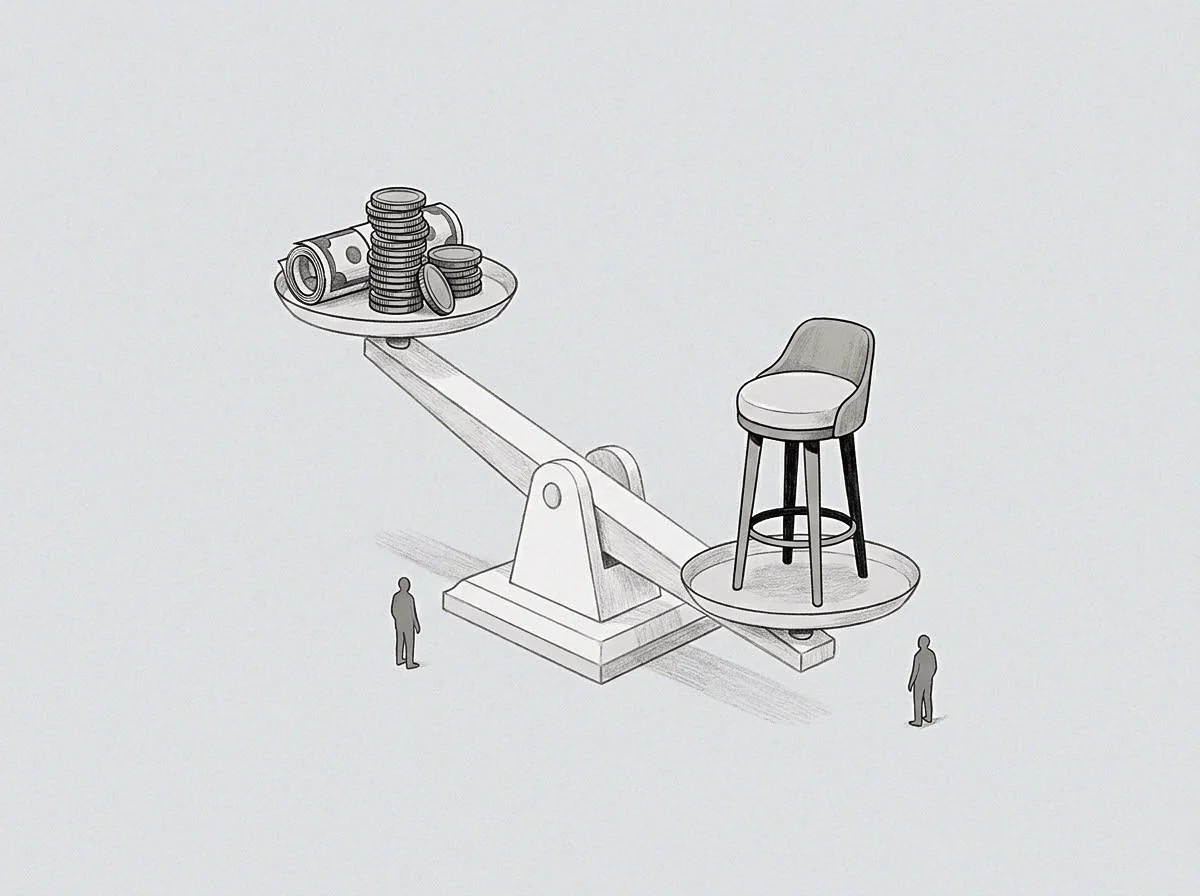
Skew
Four pending acquisition proposals sit unread on a screen late at midnight. The executive reviewing them treats every requested disbursement as an immediate threat to liquidity margin rather than an investment in asset expansion. The balance sheet carries sufficient cash reserves to fund two of the proposals without external debt, and the capacity to deploy that capital exists on paper.
Under persistent sympathetic hyperarousal, the physiological baseline driving decisions shifts. The operational window narrows as prospective compounding yields to immediate downside mitigation.
When autonomic tone remains elevated over months, systemic endocrine changes reconfigure neural processing across executive networks. Elevated circulating cortisol and tonically increased baseline norepinephrine alter signaling within the prefrontal cortex while amplifying amygdalar threat sensitivity. Risk assessment ceases to function as a symmetric calculation of expected value.
Probabilities of operational loss are weighted exponentially higher than equivalent probabilities of multi-year financial gains.
This biological shift directly alters temporal discounting equations. In standard corporate finance models, cash flows expected five years out are discounted using a stable cost of capital based on interest rates, systemic market beta, and firm-specific capital structure. Under chronic sympathetic strain, the internal discount rate spikes.
The executive’s neural architecture treats cash flows occurring beyond the acute operational horizon as highly uncertain, discounting their present value down toward zero. Capital projects requiring sustained disbursements over two years face severe penalization during internal reviews.
Systemic sympathetic activation compresses the effective capital planning horizon by systematically elevating internal discount rates applied to long-term prospective returns.
The resulting operational shift displays measurable patterns across executive decision layers. Capital projects that build durable infrastructure, fundamental research assets, or new market channels are repeatedly deferred or canceled. Meanwhile, short-cycle investments that promise immediate cost containment or risk reduction receive rapid sign-off.
Capital moves away from value creation and toward threat containment.
The executive perceives this shift as prudence, framing the decision in board memos as disciplined balance sheet management. The underlying driver is an altered physiological baseline that renders long-term commitments intolerable to cognitive bandwidth rather than a change in macroeconomic conditions. When biological reserves are depleted, financial reserves are locked down to compensate.
A simple operational relationship governs this state: as biological wear increases, the required return on long-cycle capital increases with it.

Weir
Every open capital commitment functions as an ungated cognitive loop. When an executive approves a multi-stage capital project, the transaction involves far more than a single bank transfer. It opens ongoing monitoring obligations, governance checkpoints, performance reviews, and vendor negotiations.
Each pending obligation consumes a dedicated slot within the executive’s concurrency limit. Operating near full capacity, the allocator cannot absorb additional open loops without triggering acute overload.
To prevent operational collapse, the hyperaroused executive erects structural barriers to capital flow. The investment approval process narrows into a tight weir, restricting the velocity of capital deployment across every division. Denying a capital expenditure request costs less cognitive capacity, closing an open thread immediately and freeing working headroom, whereas approval commits the office to months of follow-up reviews and vendor management.
Under severe autonomic strain, the default decision trends overwhelmingly toward denial.
This operational dynamic produces distinct structural failure modes across organizational capital distribution:
- CapEx deferral bias enforces a blanket freeze on facility updates, equipment replacements, and systems modernization to prevent immediate structural commitments.
- Granular approval centralization pulls minor purchasing decisions upward into the executive office, deliberately slowing capital velocity through procedural bottlenecks.
- Asymmetric hurdle elevation raises internal rate of return requirements specifically for offensive strategic initiatives while leaving defensive expenditures unscrutinized.
- Termination preference accelerates the cancellation of ongoing multi-year initiatives at the first sign of metric divergence to permanently close active operational loops.
The executive uses formal governance structures to mask an informal survival mechanism. Divisional managers submitting proposals observe that hurdle rates specified in corporate governance documents no longer reflect real sign-off criteria. Proposals meeting every published financial metric are returned with requests for further modeling, higher margin assumptions, or extended payback schedules.
Open operational loops impose cognitive switching costs that bias hyperaroused allocators toward immediate project rejection regardless of long-term projected returns.
This structural friction alters organizational trajectory over time. High-performing division leaders learn that proposing new growth initiatives carries high friction and low probability of approval. They stop submitting forward-looking capital requests, shifting their own operational focus toward maintaining existing operations.
The organization’s internal deal pipeline decays, leaving the firm with a passive balance sheet and an aging asset base.
The real variable changing capital velocity is the total count of ungated commitment threads currently held in executive memory rather than formal board policy.

Vault
Under sustained sympathetic tone, liquid capital on the balance sheet shifts function from an offensive tool for expansion into a defensive buffer against external volatility. The executive perceives cash reserves as the sole protection against unpredictable operating environments. Every unit of cash disbursed registers as a permanent loss of structural safety.

Why Does Autonomic Stress Inflate Liquidity Hurdles?
The inflation of internal hurdle rates under chronic stress serves a protective psychological function. When internal allostatic load reaches its ceiling, the executive’s working model of the outside environment shifts toward high perceived volatility. The operational landscape feels unpredictable, hostile, and prone to sudden shocks.
To offset this perception, the required financial margin of safety expands. A capital project that previously required a 12 percent internal rate of return under equilibrium conditions is now evaluated against an informal 25 percent hurdle rate.
This hurdle rate inflation operates through specific financial mechanics:
First, risk premia applied to project cash flows are inflated arbitrarily. The executive overweights potential cost overruns, regulatory delays, and revenue shortfalls while discounting optimistic growth trajectories. Second, payback period restrictions are tightened drastically.
Projects failing to return initial cash outlay within twelve to eighteen months are systematically eliminated. Third, working capital requirements are expanded artificially. The executive demands larger cash buffers retained in operating accounts, locking away capital that could otherwise fund high-yield growth assets.
Uncertainty in internal regulatory capacity manifests directly as inflated financial discount rates applied to external capital investments.
Cash accumulates in low-yield money market funds or excess operational treasury accounts. The board notes growing cash balances and assumes the executive team is preparing for a major strategic transaction or building reserves for an impending economic downturn. In practice, the cash sits idle because the executive lacks the autonomic headroom to tolerate the risk and complexity of deploying it.
When an organization locks its treasury in a defensive vault to compensate for executive autonomic strain, it forfeits market position to competitors capable of deploying capital at standard market discount rates.

Asymmetry
Capital allocation shifts under chronic hyperarousal display consistent structural differences when compared to baseline equilibrium allocation. Evaluating these shifts side-by-side clarifies how sympathetic strain alters every major corporate finance variable.
| Allocation Vector | Baseline Equilibrium State | Chronic Sympathetic Hyperarousal |
|---|---|---|
| Planning Horizon | Multi-year strategic compounding (3 to 7 years) | Short-term downside mitigation (3 to 12 months) |
| Hurdle Rate Baseline | Standard weighted average cost of capital plus risk adjustment | Highly inflated hurdle rates with arbitrary downside weighting |
| Cash Posture | Optimized working capital; active deployment of excess reserves | Liquidity hoarding; expansion of idle operational reserves |
| R&D and Expansion | Sustained capital commitment through market cycles | Severe starvation; immediate deferral of unproven concepts |
| Decision Velocity | Delegated approval frameworks with predictable review cycles | Centralized approval bottlenecks; elevated proposal rejection |
| Risk Sensitivity | Symmetric evaluation of potential upside and downside tail risks | Asymmetric focus on downside containment and loss prevention |
The distortion of capital allocation progresses through distinct stages as sympathetic hyperarousal remains unmitigated over extended execution cycles:
- Initial threat overweighting causes immediate re-evaluation of all active capital projects, applying aggressive downside scenarios to ongoing initiatives.
- Secondary growth starvation systematically denies funding to long-horizon R&D, market expansion, and talent acquisition programs in favor of cost-reduction software and operational maintenance.
- Terminal capacity impairment leaves the business with degraded technology stacks, stagnant product lines, and high divisional turnover due to persistent capital starvation.
The executive team remains trapped in reactive capital management, treating routine capital requests as emergency demands on firm resources. Division leaders attempting to execute multi-year plans find themselves unable to secure long-term capital guarantees.
Defensive capital preservation strategies executed over consecutive fiscal quarters degrade the firm’s underlying competitive moat through systematic underinvestment in core growth drivers.
Internal investment criteria shift every three weeks to reflect executive stress levels rather than prevailing market conditions.
Drain
The long-term consequence of sympathetic capital allocation shifts is a steady drain on organizational capability. Capital allocation is the primary mechanism through which an organization translates strategic intent into real-world capacity. When that mechanism is warped by executive autonomic strain, the physical assets, human capital, and market positioning of the business degrade over time.
Equipment ages past optimal service life, top-tier engineering talent leaves due to unfunded initiatives, and product lines lose market relevance against competitors who maintain steady investment cycles.
Addressing this structural drain requires decoupling capital allocation procedures from the acute physiological state of individual decision-makers. Relying on executive willpower or subjective discretion during periods of high operational strain guarantees allocation distortions. Organizations must install explicit, gated governance structures that operate on fixed terms, pre-committed capital pools, and objective hurdle metrics.
Pre-committing capital to long-horizon funds with explicit scope, fixed dates, and locked terms protects strategic compounding from acute executive hyperarousal.
Establishing ring-fenced growth budgets managed by investment committees with delegated authority removes the single-point cognitive bottleneck. When capital deployment follows pre-established rules rather than late-night discretionary sign-offs, the firm maintains its strategic time horizon even while its leadership navigates periods of high allostatic load.
What remains unresolved in practice is how an organization can reliably detect the early stages of executive hyperarousal before its capital allocation shifts begin visibly eroding the balance sheet.