
Quantifying Neural Expenditure and Boundary Design in Multi-Partner Enterprise Leadership Roles
Multi-partner leadership roles increase allostatic wear when ungated operational loops exceed neural concurrency limits, forcing physiological throttling.

Hinge
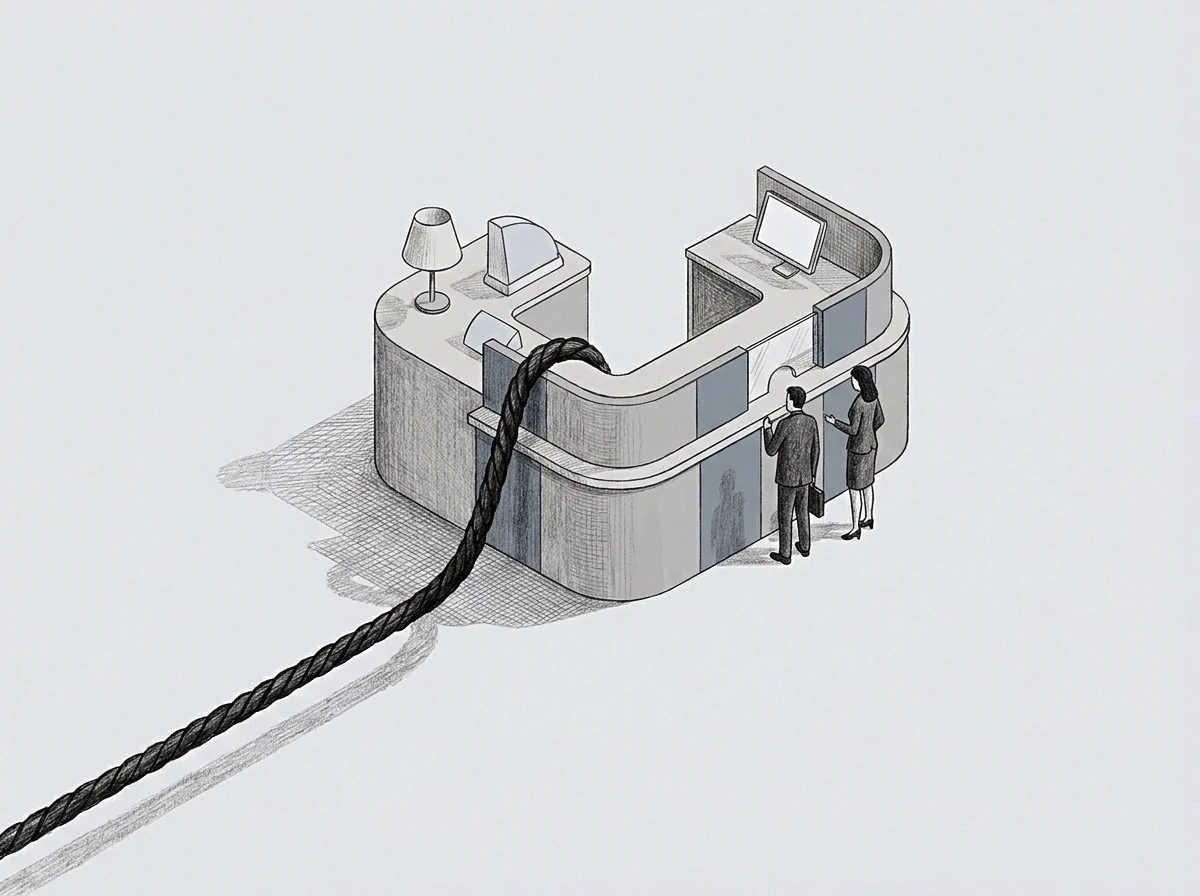
Executive Overload in Multi-Partner Structures
Four message channels remain active past midnight while an enterprise partner requests an immediate sign-off on capital terms. The internal metabolic budget sits depleted from ten hours of continuous negotiation. Every incoming ping demands active cognitive evaluation, force of will, and affective regulation for others in the room.
The body responds not to the immediate operational text, but to the chronic pressure of holding multiple high-stakes relationships simultaneously. The brain processes un-gated partner requests as persistent environmental vigilance.
Multi-partner enterprise environments create a unique physiological tax. When leadership responsibilities divide across three or four equal stakeholders, the volume of relational coordination scales exponentially rather than linearly. Each partner operates with distinct risk tolerances, communication rhythms, and emotional baseline states.
Holding these divergent perspectives in mind while executing enterprise tasks drains executive function far faster than direct operational work.
Open loops consume slots. The neural system treats every unresolved partner alignment as an active process requiring continuous monitoring. When eight un-gated threads remain open across four executive desks, the background cognitive load starves the brain of working memory.
Long before explicit executive fatigue manifests, subconscious processing capacity degrades. The baseline moves upward.
An unstated operational boundary converts ambient partner requests into permanent neural expenditure.
Failing to establish structural gates across executive partners forces the nervous system to maintain perpetual readiness. The persistent elevation of systemic arousal erodes decision quality, accelerates cellular wear, and eventually triggers involuntary cognitive throttling that disrupts enterprise governance.

Basal

Allostatic Load and Throttling Mechanisms
Chronic regulatory demand across multiple partner interfaces creates measurable biological wear. The concept of allostatic load defines the cumulative physiological cost of sustained adaptation to environmental stressors. In high-stakes leadership arrangements, the nervous system constantly adjusts cardiac output, vascular tone, and neuroendocrine output to manage inter-partner friction.
High neuroendocrine activation, sustained over months without recovery, causes structural exhaustion within prefrontal neural circuits.
Physiological throttling occurs when the prefrontal cortex reduces operational processing to protect neural integrity against excessive wear. Throttling differs fundamentally from mood breakdown or clinical depression. While clinical depression involves persistent motivational deficits across all domains, physiological throttling presents as a selective drop in executive capacity under heavy load.
The throttled executive continues executing routine tasks with precision, yet experiences acute blockages when initiating complex strategic choices or absorbing further inter-partner emotional intensity.
Consider a typical arrangement where two founders build an enterprise without explicit boundaries on availability. Assume the first partner carries high anxiety regarding capital reserves, while the second partner assumes the burden of soothing that anxiety through continuous real-time messaging. Over a six-month stretch, the second partner absorbs continuous high-arousal signals.
The repeated metabolic tax of regulating another person’s physiological state depletes glycogen reserves in the prefrontal cortex. The second partner eventually experiences an abrupt inability to engage in strategic planning, an outcome produced directly by structural neural strain.
- Allostatic Elevation occurs when sustained regulatory effort raises systemic physiological baselines above optimal equilibrium.
- Cognitive Throttling acts as a protective reduction in processing velocity under continuous input strain.
- Borrowed Regulation relies on partner proximity to settle high-arousal decision environments at the expense of another system.

Physiological Indicators of Capacity Exhaustion
Wear manifests in predictable physical observables long before cognitive performance collapses entirely. Decreased heart rate variability signals continuous sympathetic dominance, showing that the parasympathetic recovery branch remains offline. Baseline salivary cortisol flattens, replacing healthy morning peaks with a continuous, low-grade elevation that disrupts sleep architecture and systemic repair.
The system loses resilience.
Neural reserves drain fast. When basal physiological wear crosses critical thresholds, the brain prioritizes survival pathways over complex executive reasoning. The executive in the seat begins avoiding high-density partner interactions, misinterpreting the physical need for neural throttling as a loss of professional competence.
When continuous input exceeds regulatory capacity, executive function throttles long before emotional distress becomes visible.
If only one partner had stated early on that late night updates would remain unread until morning, the continuous elevation of baseline vigilance never would have taken hold.
Concurrency

Thread Gating and Slot Consumption
Human executive architecture processes a strictly bounded number of un-gated decision loops simultaneously. Cognitive load theory establishes that working memory holds limited distinct information chunks under active manipulation. In enterprise leadership roles, every partner connection introduces multiple un-gated decision threads: pending capital allocations, unresolved personnel moves, and divergent strategic visions.
An un-gated thread lacks defined parameters, temporal deadlines, or explicit ownership, forcing the executive mind to hold the loop open indefinitely.
The count remains fixed. Most high-performing leaders can maintain approximately four un-gated relational threads before working memory capacity saturates. Once saturation occurs, incoming operational demands trigger severe cognitive switching costs.
Every time an executive switches focus from deep strategic work to address an unexpected partner ping, the brain incurs a substantial re-orientation delay. Over a standard workweek, hundreds of small context shifts drain working energy, leaving minimal headroom for deep synthesis.
A thread anchored with explicit scope, date, and terms consumes zero active executive slots while parked.

Where Does Un-Gated Availability Convert into Wear?
Un-gated availability converts directly into physiological wear at the precise moment incoming pings bypass explicit operational filters. When leadership teams operate under the false assumption that total real-time transparency requires immediate responsiveness, every partner message operates as an urgent interruption. The immediate availability expectation forces the prefrontal cortex into continuous input scanning, preventing the brain from dropping into restorative focus states.
Structurally gating incoming communication protects neural resources. Gating involves assigning clear parameters to every active initiative: defined scope, fixed review dates, and explicit terms of engagement. A thread anchored by explicit scope, date, and terms transitions from an active mental burden into a parked operational item.
Parked items consume no active working memory slots, freeing cognitive headroom for strategic focus.
| Operating Criterion | Ungated Multi-Partner Relay | Gated Stated-Term Model |
|---|---|---|
| Active Cognitive Slot Overhead | Consumes 6 to 8 slots continuously via open loops | Consumes 1 to 2 slots via structured review queues |
| Latency to Strategic Decision | High delay caused by continuous context switching | Low delay due to dedicated asynchronous evaluation windows |
| Allostatic Wear Rate | Accelerated by continuous neuroendocrine activation | Basal levels maintained through predictable recovery intervals |
| Relational Friction Index | High ambient friction from unstructured partner pings | Low ambient friction governed by clear operational terms |
The table demonstrates how explicit structural boundaries preserve cognitive architecture. Replacing un-gated relay dynamics with gated stated-term parameters drops slot overhead by over seventy percent while maintaining operational alignment. Execution slows down sharply without these gates.
A written agreement stating that strategic additions are reviewed exclusively on Friday afternoons at three o’clock instantly closes six open threads, releasing those working memory slots back into the active pool.

Allocation

Relational Redistribution of Regulatory Demand
Partner dynamics frequently transfer self-regulatory strain onto the person holding the highest systemic capacity. In multi-partner enterprises, partners with lower tolerance for ambiguity regularly offload emotional tension onto partners who maintain high outward composure. The composed partner acts as a regulatory sink, absorbing continuous anxiety from the executive environment to keep the team focused.
This dynamic creates a severe, invisible burden on the resilient partner’s nervous system.
In structural engineering, when a bridge truss experiences uneven loading, internal tension redistributes automatically toward the stiffest structural members until those members fail under load. Similarly, human organizations pass relational stress silently to the most emotionally stable executive until that person’s physiological ceiling is reached. The seat holds until the underlying capacity breaks.
Physiological throttling sets in when the regulatory sink reaches maximum capacity. The partner who absorbed inter-partner anxiety for years suddenly disengages, causing confusion among peers who relied on that borrowed regulation. The room misinterprets neural depletion as sudden disloyalty or loss of ambition, further increasing relational strain.
- Define clear operational boundaries for executive communication to limit passive anxiety transfer.
- Establish independent decision authority zones that eliminate the need for consensus on minor operational points.
- Implement structured asynchronous reporting methods that remove emotional urgency from daily progress metrics.
The partner who regulates calm for the room receives every incoming thread by default.
What structural modifications can an enterprise team make to prevent the most resilient partner from bearing the entire weight of systemic emotional regulation?

Tether

Structural Boundaries and Governance Design
Designing explicit operational gates breaks the automatic transmission of inter-partner neural load. A structural boundary is not a personal reaction or an emotional request; it is a clear operational contract that governs access, decision rights, and response latencies. Establishing explicit boundaries removes ambiguity, allowing executive partner systems to function with minimal biological wear.
The ceiling holds firm when governance designs reflect biological limits. Enterprise leadership roles require high-level cognitive synthesis that cannot occur under conditions of chronic physiological elevation. By enforcing strict protocols around availability, asynchronous decision-making, and thread gating, multi-partner leadership teams insulate their prefrontal architecture from unnecessary wear.
Capacity drops below zero when boundaries rely on continuous self-control rather than clear system architecture. Boundary design relies on structural gates built directly into daily operating protocols: fixed meeting schedules, explicit ownership domains, and strict latency expectations for asynchronous communication. These structural interventions transform multi-partner governance from a continuous neural drain into a sustainable enterprise engine.
Silence alters the read. When an executive establishes an explicit boundary, partners initially experience the lack of immediate response as friction, yet over time the predictable availability rhythm establishes a higher baseline of systemic trust and executive stability.