
Longitudinal Mechanics of Derived Availability and Throttling Boundaries in Scaled Founder Systems
An executive system under load transfers operational pressure by establishing explicit throttling boundaries rather than allowing downstream actors to derive availability from silence.

Floor
Four execution threads sit open at midnight on a Tuesday while incoming notifications accumulate across three separate channels. An executive reviews incoming proposals, vendor requests, and architectural escalations without issuing an explicit refusal. Operational volume expands until individual processing capacity breaks down.
Downstream team members observe delayed responses, partial directions, and intermittent approvals, taking the delay as a sign of reduced capacity or impending structural failure.

Operational Latency and Unstated Operational Limits
When an executive operates without explicitly declared capacity boundaries, the organization treats silence as continuous passive queueing. Subordinates resend messages, increase signal frequency, and escalate minor items to secure attention. The seat retains final decision rights, but processing delays compound across every connected division.
High load alters input processing, creating a hard ceiling on executive capacity. Without stated operational terms, downstream units push against the executive until encountering an unstated physical refusal, consuming energy across every management tier.
A missing boundary forces the operational layer to test limits through repeated friction. Teams submit demands continuously, measuring where response times stretch from hours to days. The organization adapts to executive exhaustion by building informal workarounds that bypass the primary decision loop entirely.
Downstream operators eventually conclude that the executive will review urgent matters if pushed with enough repetition.

Signal
Organizational channels carry explicit message content alongside implicit capacity information. When an executive halts communication on a specific medium, downstream counterparties construct an accurate picture of throughput from that silence, inferring availability from response intervals rather than official announcements.
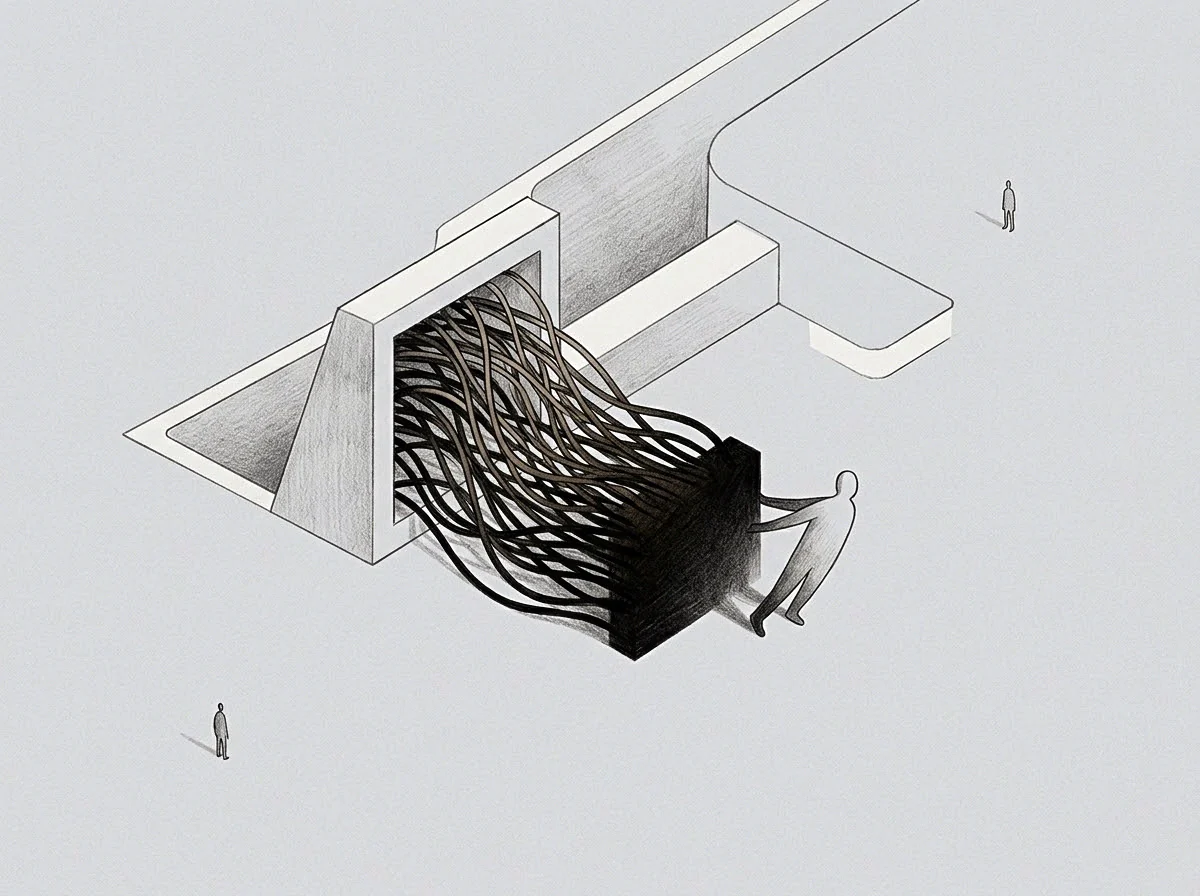
Derivation of Availability Through Channel Silence
Silence functions as a structural position within an asynchronous communications network. When a founder stops responding on a primary team channel, operational units immediately calculate the implied priority of their respective projects, using that priority to dictate channel routing.
A channel that stays quiet indicates low priority for both participants. High-frequency pings, by contrast, point to an unresolved allocation problem where incoming demand outstrips executive bandwidth.
Silence without a stated position causes downstream teams to infer priorities from random response patterns.
- Channel Silence establishes an unwritten priority ranking that downstream teams read to adjust submission frequency.
- Response Inversion occurs when minor routine approvals turn around quickly while critical strategic reviews stall in queue.
- Asynchronous Queueing transfers cognitive overhead from sender to receiver when response windows remain undefined.

Ping Arithmetic in Asynchronous Decision Architecture
Every incoming message imposes a cognitive switching penalty on the receiver. The cumulative burden of low-priority pings degrades deep decision capacity faster than occasional heavy strategic reviews. Because the threshold where silent channel decay permanently damages partner trust remains empirically unquantified across early-stage organizations, the operator establishes an explicit daily dispatch hour rather than testing channel endurance.
Because pings demand cognitive bandwidth and systems test unstated positions, an executive who accepts open-ended incoming pings permits external parties to dictate daily cognitive allocation.
The channel that generates frequent minor interruptions absorbs operational focus long before strategic priorities surface.
A founder states an explicit forty-eight-hour SLA for non-urgent internal reviews, resetting downstream ping frequency and establishing clear queueing behavior across all operational units.

Load
Continuous decision-making under high input volume triggers sustained physiological strain, raising neuroendocrine setpoints and reducing processing efficiency. The biological capacity of an individual operator sets the true boundary for system scaling.

Allostatic Setpoints and Throttling Boundaries
Allostatic load research resting on neuroendocrine markers under continuous decision pressure demonstrates that sustained cognitive over-allocation alters baseline stress reactivity; this finding holds unless future studies demonstrate co-regulation interventions that alter cortisol recovery slopes without changing decision volume. When executive capacity reaches baseline saturation, input processing degrades predictably: memory retrieval slows, risk aversion spikes, and complex synthesis breaks down into basic binary choices.
Internal state governs execution velocity, and capacity forms a hard ceiling. The physical seat demands biological recovery regardless of organizational objectives.
Throttling boundaries protect executive capacity by introducing deliberate frictional gates into the decision pipeline. Rather than processing incoming items sequentially until exhaustion sets in, explicit throttling rejects or delays inputs automatically based on pre-set structural criteria.

Does Stated Capacity Alter Executive Load?
Stating explicit capacity constraints alters how downstream units package requests before submission. When teams realize executive capacity is finite and bounded by explicit rules, they consolidate fragmented queries into structured decision memos.
| Evaluation Metric | Unstated Throttling Regime | Explicit Boundary Regime |
|---|---|---|
| Capacity Allocation | Reactive prioritization based on ping intensity | Pre-allocated blocks reserved for strategic execution |
| Latency Derivation | Inferred through variable, unpredictable delays | Calculated directly from published SLAs |
| System Stress Transfer | Absorbed continuously by executive neuroendocrine system | Transferred to structured operational queues |
| Boundary Enforcement | Enforced through executive exhaustion and failure | Enforced through automated triage rules |
When incoming demand exceeds the executive processing rate, unstated capacity limits convert incoming messages into unprioritized operational debt.
Failure to establish explicit throttling boundaries forces the executive system into reactive collapse, transferring structural friction directly onto partner relationships and critical execution threads.
Ledge
Operational barriers divide actions into distinct structural classes based on execution gating mechanisms. Certain operational tasks proceed through direct executive decision-making, while others remain strictly state-gated by baseline system capacity and physiological readiness.

State-Gated Decisions Versus Decision-Gated Execution
A decision-gated act requires only a deliberate choice to initiate execution, such as signing a contract or approving a budget. A state-gated act depends entirely on underlying cognitive headroom, emotional regulation, and deep focus reserves. No amount of conscious decision-making produces high-level strategic architecture when the executive system operates in advanced baseline depletion.
Cognitive switching cost findings resting on laboratory dual-task latency measurements indicate that context switches incur fixed processing overhead; this principle stands until field studies prove non-linear throughput restoration under asynchronous batch processing. Attempting state-gated work during acute cognitive depletion yields low-quality outputs that require future remediation.
- The founder identifies high-value state-gated tasks requiring uncorrupted cognitive capacity.
- Operational schedules isolate state-gated execution blocks from daily communication streams.
- Incoming operational decisions pass to secondary leadership through decision-gated delegation protocols.
- The organization enforces structural limits when executive state indicators drop below operational thresholds.

Structural Walls in the Operational Path
A stated limit functions as a wall within the organizational layout. Downstream teams push against the boundary, discover it does not yield, and redirect operational effort toward alternative solution paths. Structural terms replace personal intervention.
Because the wall receives the push and terms absorb organizational pressure, grounding a boundary in explicit structural terms rather than personal mood converts downstream friction into operational self-reliance.
A stated twenty-four-hour response latency term eliminates real-time monitoring expectations from external teams.
Which operational structures best allow downstream leaders to exercise delegated authority when the executive state-gate actively blocks incoming escalations?

Desk
An operator sitting at an operational workstation manages organizational velocity through the precise articulation of boundaries. Long-term systemic stability emerges when availability is treated as a calculated derivative of explicit operational position and defined cost structure.

The Single Stated Term
Stating terms clearly once eliminates the requirement for continuous defensive communication. A single explicit rule governing decision availability establishes a stable operational baseline across all operating departments.
While the seat retains accountability, operational clarity follows stated limits: an explicit term transfers the burden of operational scheduling from the founder to the requesting party.
When an executive declares a fixed weekly review window, external partners organize their preparations to align with that stated boundary. Availability becomes predictable because the underlying cost structure and time constraints are fully visible.

Transferring Load to Explicit Boundaries
Organizational scaling requires moving operational weight off individual human endurance and onto explicit structural parameters. The transition protects core executive capacity while enabling downstream units to execute with clear operational parameters.
Establishing clear boundaries transforms derived availability from an arbitrary source of frustration into a transparent operational protocol. Downstream actors calculate capacity accurately, respect structural limits, and optimize internal workflows around declared availability windows.
Operational capacity increases when availability is derived from explicit position rather than extracted through continuous interruption.