
Structural Term Mechanics For Defending Executive Energy
Executive energy preservation requires replacing personal self-regulation with explicit operational terms that absorb incoming capacity demands structurally.

Floor
Four communication threads sit open on a desktop screen at midnight on a day when executive capacity reached ceiling by mid-afternoon. A partner asks for immediate input on an operational hire; an investor requests an unscheduled sync on quarterly cash allocation; two senior operators submit opposing operational choices for resolution. The person in the seat answers all four within twenty minutes, treating promptness as operational discipline.
The counterparty reads that rapid response as high baseline availability and immediately submits three more requests before morning. The operational load expands to fill the capacity offered, moving directly into the executive setpoint. System capacity declines while incoming volume accelerates.
Personal effort functions as an elastic buffer when structural terms are absent. Stress physiology establishes that human core regulation operates as an allostatic system, adjusting physiological setpoints under sustained environmental demand. When a load-transferring system encounters an executive who absorbs incoming strain through personal effort, the system pushes continuously until it encounters a rigid boundary.
A human regulator who attempts to hold operational boundaries through mood, willpower, or interpersonal persuasion eventually fails under volume. The counterparty does not perceive personal fatigue as a system boundary; the counterparty perceives responsiveness as a live invitation.
When structural terms remain unstated, external operational systems default to maximum capacity consumption.
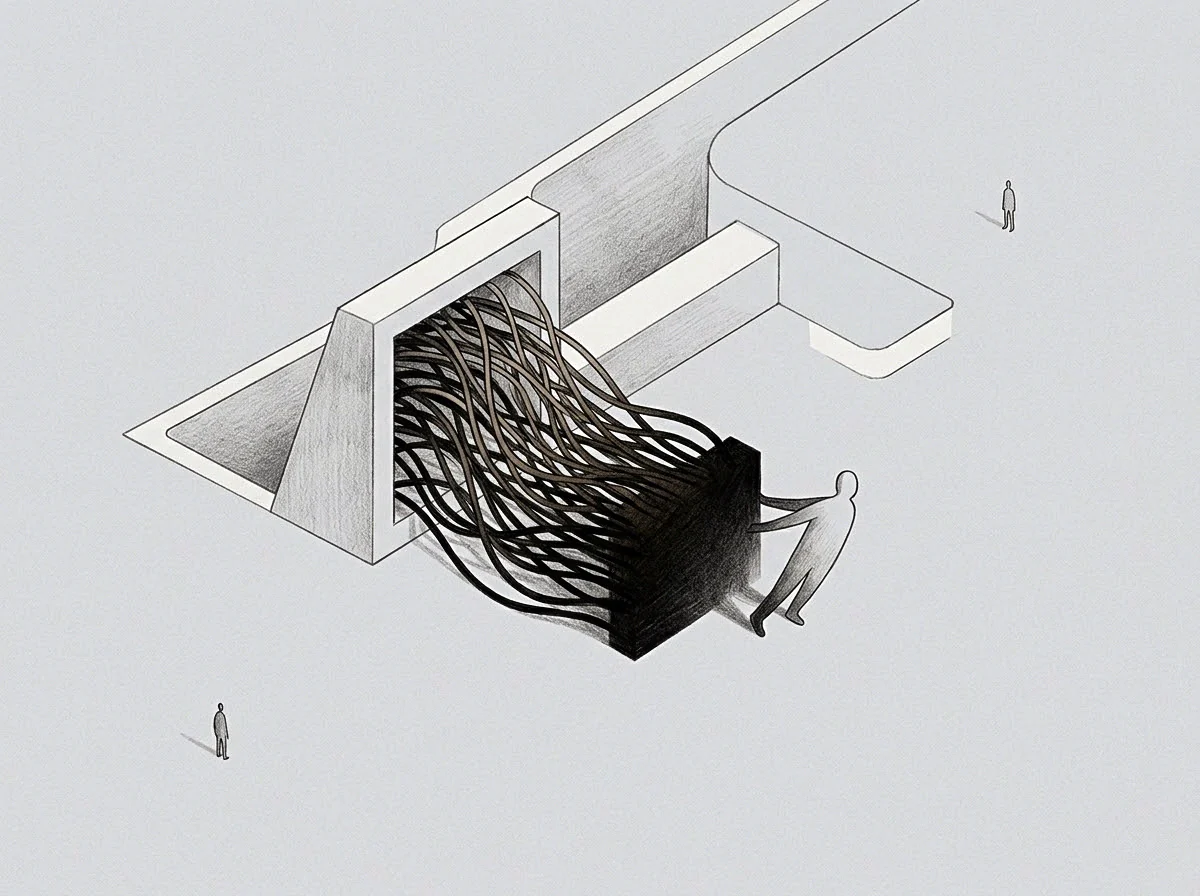
Structural terms function as physical obstacles within operational governance. A term is a pre-defined, non-negotiable parameter that governs response windows, decision rights, and availability allocations without requiring real-time personal enforcement. When a limit takes the form of an explicit operational term, the load-transferring system encounters a wall rather than a person.
The cost of enforcing the boundary shifts from internal emotional expenditure to standard contractual compliance. The executive setpoint remains protected because the term absorbs the push before the personal system engages.
Failing to establish structural terms forces the founder to pay for system elasticity entirely out of internal biological reserve, eroding decision capacity until simple operational choices trigger acute cognitive fatigue.
Position

State Against Mood
Executive performance relies on the precise distinction between internal state and observable mood. State represents the functional transfer function of the cognitive system, determining how incoming operational inputs translate into qualitative output. Variables defining state include working memory headroom, active cognitive loops, acute systemic load, and structural capacity allocation.
Mood acts merely as an informational side-effect, providing no structural feedback to external systems. Operational choices remain strictly state-gated; attempting to execute complex strategic decisions when state capacity sits at zero produces compounding systemic failure.
Counterparties routinely misinterpret stable executive mood as available capacity. When an owner maintains a calm demeanor, operational partners infer high capacity and transfer unallocated tasks directly onto the leader’s desk. Decision-gated acts, such as approving standard vendor contracts, require minimal state capacity and proceed regardless of systemic load.
State-gated acts, including structural resource allocation and strategic pivot evaluation, demand deep cognitive headroom. Attempting state-gated work during depleted setpoints degrades output quality while accelerating biological burn.
Unstated capacity limits convert incoming operational load directly into structural setpoint exhaustion.

Failure Modes of Unstated Boundaries
Relying on informal personal requests to protect operational capacity exposes the executive to predictable organizational failure modes. The following operational breakdowns recur when structural terms fail to anchor executive position:
- Covert Capacity Contracts occur when an executive assumes counterparties understand internal load levels without formal operational terms, generating friction when unspoken thresholds are inevitably crossed.
- Mood-Dependent Defenses arise when an owner relies on visible frustration or deliberate unavailability to signal capacity limits, forcing the organization to guess operational boundaries through interpersonal volatility.
- Reactive Throttling occurs when an executive abruptly halts communication after reaching severe capacity exhaustion, transforming predictable operational cadence into chaotic organizational silence.
- Load Siphoning takes place when adjacent team leaders push unresolved operational friction upward, utilizing executive energy as a substitute for clear internal team protocols.
Establishing an explicit 90-day response SLA clause in key partnership agreements converts subjective availability into a fixed contractual parameter.

Table

Structural Terms Compared
Consider an operational scenario involving two founding teams navigating rapid corporate expansion over a twelve-month period. Both organizations face identical market volatility, incoming partner inquiries, and board oversight demands. The first founding team operates without explicit structural term protection, defending executive capacity through real-time personal negotiation and calendar management.
The second founding team embeds concrete structural terms directly into governance documents, investor rights agreements, and operational communications protocols. The operational differences between these two structural postures reveal how terms dictate long-term capacity retention.
| Operational Criterion | Personal Boundary Defense Model | Structural Term Defense Model |
|---|---|---|
| Load Transfer Destination | Directly into executive biology and off-hours reserves | Onto standardized organizational SLA windows and protocols |
| Derivation Speed | Slow, requiring repeated interpersonal friction and enforcement | Immediate, governed by explicit contractual parameters |
| Counterparty Friction | High interpersonal tension attributed to executive mood | Low relational friction attributed to system mechanics |
| State Headroom Preservation | Variable, collapsing during acute operational surges | Constant, anchored by hard availability caps |
| Execution Reliability | Degrades as cognitive setpoint load accumulates | Remains baseline-stable through state-gated protection |
In the first arrangement, incoming requests land immediately on the founder’s personal device, requiring real-time evaluation of urgency and priority. The founder spends significant energy deciding whether to decline requests, generating internal guilt and external dissatisfaction. The absence of structural terms forces counterparties to test boundaries repeatedly, treating every refusal as a temporary mood state that can be negotiated down through persistent messaging.
The second arrangement establishes a strict operational architecture. Partner inquiries route through a standardized batching mechanism with a contractually specified 48-hour evaluation latency window. Investors access operational metrics through a asynchronous dashboard updated on fixed monthly schedules rather than requesting real-time updates.
When an unscheduled request arrives, operational staff cite the governance terms directly, insulating the executive setpoint entirely from immediate incoming strain.
A partner operating under personal boundary defenses typically reports that reaching the executive requires only finding the correct channel and increasing message urgency.

Ping

Signal Mechanics and Priority Derivation
The communication ping serves as the primary priority signal across organizational networks. Counterparties utilize pings to probe availability, test system latency, and transfer active cognitive load onto adjacent nodes. When an executive responds to an incoming ping instantly, the recipient learns that the channel carries zero friction.
The derivation is immediate: the executive holds open setpoint headroom ready for immediate external consumption. The channel that pings continuously becomes the default destination for unresolved operational complexity.
Silence operates as an authoritative structural position when anchored by pre-stated terms. In the absence of stated terms, silence registers to counterparties as personal rejection, systemic incompetence, or relational withdrawal. When concrete terms define response windows in advance, silence translates into expected system latency.
The counterparty reads the unanswering channel not as a broken relationship, but as an operational machine operating within designated tolerance bands. The derivation shifts from personal judgment to structural expectation.
Silence without a pre-stated term reads as rejection, while silence behind a stated term reads as system latency.

Where Does Unthrottled Availability Shift Load?
Unthrottled availability shifts operational friction directly away from the sender and places it entirely on the receiver. The sender clears an active cognitive loop by transmitting an unvetted inquiry across the network, instantly externalizing the work of structuring, prioritizing, and resolving the underlying issue. The receiver absorbs the raw cognitive fragment, forcing internal setpoint reallocation to process input that should have been resolved at lower organizational layers.
Defending executive state requires implementing explicit structural throttling protocols across all primary communication vectors:
- Establish asynchronous batching windows that consolidate incoming operational inquiries into fixed, daily processing periods.
- Mandate complete written problem framing from counterparties prior to allocating real-time sync windows on executive calendars.
- Define explicit channel routing rules that restrict direct executive messaging to critical tier-one operational emergencies.
Will an organization adapt its operational cadence when an executive systematically doubles communication response latency?

Ledge
Protecting executive energy over sustained operational horizons requires shifting from internal self-regulation to the rigorous application of structural terms. Biological systems are fundamentally unsuited to serve as continuous shock absorbers for expanding organizational complexity. The leader who attempts to protect focus through sheer force of will eventually suffers severe capacity degradation, compromising both personal health and strategic execution quality.
Structural terms provide the mechanical scaffolding necessary to decouple operational scale from biological depletion.
Terms function effectively because they alter the fundamental economics of counterparty interaction. When an owner defines clear latency windows, explicit decision rights, and structured availability protocols, the organization learns to resolve operational friction internally rather than escalating raw problems upward. The cost of initial problem formulation shifts back to the originating party, building broader organizational competence while insulating executive state headroom.
The firm develops operational resilience precisely because the executive seat stops absorbing systemic inefficiencies through personal exertion.
Structural terms convert executive availability from a personal concession into a predictable systemic resource.
Implementing these mechanics requires an upfront willingness to tolerate brief counterparty friction during initial term deployment. External actors accustomed to unlimited executive access initially push against newly introduced operational walls. When terms hold consistently without personal apology or mood volatility, counterparties recalibrate their expectations to match the new structural baseline.
The executive setpoint stabilizes, operational capacity recovers, and the seat regains the deep cognitive headroom required for high-stakes leadership execution.
The long-term defense of executive capacity rests on stating terms clearly, enforcing them structurally, and allowing availability to be derived entirely through system mechanics.