
Structural Term Partitioning for Overloaded Early Stage Leadership Groups
Structural term partitioning converts founder coregulation into explicit domain boundaries, protecting cognitive capacity by routing load onto defined operational objects.

Board
At midnight, active threads run across four separate channels while executive capacity is already exhausted. A partner sends over updated financial models just as the engineering lead asks for an immediate call on infrastructure spend. Answering both within minutes gives the impression of unlimited availability, but it relies entirely on one person absorbing operational shock through physical stamina.
When an executive team works without explicit terms, incoming demands land directly on individuals instead of structural filters. In the absence of a procedural barrier, every incoming ping turns into an immediate obligation.
Early-stage leadership teams accumulate heavy physiological strain whenever structural partitions are missing. The group relies on individual stamina to absorb surges in volume, an approach that breaks down as concurrency builds. When three escalations hit in the same hour, whoever acts as the primary shock absorber burns through cognitive bandwidth in minutes.
Without explicit limits on response latency and decision thresholds, teams default to uninterrupted access until someone breaks down or pulls away.
Silence in an unmonitored channel indicates a stated position rather than an operational failure.

The Friction of Unstated Capacity
Unspoken agreements create invisible friction inside young executive teams. Keeping roles fluid long after launch forces leadership to negotiate every unexpected task in real time. A founder who steps in as the default backstop draws constant pressure from the organization.
Colleague behavior here is rarely driven by bad intent; people push simply because the structure offers no objective boundary to push against.
Explicit terms establish that boundary. They set who owns specific operational friction, define escalation triggers, and lay out the trade-offs that take effect when attention reaches capacity. Lacking these definitions, leadership teams spend emotional energy trying to regulate what structure ought to handle.
The operational cost shows up as chronic fatigue and postponed strategic work.

Operational Pressure as a Transfer Function
Any load-transferring system routes pressure toward the point of lowest structural resistance. In early leadership groups, that point is routinely the founder who avoids setting firm availability parameters. As operational volume climbs, missing boundaries guarantee that executive focus scatters across routine tactical fires.
Setting up explicit operational partitions pushes responsibility back to defined processes and delegated roles. The shift moves an organization away from reactive buffering toward deliberate execution, protecting executive attention for critical strategic choices.
When a leadership group fails to set clear operational terms, it inevitably absorbs organizational turbulence through physical exhaustion.
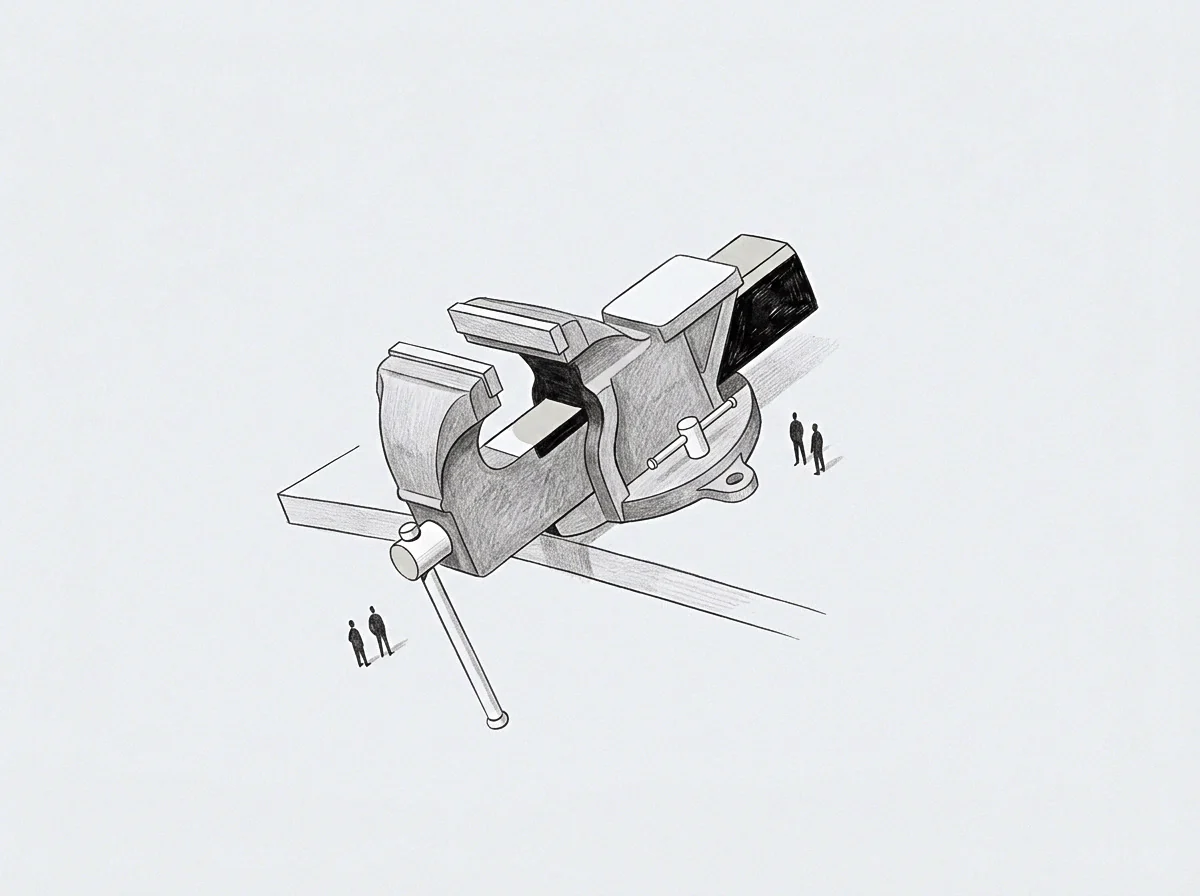
Split
Dividing executive responsibilities into distinct functional areas prevents operational overlap when pressure mounts. Early on, co-founders often hold shared authority across product, finance, and hiring. That ambiguity causes drag as concurrency increases.
Formal divisions give individual leaders full ownership of specific decisions, cutting out the need for collective consensus on everyday issues.
Clear partitions function as hard firewalls. During an infrastructure failure, the engineering lead allocates resources without checking in with commercial leads. Drawing clean lines isolates operational shocks, ensuring a disruption in one area does not consume the attention of the whole executive bench.

Partitioning Operational Decision Rights
Partitioning decision rights requires sorting choices by domain, spend size, and actual urgency. Without clear divisions, leadership groups fall back on group consensus, a habit that stalls progress under heavy load. Distributing domains clearly keeps mundane questions from drifting upward to the executive layer.
These boundaries must be visible across the entire company. When staff understand precisely which leader owns a given domain, lateral escalations drop off. Clear boundaries safeguard executive focus while anchoring accountability across every operational branch.
- Execution Throttling occurs when domain authority remains shared, forcing routine decisions into extended review loops during high-volume periods.
- Scope Spillover develops when an overloaded leader intervenes in adjacent functional areas due to ambiguous boundary definitions.
- Asymmetric Coregulation emerges when one founder repeatedly absorbs operational turbulence generated by an unpartitioned sibling department.
- Decision Latency Decay reflects the systemic slowdown caused by unclear authorization limits across executive roles.
Partitioning operational authority protects executive headroom only when domain ownership remains non-negotiable under load.

Structural Limits Replace Interpersonal Negotiation
Relying on daily communication to divide up workload collapses during sudden surges. Structural partitions provide fixed rules for managing workflow, removing the need for daily interpersonal bargaining. Stated terms establish the precise conditions for executive escalation, turning informal assumptions into operational protocols.
Once operational volume crosses set thresholds, the organization triggers predefined fallbacks instead of asking overwhelmed founders to step in. That insulation cuts down baseline operational distraction, keeping executive involvement deliberate and focused.
Explicit terms confine executive involvement to pre-budgeted limits, delegating secondary questions directly to functional leads.

Cost
Neglecting structural terms exacts measurable costs across physiological, operational, and financial lines. Sustained physiological strain erodes working memory and distorts risk assessment. Operationally, unpartitioned organizations hit severe bottlenecks because every problem competes for the same small pool of executive attention.
Financially, the dynamic yields misallocated budgets, staff departures, and stalled releases.
The attention cost of continuous availability stays hidden until costly missteps occur. Acting as an informal buffer for organizational friction buys immediate calm at the expense of strategic perspective, an exchange that yields diminishing returns as operations grow more complex.

How Does Concurrency Limit Executive Capacity?
Human attention operates under strict neurological concurrency limits. Attempting to guide high-level direction while answering urgent operational escalations burns up to forty percent of effective cognitive capacity on switching costs alone. Constant oscillation between broad strategic synthesis and immediate problem-solving accelerates mental exhaustion.
Partitioning preserves cognitive capacity by fencing off separate functional streams. Limiting incoming operational demands leaves the focus required for high-consequence choices intact. Managing high concurrency without structural barriers leads directly to operational breakdown.
| Regulation Variable | Unpartitioned Coregulation | Partitioned Term Regulation |
|---|---|---|
| Primary Regulation Mechanism | Interpersonal buffering and individual strain | Explicit structural boundaries and stated terms |
| Decision Rights Allocation | Fluid, consensus-driven, ambiguous | Domain-isolated, delegated, explicit |
| Operational Escalation Path | Direct to founder via continuous channels | Filtered through stated threshold metrics |
| Attentional Latency Overhead | High switching cost, continuous interruption | Low switching cost, batched review windows |

Quantifying the Mechanics of Allostatic Overload
Prolonged operational pressure forces the nervous system outside ordinary recovery baselines. Physiological research shows that extended periods in high-demand environments without reliable rest create cumulative physical strain. Inside executive teams, this state undermines emotional stability and drives irrational risk aversion.
A term stated once costs less attention than a year of continuous interpersonal coregulation.
Clear operational partitions serve as a practical defense against physical overload. By outlining precise boundaries for availability, authority, and team handoffs, an organization lowers the chronic stress placed on its leadership. Protecting executive health translates directly into more stable, sustained company performance.
An executive operating at mental exhaustion delivers worse decisions than a simple, process-gated system.

Cord
Communication channels act as the physical tether between executive attention and routine operations. When structures are undefined, notification feeds flood leadership with status chatter, low-stakes questions, and sudden escalations. The endless stream of pings fractures concentration while conditioning the company to expect instantaneous intervention.
Controlling notification volume requires genuine channel discipline and published response windows.
A quiet channel reflects operational efficiency, not neglect. Reserving high-priority alerts for genuine emergencies allows leadership to regain control over its time. The channel that stays silent creates room for focused strategic work.

Ping Arithmetic and Priority Signals
Every notification exacts a direct attentional tax. When an executive handles fifty unsorted pings a day, the simple effort of triaging their urgency drains reserve capacity. Interruption cost multiplies quickly: each disruption requires a full cycle of recovery time before a person returns to deep focus.
Structural partitioning sorts channels by domain and real urgency. Routine updates shift to scheduled asynchronous batches, while urgent channels remain tightly governed by clear escalation rules. This arrangement significantly lowers the daily count of interruptions.
- Audit all incoming communication channels to establish baseline notification volume across executive roles.
- Define explicit escalation criteria that restrict immediate notification channels to critical operational failures.
- Migrate routine status updates and non-urgent decision requests to scheduled asynchronous review windows.
- Enforce strict channel adherence by refusing to answer non-critical inquiries delivered through high-priority pathways.

Deriving Availability from Stated Position
Availability should follow directly from stated policy rather than being negotiated on demand. When leadership explicitly publishes focus blocks and offline hours, teams adapt their expectations accordingly. Stating these limits in advance removes the ambiguity that drives repeated follow-up messages.
The stated boundary establishes the frame, and the team’s subsequent adjustment proves whether it works. Holding firm to availability limits forces the broader organization to resolve problems earlier in the reporting chain, creating genuine institutional resilience.
Staff accept delayed replies without friction once explicit operating windows govern leadership availability.
State
Operational execution depends on the internal baseline of the leadership group. Mental state governs how incoming problems are processed into decisions. When leadership operates under chronic sleep loss, sustained physical stress, or endless interruption, even standard challenges produce erratic choices and defensive reactions.
Mood fluctuates day to day, but baseline state governs total operational capacity.
Distinguishing state-gated tasks from decision-gated tasks offers a straightforward method for managing load. Consequential decisions require clear cognitive baselines; attempting to resolve them while exhausted invites major errors. Organizing priorities around state capacity protects high-stakes initiatives from mental fatigue.

State-Gated Acts Versus Decision-Gated Execution
A decision-gated task can be pushed through on routine effort alone, like approving regular expense filings or answering logistical emails. A state-gated task, by contrast, demands sustained focus, emotional balance, and careful synthesis. Evaluating a major pivot, hiring key senior personnel, or running investor negotiations all fall into this category.
Committing to a state-gated decision under deep fatigue creates compounding structural risk.
Leadership teams need clear rules that pause state-gated decisions whenever executive capacity drops below baseline. Forcing through major strategic choices while exhausted consistently produces flawed outcomes that take months to correct.
Executive action taken below baseline cognitive setpoints creates structural debt across the entire organization.

Sustaining Boundary Partitioning Under High Load
Holding structural boundaries is hardest when pressure peaks. During emergencies, early-stage executives feel a strong urge to scrap stated terms and step back into direct operational firefighting. Collapsing back into informal triage strips autonomy from the team and immediately drains executive focus.
Sustaining boundaries under stress requires discipline around established protocols. When organizational pressure spikes, leadership needs to rely on structural partitions and delegated authority to absorb the impact. Holding boundaries through moments of friction builds long-term operational resilience and ensures organizational stability.
What structural mechanism prevents an overloaded leadership group from abandoning stated terms during an acute capital crisis?