
Measuring Prefrontal Loop Saturation in Active Executive Seats
Prefrontal loop saturation occurs when active executive working memory slots fill with ungated operational threads, throttling cognitive performance.

Volume
Active operational roles place continuous demands on the dorso-lateral prefrontal cortex, which maintains goal-directed attention and holds active variables across competing tasks. Executive seats require the simultaneous processing of strategic direction, immediate personnel decisions, capital allocation, and risk management. Each unresolved operational item functions as an active prefrontal loop, occupying cognitive real estate within working memory until resolved, delegated, or explicitly parked.
When unresolved operational items exceed individual processing capacity, the prefrontal cortex reaches saturation. This condition differs fundamentally from emotional burnout or primary affective disorders. Clinical depression presents with pervasive anhedonia, emotional blunting, and a generalised lack of drive across all life domains.
In contrast, prefrontal loop saturation shows up as severe localized cognitive throttling in an individual who remains highly motivated, deeply engaged, and acutely aware of operational demands. The saturated regulator retains high task motivation but loses the cognitive headroom needed to process incoming novel information or shift context cleanly between active threads.

Prefrontal Processing and Maintenance
The human brain maintains working memory items through sustained neuronal firing patterns across prefrontal networks. Laboratory paradigms examining lateral prefrontal activity during dual-task execution demonstrate that working memory maintains an active ceiling of approximately three to four concurrent complex variables. Beyond this threshold, adding further active threads creates immediate interference.
This research rests on functional neuroimaging during N-back tasks and dual-task paradigms across high-cognitive-load cohorts. The finding would face challenge if longitudinal imaging proved that chronic executive exposure expands baseline working memory slot capacity without increasing metabolic strain.
Measuring loop saturation relies on operational observables rather than subjective internal states. The earliest indicators appear in working memory allocation patterns, processing delays on simple decisions, and degraded mental context switching. An executive operating at saturation exhibits normal or elevated performance on highly structured, familiar tasks while experiencing acute paralysis when presented with unstructured, open-ended decisions.
When active working memory slots remain occupied by unresolved operational threads, executive speed drops regardless of baseline cognitive capacity.
The distinction between throttling and failure carries severe operational consequences. Misinterpreting prefrontal saturation as clinical executive dysfunction leads organisations to prescribe rest, psychological interventions, or reduced responsibility, none of which alter the underlying ungated loop count. When the saturated individual returns to an identical system state containing dozens of un-gated open threads, saturation re-emerges immediately, compounding cognitive fatigue with institutional confusion.

Desk
Physical environments mirror internal prefrontal architecture, where open correspondence, pending approvals, and unresolved notifications act as persistent external pings. Every un-gated thread left open in digital or physical workspaces requires passive monitoring. The prefrontal cortex allocates continuous background attention to track these items, treating every unresolved inquiry as a potential priority override.
The accumulation of ungated threads consumes available slots sequentially. A slot occupied by a pending decision cannot process new incoming operational telemetry. As open loops multiply, the cognitive headroom necessary to evaluate strategic trade-offs shrinks, manifesting as elevated cognitive friction during routine tasks.
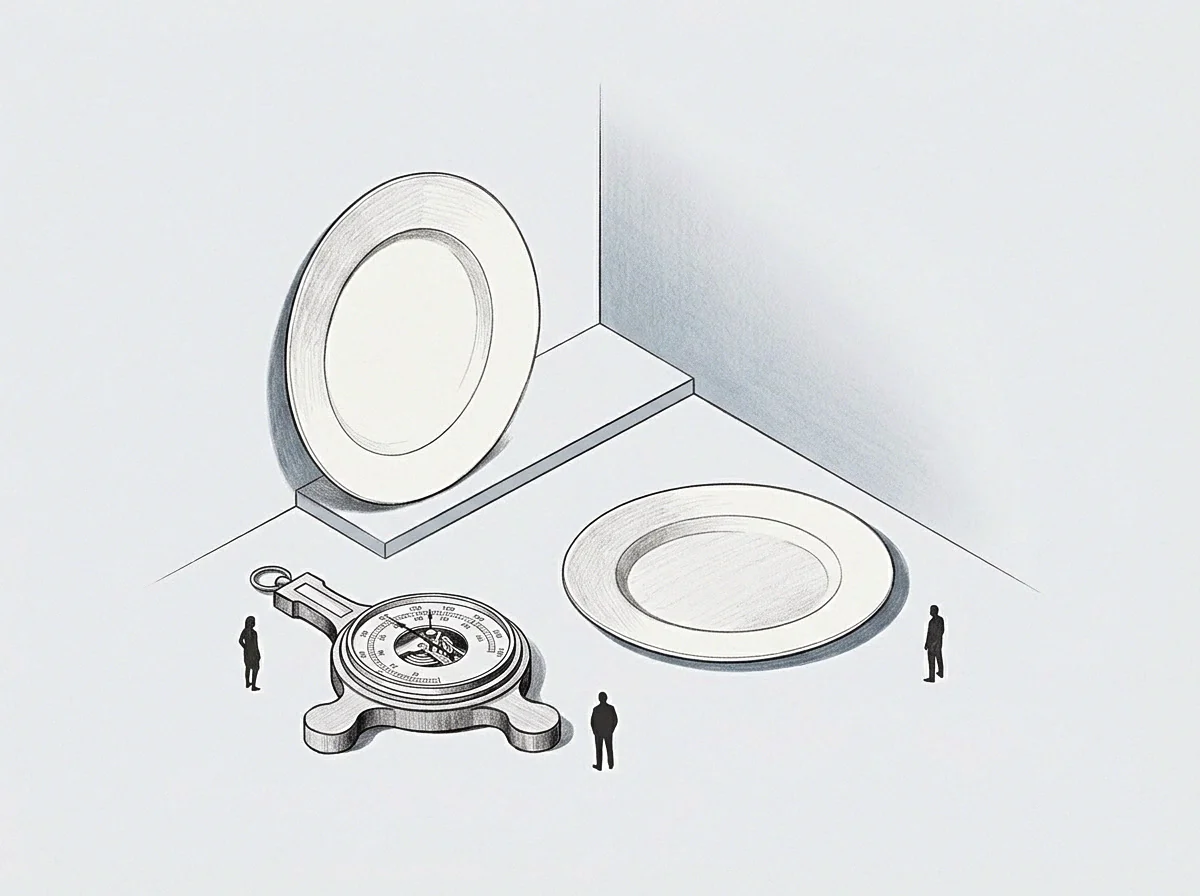
Occupied Slots in Daily Operation
Open loops enter executive working memory through four primary operational categories:
- Uncertain commitment deadlines where project completion timelines lack explicit verification points, causing continuous background status checking.
- Unresolved inter-party conflicts where interpersonal tension or misaligned expectations linger without scheduled mediation sessions.
- Unbounded monitoring demands where real-time communications channels remain continuously active without designated silence windows.
- Ambiguous delegation terms where tasks assigned to sub-ordinates lack explicit completion conditions, compelling frequent supervisory checks.
Every ungated loop consumes cognitive resources continuously. Total mental strain equals the number of active threads multiplied by the monitoring frequency required for each item. When incoming ping volume rises alongside thread accumulation, switching penalties compound rapidly.
An open thread with no fixed review date consumes as much active capacity as a live crisis.
Structural mitigation begins by identifying every active open loop and applying formal bounding terms. Applying an explicit term containing defined scope parameters, an evaluation date, and clear delivery criteria converts an ungated open loop into a dormant scheduled event, instantly restoring occupied prefrontal capacity to active working memory.

Triage
Evaluating cognitive strain requires concrete metrics to differentiate capacity overload from secondary symptoms. Measuring prefrontal saturation involves assessing incoming ping rates, current ungated loop inventories, and active decision latency. When incoming operational requests arrive faster than prefrontal processing can clear existing threads, the system enters an unsustainable queue-building state.
Monitoring physiological markers provides complementary empirical validation. Autonomic nervous system research demonstrates that sustained prefrontal exertion suppresses parasympathetic tone, observable via reduced resting vagal tone and diminished high-frequency heart rate variability. These physiological measurements rest on continuous ambulatory electrocardiography across executive populations under sustained operational strain.
The diagnostic model would require revision if non-invasive autonomic markers proved un-correlated with objective working memory slot exhaustion under real-time cognitive stress testing.

Is Loop Saturation Readily Distinguishable From Low Motivation?
Disentangling cognitive throttling from reduced motivation requires comparing system behavior under structured versus unstructured operational demands. The saturated regulator retains full functional capacity when executing pre-scripted, single-variable tasks but demonstrates severe processing degradation when forced to evaluate complex, open-ended operational choices. Clinical depressive states demonstrate uniform performance degradation across both structured and unstructured domains.
| Operational Criterion | Prefrontal Saturation State | Depressive Regulatory Failure |
|---|---|---|
| Task Motivation | Elevated or preserved task drive | Pervasive reduction in task drive |
| Structured Execution | High accuracy on routine tasks | Impaired execution across all tasks |
| Unstructured Decisions | Severe processing delay or lock | General aversion to initiation |
| Response to Incoming Pings | Irritation driven by slot exhaustion | Withdrawal or complete non-response |
| Recovery Trajectory | Rapid clearance upon thread closure | Slow resolution requiring therapeutic intervention |
Measurement precedes intervention because capacity drops under load and every open loop costs focus; establishing structural limits protects processing headroom when the desk absorbs weight.
Clear scope definitions free prefrontal working memory slots instantly without changing the underlying work load.
Effective operational management treats prefrontal capacity as a finite physical quantity, where adding new strategic initiatives mandates the explicit parking or closure of existing open threads.

Gate
Converting open loops into managed processes prevents systemic prefrontal saturation. Thread gating establishes structural barriers between inbound operational noise and active working memory slots. By enforcing explicit intake parameters, executive seats protect internal processing capacity from continuous external interruption.
High-density operational sectors outside corporate management use physical and structural constraints to manage cognitive saturation. Analog air traffic control operations utilize physical flight progress strips passed across sector desks to track aircraft transitions. The physical strip represents a bounded thread: when handed off to an adjacent controller, the sending controller clears the mental tracking slot completely, trusting the physical system to enforce continuity.

Structuring Operational Thread Boundaries
Implementing thread gating requires converting informal communications into structured operational commits through a four-stage process.
- Define explicit scope parameters for every inbound assignment to prevent task creep.
- Assign an exact date for progress evaluation, removing the need for passive monitoring.
- State clear criteria for task completion to eliminate ambiguous handoffs.
- Transfer tracking responsibilities to a non-active system outside working memory.
Gating protocols reduce the mental overhead of continuous monitoring. Un-gated loops remain open and drain capacity until explicit terms establish boundaries and stop arriving signals.
A critical question remains unanswered in operational practice: what structural limit determines the maximum duration an executive seat can operate at eighty percent slot capacity before permanent autonomic baseline shift occurs?

Transfer
Regulators operating at prefrontal ceiling inevitably export internal strain into surrounding organizational systems. When an active seat lacks headroom, interpersonal communication becomes truncated, decision-making turns reactive, and the capacity to assist co-workers with emotional or cognitive regulation vanishes. Surrounding team members adjust by absorbing un-processed operational complexity, elevating overall team wear.
Co-regulation theory demonstrates that individuals in proximity rely on stable leaders to anchor systemic emotional and cognitive balance. When the central seat operates in a state of continuous throttling, team members lose this core regulatory anchor. The resulting ambiguity forces sub-ordinates to spend additional prefrontal resources interpreting muted signals, escalating secondary cognitive load throughout the enterprise.

Relational Strain and Co-Regulation
The exact decay rate of prefrontal loop load following an explicit verbal commitment compared to a written system entry remains un-quantified within current operational literature. Practicing managers operate under uncertainty regarding whether verbal alignment offers equivalent cognitive relief to formal digital tracking. In the presence of this empirical gap, cautious operators default to written tracking logs, guaranteeing that open loop variables leave active working memory completely.
A regulator operating at full capacity transfers regulatory strain directly to surrounding team members.
Because high load alters perception, clearing ungated loops through systematic gating and slot management restores relational stability to surrounding operational layers. The seat recovers headroom, processing latency declines, and the organizational system restores its baseline decision velocity.