
Measuring Temporal Discounting In High Stress Executive Decisions
Acute allostatic load elevates executive temporal discounting by downregulating prefrontal networks, compressing choice horizons to immediate homeostatic survival.

Window
Trait discount rates reflect an individual baseline preference for immediate relative to delayed financial returns under resting conditions. When high-stress executive decisions emerge, acute physiological arousal fundamentally alters this calculation. The mathematical formulation of temporal discounting models value loss over time through hyperbolic decay functions.
In these models, the present value of a delayed payout drops as the delay increases, driven by a specific discounting parameter. Baseline measurements capture this parameter under calm operational settings. Under severe acute stress, the discount parameter increases rapidly, causing a sharp contraction in the executive temporal horizon.
The discount parameter scales rapidly. Present value collapses. Delayed returns lose weight.
Under elevated autonomic pressure, an executive evaluating capital deployment options shifts focus toward immediate liquidity over multi-year enterprise value. This change is state-dependent rather than a structural flaw in strategic capability. The neurobiological system under acute load prioritizes immediate homeostatic preservation.
Immediate payouts take priority. Stress narrows cognitive horizon. Measuring this shift demands separating steady-state discount curves from stress-induced discount spikes.
Misinterpreting acute discount spikes as permanent shifts in risk appetite leads organizations to misallocate capital and over-correct incentive structures during operational crises.

Board
Quantifying changes in temporal discounting involves isolating psychological strain from baseline risk aversion. Laboratory environments evaluate this phenomenon through indifference point mapping, where subjects choose between smaller immediate rewards and larger delayed rewards across titrated timeframes. Translating these behavioral measurements to high-stakes executive contexts requires monitoring operational proxies alongside physiological markers.

Titrated Behavioral Paradigms and Proxy Metrics
Measuring executive temporal preferences presents explicit trade-offs between immediate smaller rewards and delayed larger payouts. Titrated monetary choice tasks alter decision variables until an indifference point is located. In executive environments, direct behavioral titration is supplemented by tracking real-time corporate allocation shifts.
Accelerated liquidations, high-yield short-term debt acquisitions, and deferred capital expenditure serve as structural proxies for elevated discount parameters.
Elevated salivary alpha-amylase during crisis decision cycles correlates with a three-fold increase in the hyperbolic discount parameter k.
Physiological tracking provides continuous data during active strategic decisions. Heart rate variability metrics, specifically vagal tone suppression, indicate reduced prefrontal neural control and correspond directly with steepened discount curves. Combining biometric readings with capital deployment tracking enables real-time auditing of state-dependent temporal compression.
| Measurement Modality | Temporal Granularity | Ecological Validity | Stress Sensitivity | Implementation Cost |
|---|---|---|---|---|
| Titrated Choice Paradigms | High | Moderate | High | Low |
| Vagal Tone Autonomic Tracking | Continuous | High | Extreme | Moderate |
| Capital Allocation Audits | Low | Extreme | Moderate | High |
Applying a temporal adjustment clause to executive decision mandates freezes major asset sales whenever continuous physiological indicators confirm a state-dependent discount spike.

Strain
Neurobiological research links acute stress activation directly to prefrontal cortex suppression. The human brain manages trade-offs through two primary neural systems: model-based deliberative networks centered in the prefrontal cortex and model-free habitual networks grounded in the striatum. High allostatic load triggers a rapid neurochemical shift that alters neural network dominance.

How Does Autonomic Arousal Compress Temporal Horizons?
Sympathetic nervous system dominant states flood neural circuits with catecholamines and glucocorticoids. Elevated systemic cortisol impairs top-down executive functioning while enhancing reflex-driven striatal processing. Consequently, the brain’s internal modeling of future states degrades, reducing multi-year strategic projections to short-term immediate considerations.
- Sympathetic nervous system activation triggers elevated cortisol and salivary alpha-amylase levels.
- Prefrontal executive control networks undergo acute functional downregulation.
- Striatal model-free decision structures assume dominance over model-based temporal planning.
- The effective time horizon collapses from years to immediate operational hours.
When open operational loops exceed processing capacity, executive evaluation defaults to immediate loss minimization.
Vagal tone drops sharply. Cortisol reshapes priority. Dynamic cognitive load accelerates temporal erosion.
Reflexive processing replaces deliberation. Cognitive capacity limits temporal depth. As open operational loops consume finite processing bandwidth, the executive brain sacrifices future option value to relieve immediate cognitive throttling.
It remains uncertain whether individual resilience to state-induced discounting stems from genetics, chronic exposure, or pre-existing regulatory mechanisms.

Gate
Counteracting acute temporal discounting relies on governance structures designed to bypass real-time executive volition. Choice architecture in high-stress environments must enforce temporal distance between crisis identification and final capital execution.

Structural Precommitment and Horizon Preservation
Institutional guardrails restrict short-term liquidations by forcing strategic choices through predetermined temporal buffers. Pre-commitment contracts lock in long-term allocations before acute stress events materialize, removing real-time discounting spikes from the operational loop.
A decision protocol defined before acute pressure protects temporal range far better than real-time willpower.
Pre-commitments bound future choice. Temporal buffers restore balance. Crisis accelerates systemic wear.
Implementing explicit governance constraints ensures strategic choices remain anchored to baseline valuation models.
- Pre-committed allocation thresholds fix maximum short-term liquidity sacrifices prior to crisis emergence.
- Asynchronous approval delays enforce a time buffer between evaluation and execution.
- External decision proxies transfer capital authorization to non-stressed governance committees.
The executive team appears focused exclusively on quarterly cash survival while sacrificing three years of developed technical advantage.

Span
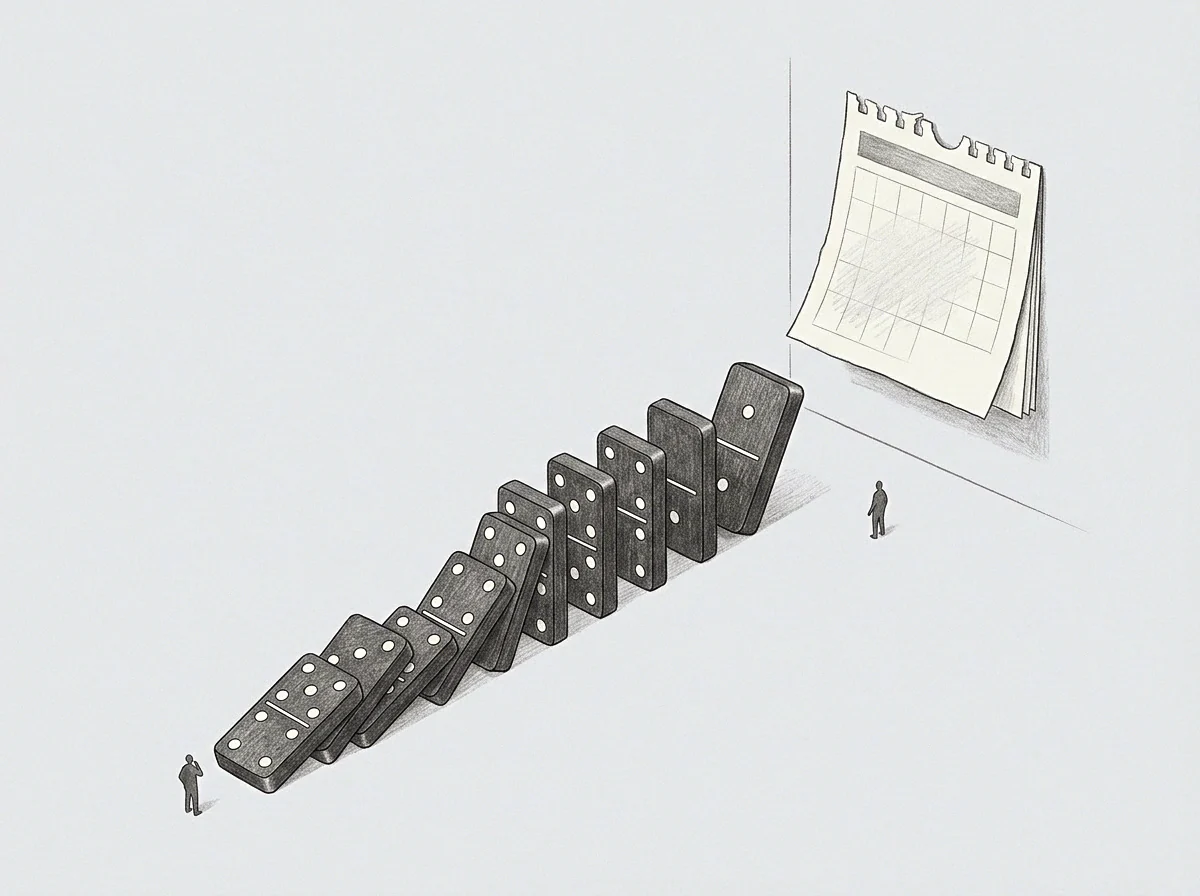
Repeated reliance on compressed temporal choices alters long-term capital structures. Shortened horizons create compounding debt. Operating under chronic discount spikes systematically erodes enterprise value through the accumulation of deferred organizational maintenance and premature asset liquidation.
Quantifying Organizational Debt Across Long Horizons
Compounding short-term liquidations converts strategic equity into high-cost immediate liquidity. When stress-induced discounting governs consecutive operational decisions, technical debt, talent attrition, and deferred infrastructure maintenance compound exponentially.
Repeated state-induced discount spikes turn long-term strategic positioning into a series of emergency liquidations.
Capital preservation demands baseline audits. Measuring temporal discounting in high-stress decisions provides the quantitative baseline required to build resilient organizational governance. Systemic survival ultimately depends on recognizing that temporal discounting under stress is an adaptive physiological defense mechanism.
Organizations measuring the discounting parameter across stress events align capital decisions with long-term survival limits.