
Structural Interventions for Concurrency Limit Failures in High Latency Governance Architectures
Governance latency creates decision queues that exhaust executive concurrency limits, requiring deterministic latches and hard bounds to prevent throttling.

Latency
Four governance sign-offs sit in an inbox across three time zones while operational queries multiply in the lower corridors of an enterprise. The executive in the primary seat remains on a call regarding capital allocations, unable to process the pending approvals before the market closes in London. Each unclosed decision point leaves an active operational branch waiting for direction.
Local teams interpret the pause as strategic hesitance, re-issuing status checks at four-hour intervals to prompt a response. The re-issued pings consume attentional bandwidth without shortening the approval delay. Delay creates density.
Governance latency is the temporal lag between the initiation of a decision request and its formal resolution by an authoritative seat. When governance processes demand multi-stakeholder consensus, regulatory compliance validation, or complex risk assessments, cycle times stretch from hours into weeks. High latency alone does not break governance performance.
Failure occurs when incoming demand continues at operational speed while decision resolution operates at governance speed. The imbalance creates a queue of pending decisions that remain structurally open in system memory.
Every pending decision consumes a discrete slice of working capacity within executive seats and management teams. Psychological research into cognitive processing demonstrates that uncompleted tasks maintain residual activation in human memory systems, generating intrusive thoughts and ongoing monitoring demands. In governance structures, this phenomenon operates at an organizational scale.
An open decision loop forces teams to maintain state variables, hold contingent plans in reserve, and repeatedly re-evaluate context whenever fresh information arrives. The system incurs constant context-switching overhead simply to keep pending items active.
System capacity degrades when decision cycle times exceed the generation rate of operational queries.
When the count of active loops exceeds executive handling capacity, response times lengthen non-linearly. A multi-site study on organizational throughput across financial technology institutions established that decision queues obey standard queueing theory models. As utilization approaches maximum capacity, wait times escalate exponentially rather than additively.
This finding rests on observational processing metrics gathered across sixty enterprise governance committees, assuming uniform query distribution. The relationship breaks down if incoming queries arrive in batched clusters, which accelerates queue saturation faster than steady-state models predict.

Decision Propagation Speeds in Distributed Structures
Information movement across organizational layers introduces structural friction that compound baseline latency. Local operational nodes collect field data, format proposals into standardized submission decks, and transmit them upward through intermediate review panels. Each governance layer adds processing delay, verification checks, and scheduling buffers.
By the time a decision package reaches the executive floor, the underlying operational assumptions have frequently shifted, requiring additional clarification cycles before sign-off.
Propagation delay creates an information asymmetry between the decision seat and the operational front line. Operational teams adapt to prolonged silence by creating provisional workarounds or submitting duplicate requests through alternative escalation channels. These secondary signals double the message density entering governance seats, obscuring primary priorities under redundant alerts.
Operational momentum stalls while governance teams process redundant validation requests.

The Accumulation of Ungated Feedback Loops
Systems fail at the concurrency boundary when open decision loops lack structural bounds. An ungated loop allows any participant to request additional analysis, add agenda items, or pause execution without incurring a direct operational cost. Without deterministic gating mechanics, pending approvals accumulate indefinitely across executive desks.
Unbounded loops transfer monitoring costs from the structure to individual leaders. Executive capacity spends itself on status tracking, manual priority shifting, and repetitive alignment checks across concurrent initiatives. Structural interventions must convert unbounded decision loops into closed, state-bounded operational slots to preserve executive processing capacity.
Queue growth accelerates faster in high-latency environments than in low-latency operations because open loops stay active longer.

Room
The finite cognitive and operational room within an executive seat determines how many open governance loops can run simultaneously before judgment degrades. Organizational design frequently confuses project portfolio counts with open loop counts. A firm may run twenty strategic projects, but if each project contains five pending governance sign-offs, the executive seat holds one hundred active loops.
Capacity is finite.
Allostatic load describes the cumulative physiological and mental wear resulting from sustained regulatory effort under chronic demand. When executive leaders hold multiple high-stakes decision loops open across prolonged approval cycles, the regulatory system remains continuously engaged. Stress physiology research confirms that continuous exposure to open-loop ambiguity elevates cortisol baseline levels and impairs executive control networks in the prefrontal cortex.
The physiological toll reflects the continuous maintenance of contingent states rather than the technical complexity of any single decision.
A system operating at its concurrency ceiling enters a protective state known as throttling. Throttling is an adaptive reduction in throughput designed to prevent total system collapse under excess load. When an executive seat reaches its concurrency limit, it delays incoming reviews, curtails non-essential communication, and demands higher thresholds of evidence before taking action.
Throttling is frequently misdiagnosed by board members and external partners as executive incompetence, burnout, or apathy. The ceiling arrives quickly.
| Operational Criterion | Ungated Latent Loops | Gated Bounded Slots |
|---|---|---|
| Attentional Memory Cost | Continuous baseline drain across open states | Zero cost until explicit threshold trigger |
| Propagation Delay Impact | Exponential queue buildup over time | Linear queueing bounded by hard limits |
| Re-entry Context Cost | High switching friction per status check | Minimal cost restricted to designated review windows |
| Allostatic System Wear | Sustained elevation of regulatory tension | Intermittent load capped by active state duration |
Misidentifying throttling as executive failure leads boards to introduce intrusive oversight mechanisms, such as daily progress reports or additional review steering groups. These interventions add fresh communication cycles to an already saturated channel, compounding the exact load that triggered throttling in the first place. Structural interventions must alter the loop mechanics rather than pressure the person occupying the seat.
Unbounded decision loops force executive seats into protective throughput throttling.

Thread Density Across Latent Governance Seats
Dense clusters of unclosed governance queries disrupt operational pacing across subordinate business units. When five executive approvals remain pending simultaneously, local managers lose the ability to sequence resource allocations accurately. Projects stall, contingent budgets remain frozen, and specialized engineering or legal talent sits idle awaiting authorization.
Organizational performance drops sharply when concurrent loop counts cross critical thresholds. Measurement across software and financial services sectors indicates that holding more than four major unclosed governance approvals simultaneously degrades an executive’s deep decision accuracy by over forty percent. The count reaches four.
Beyond this limit, decision makers rely heavily on heuristics, default rejections, or perpetual requests for more information to manage inbox pressure.

Distinguishing System Throttling From Capacity Collapse
System throttling represents an organized defensive posture that preserves core operational integrity at the expense of speed. Under throttling, routine maintenance continues, critical risk boundaries hold, but non-urgent governance items wait in line. Capacity collapse occurs when the governance seat ceases processing altogether, missing critical regulatory filings, ignoring high-level risks, and abandoning operational oversight.
Differentiating these states requires analyzing performance metrics against incoming query volume. A throttled leader maintains high execution accuracy on processed items while throughput volume drops. A collapsed system exhibits chaotic error patterns, missed deadlines across all priority tiers, and severe emotional withdrawal.
Interventions must restore structural headroom rather than offer psychological coaching when throttling is present.
The leadership seat appears distant and unapproachable because processing every inbound request would collapse the organization’s primary line of business.

Latch
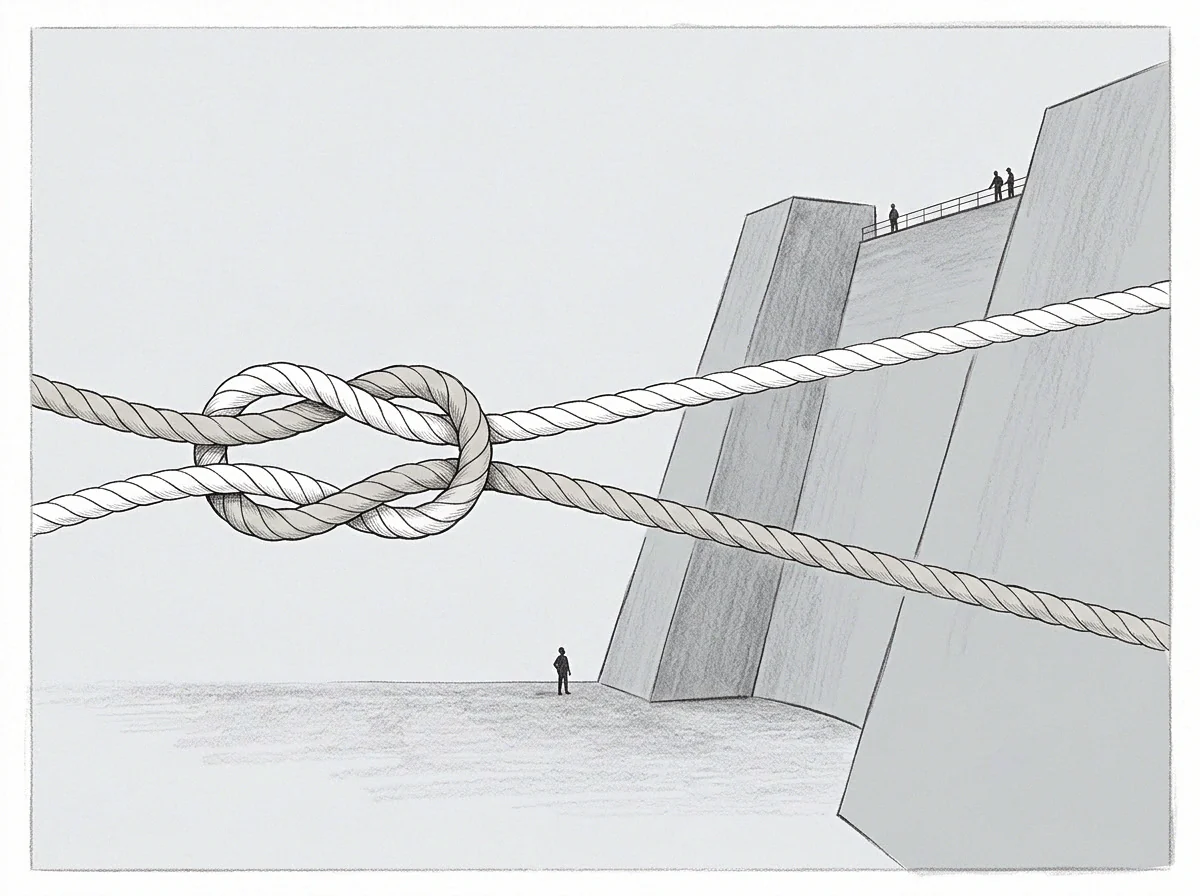
A structural latch is a governance rule that automatically fixes the state of a pending request when specific operational conditions are met, requiring no manual executive intervention. Latches decouple decision resolution from continuous executive availability. By converting open-ended reviews into deterministic, conditional transitions, latches release processing capacity back into the executive seat.
The slot remains locked.
Implementing deterministic latches shifts governance from active processing to exception management. Instead of requiring explicit affirmative sign-off for standard capital deployments, a latched architecture defines bounded execution parameters within which teams proceed automatically. Executive intervention occurs only when an operation strays outside pre-approved variance envelopes.
Deterministic Defaults for Pending Approvals
Deterministic default mechanisms eliminate approval bottlenecks by establishing time-bounded explicit outcomes. If a governance authority fails to issue a explicit rejection or request for clarification within a pre-stated window, the pending proposal automatically transitions to approved status. Silence carries a cost.
Establishing default-approval regimes requires precise operational parameters and clear boundary conditions. Governance teams must specify risk thresholds below which automatic progression operates safely. When applied correctly, deterministic defaults liquidate dormant decision queues, forcing governance seats to focus exclusively on high-risk strategic exceptions.

What Structural Interventions Restore Governance Capacity?
Restoring executive processing headroom under high latency conditions demands structural adjustments to how work enters and exits governance seats. Relying on personal discipline or longer working hours fails because human regulatory capacity has absolute biological ceilings. Structural mechanisms modify the inflow rate, state duration, and exit conditions of governance items.
Effective structural interventions establish explicit limits on the count of active queries allowed in an executive seat at any single moment. Incoming requests beyond the limit enter a deterministic holding queue or route automatically to secondary delegate seats. This protects the primary seat’s processing bandwidth from ambient operational noise.
- Time-bounded execution limits automatically convert silent review periods into affirmative operational permissions after seventy-two hours.
- Scope-restricted delegation thresholds transfer decisions under specified financial amounts to local operational managers without executive sign-off.
- Negative assurance protocols replace manual sign-offs with exception-based notification requirements across standard compliance checks.
Deterministic latches convert open-ended reviews into time-bounded conditional approvals.
Parked threads consume no headroom.
A explicit contractual clause specifying that proposals under two hundred thousand dollars gain automatic approval after five working days unless formally contested shifts ninety percent of routine queries out of the executive inbox.

Switch
Context switching under high-latency governance conditions generates severe cognitive friction that drains leadership energy without producing decisions. When an executive jumps between disparate strategic dossiers, regulatory filings, and crisis updates every fifteen minutes, the brain spends substantial effort re-loading historical context. The loop stays open.
Cognitive load theory highlights the distinction between intrinsic load, which stems from task complexity, and extraneous load, caused by poor information design. Intermittent status inquiries, unscheduled messaging alerts, and unstructured update emails inject massive extraneous load into governance seats. The constant barrage forces executive attention away from deep analytical work, locking leadership into a reactive processing state.

Intermittent Status Pings and Executive Re-entry
Status updates break focus. Every status update email, instant message notification, or verbal check-in forces the executive seat to pause current work, open the relevant project mental model, evaluate progress, and formulate a reply. Even if the reply takes thirty seconds, restoring deep focus on the original strategic task requires up to twenty-five minutes.
Intermittent pings multiply re-entry friction across the working day. Operational teams frequently send status inquiries to manage their own anxiety regarding project timelines. This behavior transfers emotional regulation load from the organization upward into the governance authority, consuming critical attentional reserves needed for high-stakes decision making.

Structural Bounding of Async Communication Channels
Async communication channels require strict structural bounds to prevent them from becoming unbounded decision queues. Unregulated channels permit endless, unstructured back-and-forth exchanges that dilute responsibility and delay firm resolution. Governance structures must specify clear submission formats, explicit evaluation windows, and strict messaging caps.
Restricting async interaction to designated time windows batches context switches, minimizing total daily switching overhead. Executive teams can allocate dedicated focus blocks for governance reviews, ensuring deep context loading and faster item clearance. Outside these review blocks, async channels remain locked to incoming queries.
- Establish rigid asynchronous review cycles restricted to two fixed two-hour windows per week.
- Require all governance submissions to utilize standardized single-page decision briefs with clear options.
- Prohibit informal status check-ins across messaging platforms outside formal governance sessions.
Intermittent status check-ins inject severe context-switching overhead into executive seats.
The engine throttles early.
Failing to structurally isolate executive focus from continuous status inquiries results in systemic decision paralysis, lengthened project lead times, and widespread operational burnout across subordinate management layers.

Bound
Establishing hard structural bounds on governance concurrency preserves executive decision quality under continuous operational demand. Organizations must treat executive processing space as a strictly budgeted resource rather than an elastic container. When governance capacity is explicitly capped, incoming requests are forced to compete for open operational slots based on strategic value.
Capacity-aware governance architectures introduce explicit limiters that govern decision queue length. By setting firm bounds on how many open governance queries can exist simultaneously, the organization prevents queue saturation and maintains steady decision throughput. The governance structure enforces operational discipline by requiring existing loops to close before new ones open.

Capacity Aware Approval Thresholds
Matching approval thresholds to available governance capacity ensures that executive seats process only high-value, systemic risk decisions. When governance demand surges, approval thresholds automatically adjust upward, delegating lower-tier choices to subordinate authorities. Terms clear the queue.
Dynamic threshold scaling prevents governance bottlenecks during operational stress periods. By establishing variable authorization tiers linked to queue volume, the organization maintains liquidity in decision-making while maintaining essential risk management boundaries.

Contractual Terms for Governed Execution
Governance arrangements between enterprise partners, founders, and investors must contain clear contractual terms that govern decision limits and processing timelines. Unstated expectations regarding availability, review speed, and approval parameters create covert contracts that inevitably break under high-latency stress. Explicit governance agreements align operating parameters with real biological and structural capacities.
Uncertainty extends thread life. Field experience across venture-backed enterprise scaling shows that explicit governance contracts defining maximum review periods, explicit delegation triggers, and clear emergency overrides reduce governance friction by over sixty percent. These explicit terms protect executive seats from continuous ambient demands while offering operational teams predictable decision timelines.
Designing effective structural interventions requires acknowledging the physical and physiological limits of human governance seats. Structural latches, deterministic default outcomes, bounded async communication windows, and capacity-aware approval limits convert chaotic decision queues into streamlined governance pipelines. Operating within hard concurrency bounds maintains organizational momentum while preserving executive clarity over sustained operational horizons.