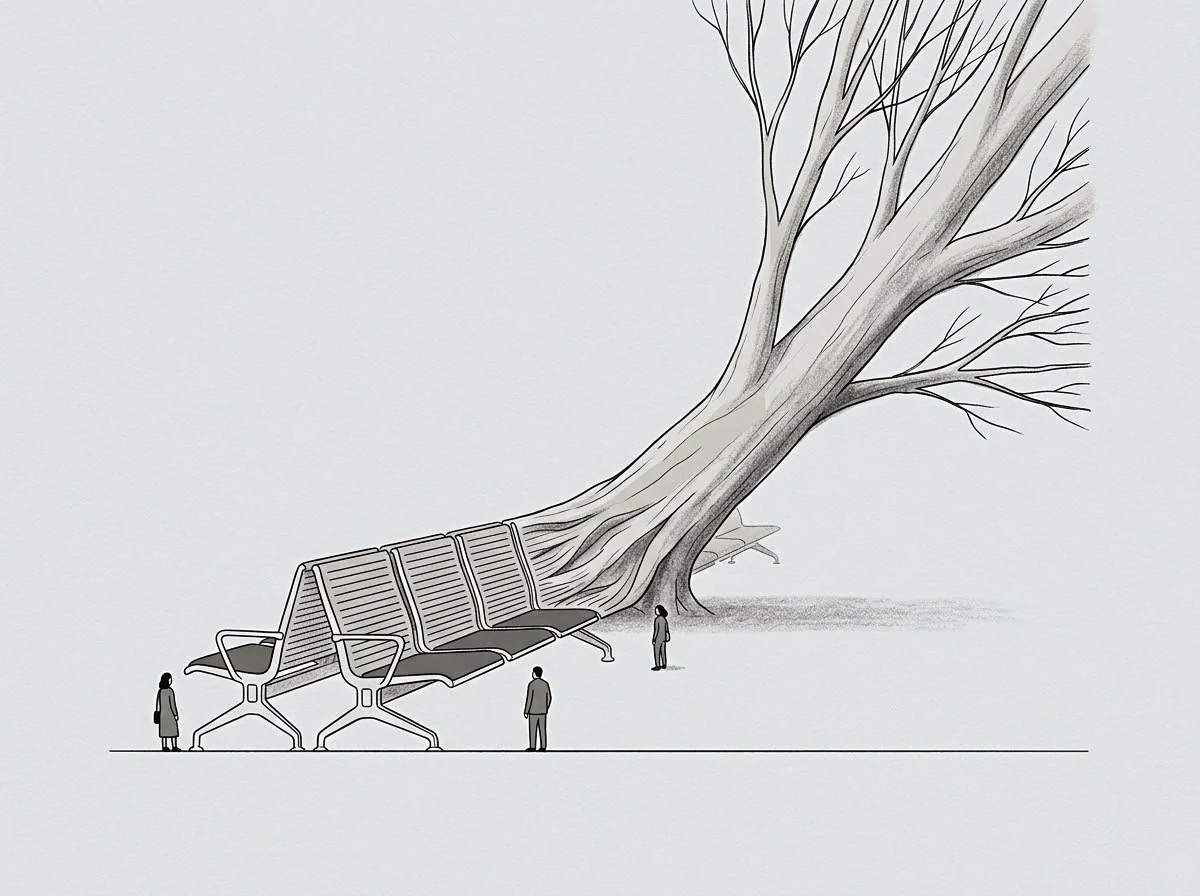
Meaning
Oculomotor locking patterns restrict visual scanning arcs and fix focal depth during states of elevated sympathetic autonomic activation. Tonic pupil dilation combines with pupillary fixation to tether attention to high-salience central inputs while peripheral visual processing experiences rapid sensory attenuation. The behavior governs ocular motor control under acute emergency triage, ceasing when parasympathetic tone returns or total sensory exhaustion induces saccadic wandering.
Autonomic Lock
Sympathetic efferent discharges paralyze the ciliary muscles and lock the lens at a fixed focal distance. Central noradrenergic surges suppress spontaneous micro-saccades that maintain broad field awareness during calm exploration. Ocular movement drops to rigid, intermittent adjustments focused solely on immediate survival signals.
Peripheral retinal fields darken functionally as visual cortex resources concentrate exclusively on foveal processing.
Visual Tunneling
Sensory processing boundaries narrow dramatically around immediate external stressors. Peripheral movements and structural environmental shifts escape conscious detection entirely. Visual scanning intervals shorten into frozen staring patterns.
This perceptual compression minimizes cognitive load by discarding ninety percent of ambient spatial data.
Attentional Exhaustion
Sustained contraction of the ocular apparatus consumes elevated quantities of glucose and induces local neuromuscular fatigue. Frontal eye field circuits experience metabolic depletion after hours of uninterrupted focal concentration. Headache and sensory irritability follow rapidly.
Persistent pupillary fixation degrades broader environmental comprehension by freezing the visual apparatus into narrow spatial vectors.