
How Unilateral Founder Regulation Distorts Departmental Capital Allocations
Unilateral founder self-regulation transforms capital allocation into an emotional load management tool, funding vocal departments while starving quiet units.

Drain
Four financial reports remain open on a monitor at midnight while an executive balances departmental budget requests against personal energy thresholds. The head of engineering asks for three additional senior headcount to stabilize deployment pipelines. The head of sales requests an immediate expansion of marketing expenditure to offset missed quarterly targets.
Neither request is evaluated purely on projected yield or historical capital efficiency. The executive absorbs the tension generated by both departmental leaders, taking their anxiety into personal baseline management before making a fiscal determination.
Social baseline theory establishes that the human nervous system budgets metabolic expenditure under the assumption that environmental threats are shared with proximate, reliable others. When an executive operates as a unilateral regulator, this physiological baseline breaks down. Departmental friction is treated as a personal load to be smoothed rather than an operational variance to be resolved structurally.
The executive absorbs the emotional turbulence of team leads, mistaking personal capacity to bear load for institutional stability.
When operational threat is absorbed by an individual leader without structural redistribution, departmental budget requests are approved to lower immediate relational friction rather than to build baseline capacity.
Capital allocations become the primary instrument for managing the leader’s internal working model of threat. A loud department head who generates frequent emergency pings creates high metabolic strain for the executive. To quiet the incoming signal and restore personal calm, the executive approves capital outlays for that unit regardless of operational merit.
Conversely, a self-contained department head who manages internal friction quietly receives less capital because that unit imposes no immediate regulatory cost on the leadership seat. The budget reflects the leader’s personal load accounting rather than objective baseline requirements.
This dynamic creates an invisible tax on corporate reserves. Energy spent managing internal threat perception reduces the cognitive capacity available for long-term strategic evaluation. The leader becomes a human surge protector, dampening operational noise by spending capital to buy temporary stillness.
The baseline cost of operating the executive seat rises continuously as team members learn that capital flows toward units that disrupt the leader’s internal equilibrium. The allocation structure becomes a mirror of the leader’s allostatic load.
Whether an organization can decouple capital deployment from the executive’s personal baseline load remains an open question when governance structures lack independent operational audits.

Vessel
Internal working models established during early development dictate how individuals handle stress and relational proximity. A leader who internalizes a model of self-reliance operates without an active receptor slot for being supported. This backward template forces the leader to act as the sole stabilizing presence for surrounding teams.
Department heads attach to the leader’s emotional steadiness, borrowing calm during operational crises while offering no regulatory relief in return.
Relational asymmetry dictates capital distribution across divisions. Departmental leads who rely heavily on borrowed calm consume significant executive bandwidth during weekly reviews. The leader experiences these interactions as metabolic expenditures, spending personal baseline reserves to keep department heads operational.
The capital budget becomes a compensation mechanism: money is released to compensate for the leader’s inability to establish clear relational limits or structural delegation.
| Allocation Vector | Absorbed Unilateral Allocation | Structural Baseline Allocation |
|---|---|---|
| Trigger for Funding | Elevated relational tension or high ping frequency from departmental lead | Verified unit economics and measured baseline capacity constraints |
| Executive Role | Absorbs operational shock personally to maintain team calm | Maintains structural parameters and enforces departmental accountability |
| Resource Distribution | Distorted toward units generating the highest immediate friction | Proportional to strategic return and verified operational throughput |
| Long-Term Failure Mode | Executive exhaustion leading to sudden arbitrary budget contractions | Gradual capacity deterioration due to external market shifts |
The absence of a reciprocal regulation channel distorts leadership decision-making. The executive perceives every request for capital as a demand for personal presence and reassurance. When capacity runs thin, the leader engages in arbitrary budget cuts across quiet departments to regain a sense of internal control.
These contractions hit teams that operate efficiently, penalizing structural self-reliance while rewarding relational dependence.
The organization develops a covert contract around capital requests. Department heads discover that presenting operational problems as personal crises yields faster financial approval than submitting analytical business cases. The leadership template normalizes this baseline dysfunction, embedding high operational friction into the quarterly budget cycle.
The team relies on borrowed calm, and the leader bears the ultimate metabolic expense.
Capital allocation routines mirror the internal working models of the leadership seat.
Proximity to an unyielding regulator forces teams to alter their communication patterns. Departmental leaders begin withholding bad news until operational breakdown occurs, knowing that early indicators trigger intense executive micromanagement. The leader interprets this late-stage communication as unexpected operational failure, escalating baseline stress further.
The systemic cost compounds until capital reserves can no longer mask underlying structural defects.
A leader who functions as the sole baseline for an organization eventually exhausts personal reserves, forcing the business to confront its structural defects.
Valve
Throttling occurs when an executive reaches an allostatic ceiling. The brain, overwhelmed by continuous incoming load, restricts access to capital to protect the leader from further decision complexity. This sudden restriction operates as an unstated emergency valve, shutting down investment across critical divisions without warning.
Departmental managers find their spending frozen despite prior budget commitments.
Capital flow patterns reveal the underlying regulation budget of the executive seat:
- Reactive Capital Injections take place when department heads escalate operational noise to force immediate funding approvals.
- Stealth Budget Contractions occur when quiet operational units are stripped of growth capital during periods of high executive fatigue.
- Arbitrary Spending Caps arise as the executive uses financial control to substitute for missing relational boundaries.
- Proximity-Based Funding Allocations favor department heads who physically share space or communicate frequently with leadership.
The distinction between genuine operational investment and anxiety-driven spending disappears under high allostatic load. When an executive acts as the single baseline regulator, capital outlays become tactical maneuvers to defer uncomfortable structural decisions. An underperforming sales division receives continuous funding injections because facing its fundamental failure requires high cognitive load and direct interpersonal conflict.
The money acts as a barrier, keeping the underlying operational truth at a safe distance.
When an executive reaches allostatic ceiling, capital restrictions are deployed to reduce personal cognitive load rather than to preserve cash reserves.
Departmental leaders learn to navigate this capital valve by timing their funding requests around executive capacity cycles. Approaching the leader immediately following a successful product deployment yields quick financial sign-offs, as the executive’s personal load is temporarily reduced. Requesting resources during operational downtime results in immediate rejection, regardless of business necessity.
Strategic planning degrades into a game of timing the leader’s internal equilibrium.
1. The executive experiences heightened baseline load from market volatility.
2. Interpersonal ping frequency from department heads increases rapidly.
3. Strategic evaluation capacity degrades under acute cognitive strain.
4. Capital outlays are approved to reduce short-term relational friction.
5. Departmental budgets expand without matching yield improvements.
6. Corporate cash reserves deplete, triggering sudden arbitrary freezes.
Mismanaging this capital valve leads to severe institutional atrophy, as high-performing engineers and managers exit when financial commitments are repeatedly rewritten to manage executive stress.

Margin
Consider a tech company operating over a twelve-month cycle with three primary divisions: core product engineering, enterprise sales, and customer operations. Assume two co-founders built the firm over four years without establishing explicit departmental capital policies. The chief executive officer retains sole sign-off authority for expenditures exceeding ten thousand dollars.
The chief technology officer leads product development, maintaining a quiet, self-contained operational style that minimizes direct friction during executive meetings.
The enterprise sales division experiences severe friction during the second quarter, missing revenue targets by thirty percent. The sales lead engages in constant direct communication with the chief executive officer, sending late-night messages, demanding extra headcount, and framing market challenges as existential threats. The chief executive officer absorbs this emotional volatility directly.
To quiet the incoming signal and restore personal equilibrium, the chief executive officer grants sales a forty percent budget expansion, reallocating funds previously targeted for infrastructure upgrades in product engineering.
The chief technology officer accepts the budget reduction without public challenge, attempting to protect team morale by absorbing the technical debt internally. Engineering velocity drops over the subsequent six months as aging infrastructure triggers repeated system outages. Customer operations then experiences a surge in ticket volume, requiring emergency overtime expenditure.
The chief executive officer, now operating at an allostatic ceiling due to continuous sales friction and system instability, reacts by placing a blanket freeze on all departmental hiring.
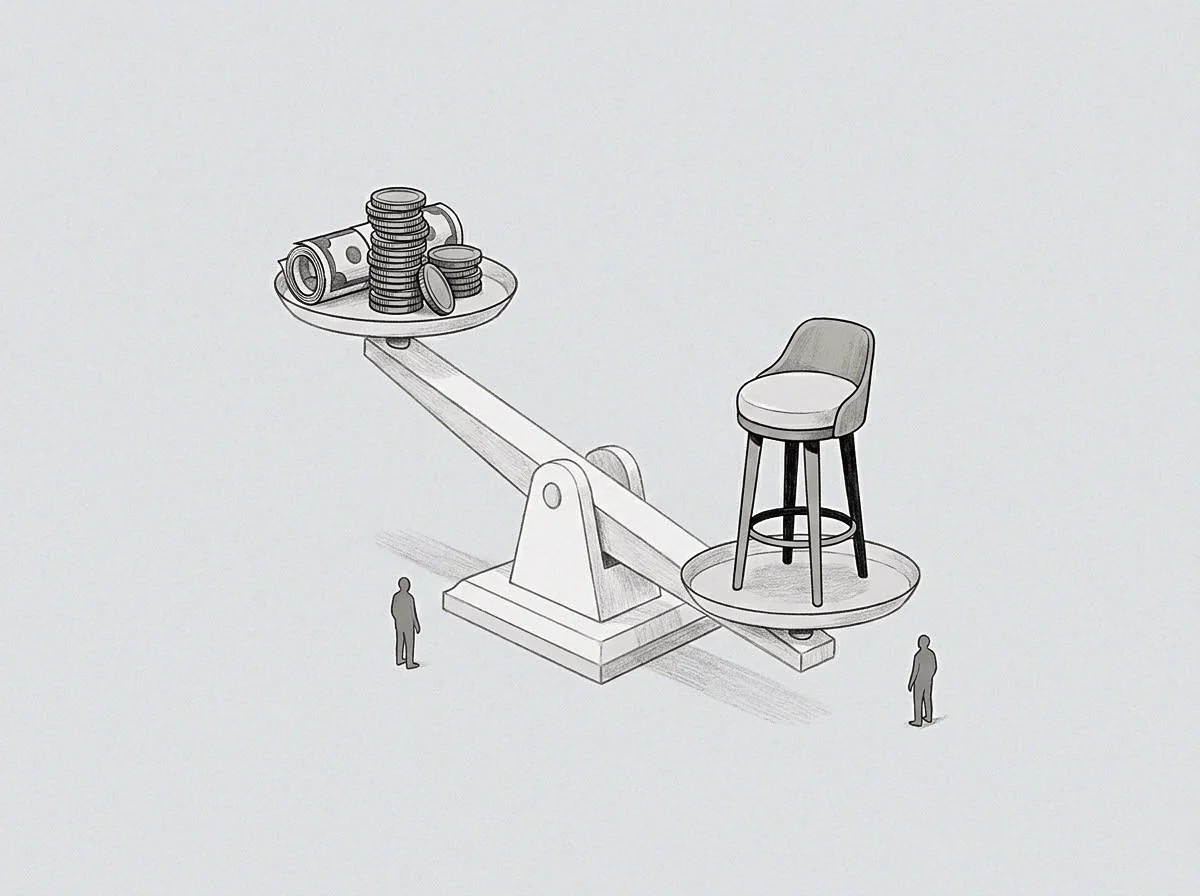
A quiet department absorbs technical debt while an anxious unit secures capital expansion.
The customer operations lead attempts to present a structured cost-benefit analysis showing that three junior support hires would reduce customer churn by fifteen percent. The chief executive officer dismisses the presentation within five minutes, stating that the company must preserve cash during volatile market conditions. The refusal stems from cognitive saturation rather than financial reality.
The sales division continues to spend its expanded allocation on underperforming channels, while customer support burns out its staff and engineering infrastructure continues to degrade.
The sales lead quietly tells colleagues that securing budget demands continuous visibility and relentless escalation to executive leadership.

Signal
Transitioning away from unilateral regulation requires the establishment of objective structural boundaries. Capital allocation formulas must be anchored to verified operational metrics rather than relational interactions between executives and unit heads. When resource distribution follows explicit parameters, the executive seat no longer serves as the primary absorption point for organizational friction.
Earned security within an enterprise framework emerges through repeated exposure to objective governance mechanisms. The executive learns that allowing a department to experience operational consequences does not require personal intervention or baseline regulation. This realization frees cognitive capacity, enabling long-term strategic evaluation.
Capital flows convert from instruments of emotional baseline management into targeted investments for institutional growth.
Structural baseline recalibration follows a distinct operational progression:
1. Operational variance limits are established in writing for each department.
2. Direct capital requests outside scheduled quarterly reviews are restricted.
3. Department heads assume full responsibility for internal baseline regulation.
4. Executive sign-off procedures are replaced by automated budget triggers.
5. Departmental performance audits are conducted by independent third parties.
Decoupling personal baseline regulation from financial distribution protects corporate reserves from emotional volatility. Teams adapt to clear operational parameters, building internal self-reliance and eliminating dependence on borrowed executive calm. Capital returns to its primary function: funding sustainable operational capacity across the entire enterprise balance sheet.
The execution of an explicit governance clause that mandates automated threshold funding eliminates executive discretion over routine departmental adjustments.