
Deriving Executive Capacity Boundaries Through Active Intake Parameter Configuration Controls
Active intake parameter configuration establishes structural barriers that preserve executive cognitive bandwidth by rejecting unstructured operational noise.
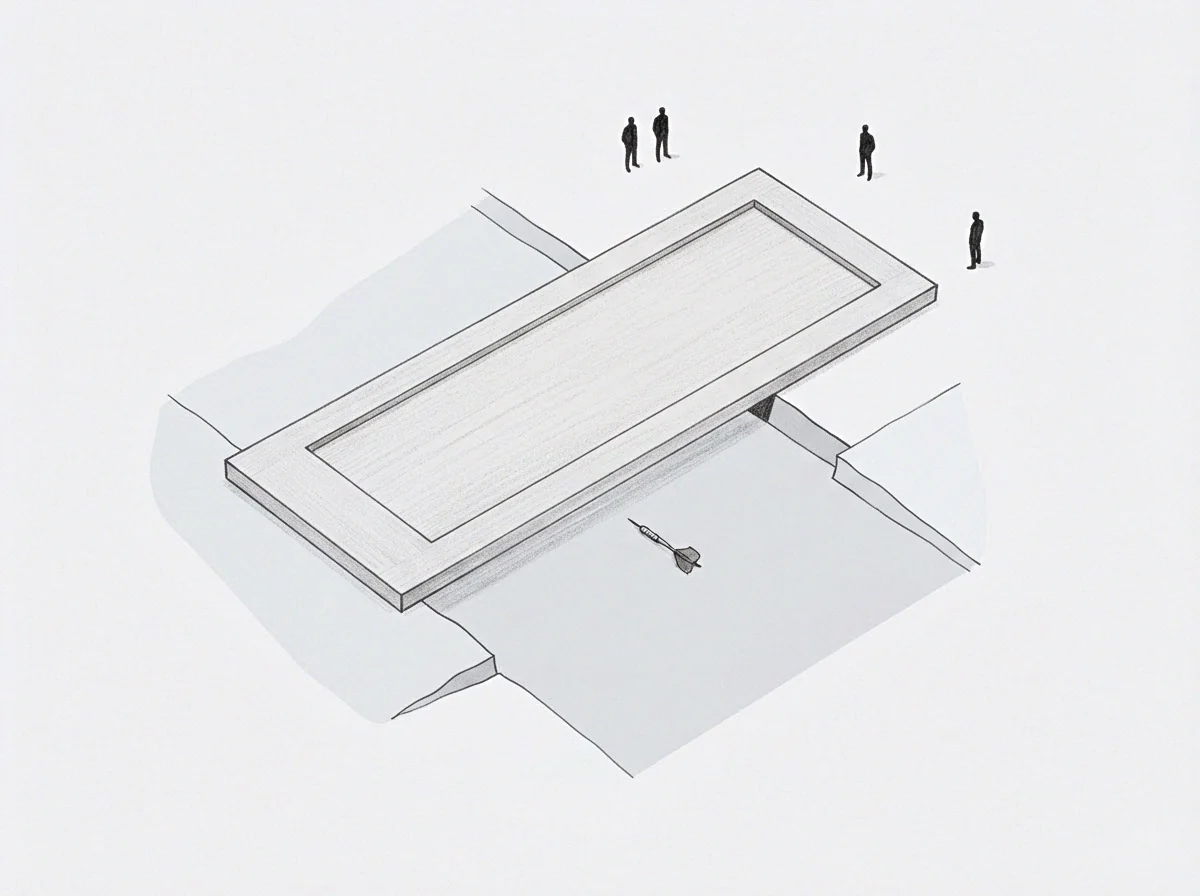
Wall
Incoming demands hit an interface driven by the sender’s urgency rather than the recipient’s available bandwidth. Someone who absorbs this impact directly acts as an unbuffered shock absorber, letting external speed dictate internal focus. When an executive relies on personal endurance to manage incoming work, the organization treats constant availability as unlimited capacity.
The system pushes against the person until a failure point appears, because human capacity has no visible boundary without explicit, structural limits.
Structural impedance functions independently of personal willpower. In control theory, an unconstrained input channel drives an active system to saturation, overloading processing queues as they lengthen indefinitely. When incoming requests land directly on an executive without prior conditioning, mental focus degrades from selective synthesis into reactive triage.
Executive capacity is established by mechanical resistance rather than internal determination.
A structural boundary exists only where an incoming load encounters resistance separate from the person occupying the office.
Active intake controls place mechanical friction between outside initiators and internal processing cycles. These controls create a firm boundary that deflects unstructured solicitations, forcing them into standardized, inspectable formats before getting attention. When intake requirements remain implicit, an executive spends attention energy maintaining limits through constant negotiation.
Explicit specifications relieve the individual from personal boundary defense by turning interpersonal friction into fixed operational parameters.
Converting informal pings into structured intake parameters eliminates ambiguous channels. An unbuffered inbox invites unstructured load-dumping, letting senders offload basic thinking onto the recipient. Parameter configuration sets explicit prerequisites, requiring every transaction to carry defined problem statements, evaluated alternatives, and specific resource requirements prior to review.
This setup turns an undifferentiated stream of queries into bounded, discrete decision items.
Unregulated intake channels systematically transfer exhaustion from disorganized senders to conscientious receivers, ending in total cognitive depletion across critical governance functions.

Dial

Intake Parameter Calibration
Calibrating entry variables requires granular control over the velocity, format, and volume of incoming data. A perimeter without variable controls acts as a binary barrier, causing organizational stagnation when shut or overload when opened. Calibration configures the intake aperture to admit only submissions structured for decisive resolution.
Configuring these apertures stabilizes operational throughput. Four discrete variables govern the stability of executive intake channels:
- Batching intervals enforce temporal isolation by consolidating intake evaluation into fixed, synchronized processing cycles.
- Structural schema mandates pre-formatted decision documents that eliminate conversational ambiguity and unverified data.
- Threshold criteria rejects any proposal lacking clear financial impact, cross-functional dependencies, and defined resource allocations.
- Escalation paths reroute tactical inquiries to designated operational delegates before executive attention is triggered.
Parameter calibration converts an arbitrary incoming deluge into a measured, predictable stream. The table below outlines systemic responses to uncalibrated versus calibrated intake controls across standard operational vectors.
| Intake Vector | Uncalibrated State | Calibrated Configuration | Cognitive Expenditure Result |
|---|---|---|---|
| Ad-hoc Communication | Instant messaging pings with immediate response expectations | Asynchronous ticket submission with forty-eight-hour evaluation cycles | Shifts continuous interrupt latency into predictable deep processing blocks |
| Decision Escalations | Verbal summaries delivered during emergency meetings | Written five-section memoranda detailing rejected counter-proposals | Eliminates affective contagion while enforcing analytical rigor in the sender |
| Project Inception | Open-ended brainstorming invitations and vague solicitations | Formal project charters requiring verified executive sponsorship metrics | Prevents speculative initiative creep from consuming strategic bandwidth |
| Operational Reporting | Unfiltered metric dashboards and voluminous operational data logs | Exception-only anomaly briefs identifying variance beyond target ranges | Directs analytical synthesis toward systemic failures rather than continuous monitoring |

Systemic Resistance to Friction
Initiators routinely experience calibrated intake as institutional bureaucracy. When an organization transitions from unconstrained informal access to formalized submission standards, counterparties encounter friction where free transmission once existed. This friction forces the initiator to perform the mental preparation previously absorbed by the executive.
A parameter configuration forces the sender to finance the cognitive preparation of their own request.
Resistance to these controls intensifies before a new equilibrium settles. Counterparties test the perimeter through alternate backchannels, personal appeals, and manufactured crises designed to bypass standard validation paths. The integrity of the intake parameter depends upon an absolute refusal to process unstructured exceptions, demonstrating that the control boundary is a firm operating rule rather than an administrative preference.
The parameter holds firm through a clause declaring that unformatted submissions remain unread until compliant structure is delivered.

Grid

Distributed Load Accounting
Intake parameters operate within a broader network of interdependent processing nodes. When one node installs rigorous boundaries, displaced work routes elsewhere across the corporate structure. Consider an organization operating with two senior principals and three functional leads across a high-tempo production cycle.
If one principal installs strict intake parameters without calibrating capacity across adjacent nodes, unstructured work cascades directly into the functional leads.
Uncoordinated parameter installation shifts systemic strain downward. The three functional leads absorb incoming operational noise, increasing their internal error rates and generating secondary crises that eventually breach the principal’s perimeter as urgent structural failures. A boundary established without systemic load distribution merely postpones disruption while exhausting subordinate capacity.
Protecting the center while suffocating the perimeter accelerates enterprise operational collapse.
Effective boundary setting coordinates intake parameters across all leadership tiers. This coordination establishes uniform submission criteria enterprise-wide, preventing senders from exploiting weaker intake nodes. When an entire leadership tier adopts standardized intake controls, the organization collectively resets its baseline operational cadence, shifting cultural expectations from immediate reactivity to deliberate, well-prepared documentation.
The project moves forward smoothly only when every node processes documentation at an identical standard of preparation.
Lock
Concurrency Limits and State-Gated Attention
Cognitive processing operates under rigid mental limits. When an executive attempts parallel execution across multiple complex decision domains, context switching degrades analytical clarity. Concurrency controls lock the intake channel once active processing queues reach saturation, preventing new inputs from entering until existing workloads resolve.
State-gated controls evaluate the physiological and mental condition of the decision-maker before unlocking intake capacity. Decisions resolved during cognitive depletion show elevated rates of error, premature concession, and narrow strategic focus. Establishing automated intake locks based on open-loop counts and uninterrupted processing blocks ensures that strategic work occurs exclusively during peak capacity.
A closed intake lock forces pending initiatives into external queue storage. This external buffer preserves mental reserves, allowing the executive to complete complex tasks without distraction from accumulating backlog anxiety. The queue remains outside the executive’s immediate perimeter, managed by automated systems or operational coordinators until execution bandwidth reopens.
Intake stays closed whenever active processing loops remain unresolved.