
Adrenal Downregulation Versus Clinical Depression In Enterprise Leadership
Adrenal downregulation throttles output to protect tissue under sustained allostatic load, while clinical depression reflects systemic affective failure.

Seat

Endocrine Adaptation Under Enterprise Pressure
Four operational pings remain unanswered on an executive desk while a board memo sits open. This reaction is routinely misread as an affective disorder. Sustained executive responsibility places continuous demand on the hypothalamic-pituitary-adrenal axis, triggering glucocorticoid receptor downregulation.
The body reduces cellular responsiveness to cortisol when exposure stays elevated over extended horizons. Downregulation functions as a protective circuit breaker, sheltering vascular and neural tissue from oxidative wear by restricting peripheral biological outputs.
Systemic throttling manifests as selective energy preservation rather than global mood collapse. Someone experiencing adrenal downregulation retains full cognitive capability on isolated, bounded technical problems, yet stalls when faced with high-concurrency strategic choices. Biological signaling has capped active output to prevent systemic burnout.
Clinical depression presents as pervasive anhedonia that persists regardless of workload or external changes. Misinterpreting this systemic suppression as psychiatric pathology leads to clinical interventions that fail to address the underlying physiological wear.
When sustained administrative demand exceeds neuroendocrine recycling rates, the HPA axis suppresses peripheral signal sensitivity to protect cardiac and cellular tissue.
The operational environment of enterprise governance creates chronic regulatory tension. While acute stressors cause brief cortisol spikes that clear upon task completion, modern governance keeps multiple unclosed loops active across nights and weekends. The brain interprets unresolved organizational risk as a continuous environmental threat.
Over months of uninterrupted pressure, adrenal output shifts from hyper-reactivity to compensatory suppression. The individual continues meeting baseline obligations but loses the capacity for self-initiated expansion.
Applying psychiatric pharmaceutical protocols to a downregulation state leaves the primary stress driver untouched. Antidepressant interventions may alter neurochemistry, but they do not reduce the volume of open operational threads consuming executive capacity. The individual remains stuck in a physiological bottleneck while incoming demand continues to match or exceed metabolic headroom.
Misidentifying stress-induced throttling as a primary mood disorder guarantees that organizational load stays unadjusted until somatic failure occurs.

Loop

Concurrency Limits and Administrative Thread Accounting
Executive exhaustion stems from ungated concurrent operations rather than total output volume. Working memory has strict limits on simultaneous cognitive processing. Every open operational thread, regardless of priority, occupies an active reservation in memory until explicit closure.
An unclosed thread acts as a continuous background tax on neural processing power.
When an enterprise founder carries dozens of unresolved operational decisions across product, capital, and talent channels, administrative load saturates neuroendocrine tolerance. The system relies on defined operational gates to clear active threads from immediate cognitive accounting. Without explicit dates, bounds, and handovers, every active issue continuously pings central executive control.
An ungated operational thread consumes one complete working memory slot until bounded by scope, date, and terms.
Administrative loops collapse executive capacity through four distinct thread states that drain neuroendocrine reserves:
- Unbounded Scope Threads continuous strategic inquiries lacking explicit operational metrics that force continuous internal evaluation without resolution.
- Unassigned Ownership Loops cross-functional operational friction where final authority remains diffuse, forcing the seat holder to maintain constant vigilance.
- Deferred Capital Decisions lingering financing choices where timeframes remain open, triggering repetitive stress responses with every calendar milestone.
- Ambiguous Partner Contracts unresolved equity or compensation discussions with key personnel that carry covert relational demands.
Accumulating these ungated threads triggers physiological throttling long before cognitive capacity breaks down completely. The brain reads open loops as unresolved environmental exposure and dials down systemic energy distribution. Energy returns when incoming volume drops below the daily rate of biological recovery.
Converting open loops into bounded, gated entries clears active cognitive space without requiring emotional reprocessing. Leaving an operational thread ungated guarantees that biological regulation spends capacity on passive loop maintenance.

Dial

Diagnostic Variance in High-Performance States
Distinguishing between adrenal downregulation and major clinical depression requires rigorous evaluation of functional and physiological criteria. Diagnostic taxonomies routinely blur these conditions because both present with physical fatigue, sleep disruption, and diminished executive initiative. Yet the root mechanism of each remains distinct.
Downregulation represents a regulatory system operating at its physical safety limit, whereas clinical depression reflects a breakdown in affective and neurochemical regulation.
The following evaluation matrix outlines the structural differences between physiological throttling and affective depression across operational parameters:
| Evaluation Variable | Adrenal Downregulation State | Clinical Depressive State |
|---|---|---|
| Task Initiative | Suppressed for strategic, open-ended expansion; intact for bounded mechanical execution | Pervasively absent across all operational and personal domains regardless of structure |
| Response to Zero Demand | Rapid baseline recovery of baseline mood and physical vigor when load drops | Persistent dysphoria and low affective valence lingering through prolonged restful periods |
| Cortisol Awakening Response | Blunted or flattened morning CAR profile due to receptor desensitization | Variable or dysregulated CAR, often accompanied by elevated baseline evening cortisol |
| Cognitive Clarity | Targeted executive fatigue tied to switching costs between active open loops | Global cognitive slowing, persistent irrational guilt, and pervasive worthlessness |
| Data synthesized from occupational stress physiology and neuropsychiatric diagnostic criteria. | ||
Physiological throttling responds directly to volumetric adjustments in open operational loops. When operational demands are stripped away or hard boundaries are placed around administrative channels, someone experiencing adrenal downregulation recovers cognitive speed rapidly. The underlying capacity for pleasure, curiosity, and strategic calculation remains sound, needing only metabolic headroom to reappear.
Major clinical depression does not resolve upon simple removal of operational load. An individual experiencing psychiatric mood failure continues to exhibit pervasive hopelessness and somatic paralysis even in zero-demand environments. The protocol for true depressive states requires direct psychological or neurochemical intervention.
Applying depressive diagnostic frameworks to throttled enterprise leaders leads observers to misread protective physical conservation as emotional withdrawal.
A throttled executive completes scheduled mechanical tasks while declining self-initiated strategic expansion.
The board concludes that the founder has lost commitment to the corporate mission.

Mesh

Co-Regulation and Social Baseline Economics
Human beings regulate physiological arousal through social baseline architecture. Neural systems treat proximity to reliable, competent co-regulators as a direct reduction in biological effort. In enterprise leadership, the executive seat is systematically isolated from co-regulatory support networks.
The founder occupies a position where information flows inward while emotional and operational stability flows outward.
When an executive regulates for board members, investors, and subordinate teams without receiving reciprocal dampening, physiological costs rise dramatically. The body spends metabolic reserves maintaining an appearance of calm control. Continuous deliberate suppression of stress signaling accelerates adrenal downregulation.
The metabolic cost of solitude in high-stakes seats represents an unaccounted burden in governance structure design.
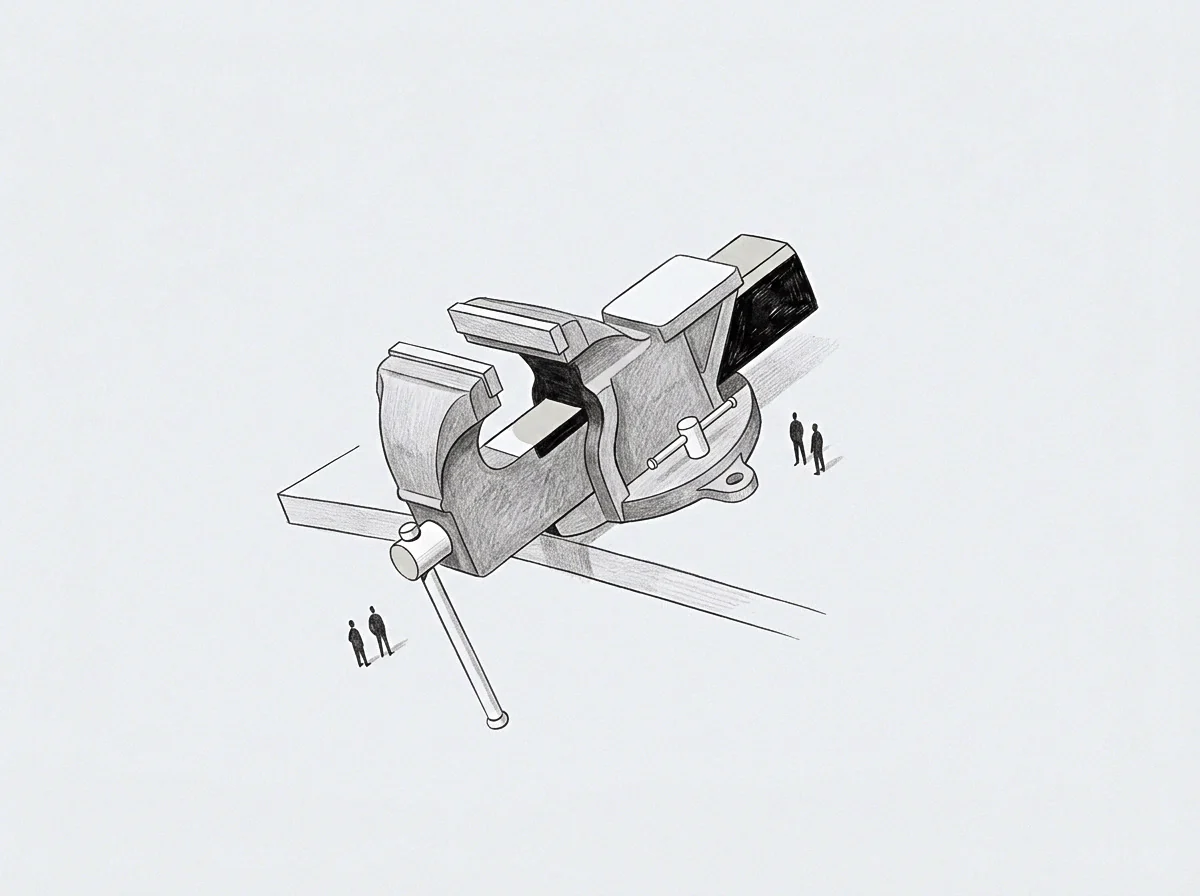
Can Borrowed Regulation Lower Executive Systemic Wear?
Shared operational burden acts as a physiological buffer protecting neuroendocrine tissue. When two leaders share explicit co-equal authority over complex decisions, the neural cost of monitoring open loops drops substantially. Presence alone alters the physiological threat assessment executed by the amygdala during crisis events.
Without functional co-regulation, an isolated leader must generate every unit of emotional balance through internal willpower. This reliance exhausts executive capacity far faster than physical labor or strategic analysis. The system hits maximum stress capacity, forcing the adrenal axis to downregulate output as an automated survival strategy.
Whether governance structures can integrate co-regulatory mechanisms without diluting clear operational accountability remains an open challenge for organizational design.

Slot

Architectural Interventions and Floor Capacity Management
Resolving executive adrenal downregulation requires structural modifications to operational channels rather than clinical therapy. The primary move involves establishing hard capacity floors that limit simultaneous active threads. Executive energy recovers when incoming inputs are constrained by rigid administrative filters.
To restore biological headroom without abandoning governance responsibilities, leadership teams implement specific capacity controls:
- Define explicit scope parameters for every open strategic initiative to eliminate continuous open-ended background processing.
- Establish fixed decision dates for all pending capital allocations and lock communications until those dates arrive.
- Transfer primary operational monitoring for active functional streams to dedicated operators with complete authority.
- Restrict real-time communication channels to emergency escalations while moving general updates to batched reports.
Setting definitive operational bounds transforms open loops into dormant items that consume zero working memory. The brain registers these bounded items as managed variables rather than active environmental threats. Biological downregulation halts, allowing glucocorticoid receptor sensitivity to normalize over subsequent metabolic cycles.
Enterprise health depends on maintaining executive capacity above minimum biological thresholds. Treating physiological fatigue as a personal moral failing or clinical depression ignores basic human stress architecture. Organizational design must account for the metabolic limits of human physiology.
Sustainable leadership demands operational systems that respect physical processing caps while enforcing clear boundaries around administrative capacity.