
Longitudinal Capacity Limits Of Executive Systems Operating Under Decoupled Coregulation Metrics
Executive capacity collapses when operating metrics hide solitary allostatic load caused by decoupled organizational coregulation.
Wire
Biological systems conserve energy by distributing regulatory work across close physical proximity. In primate social baseline models, autonomic stability relies upon shared thermal, defensive, and spatial cues, allowing an individual organism to operate with reduced prefrontal expenditure. When an executive runs without reciprocal metabolic buffering, the neural baseline resets toward solitary threat surveillance.
Prefrontal tissue consumes glucose rapidly when forced to handle predictive errors without an external stabilizing partner. The physiological wire connecting two decision makers carries continuous autonomic calibration, measurable through respiratory sinus arrhythmia and pupillary synchrony during shared evaluation.
Metabolic Economics of Shared Regulation
Laboratory findings demonstrate that task difficulty scores drop significantly when a trusted partner sits quietly beside the subject facing a visual cliff or physical resistance. The presence of an aligned peer reduces anterior cingulate activation, preserving glycogen stores inside executive cortical tissue. Solitary operation removes this quiet metabolic subsidy.
The brain treats solitary command as an exposed position, elevating baseline cortisol production while increasing vigilance across basic communication channels. Every strategic evaluation demands higher autonomic recruitment when the person knows no secondary monitor shares the downstream downside.
The battery empties silently.
Social proximity reduces prefrontal oxygen consumption only when both participants carry equal exposure to the evaluated risk.
Decoupled systems appear stable when external key indicators remain positive. A dashboard tracking software uptime, client renewals, and revenue growth often records peak operational efficiency while the nervous system of the operator absorbs all residual systemic vibration. Biological decoupling happens whenever organizational indicators reflect calm execution while the human node at the top performs solitary, unassisted down-regulation of every operational shock.
That metabolic subsidy remains invisible to board members because reporting tools only read institutional output, never autonomic wear.
Chronic compensatory down-regulation burns executive capacity across three to six quarters before behavioral symptoms emerge. Autonomic markers indicate sustained sympathetic tone long before task completion rates decay. The executive system throttles long-range scenario simulation first, favoring familiar operational routines that preserve working memory.
Solitary command structures create an artificial split: the corporate balance sheet registers zero metabolic drag, while the operator experiences relentless cognitive narrowing.

Load
Daily operations impose a secondary tax when reporting relationships hide true relational strain. An operator sits between anxious department leaders and demanding board directors, absorbing divergent institutional signals without passing tension downward. This insulation function requires continuous inhibitory control, which depletes dorsal striatal reserves and impairs contextual flexibility.
Metrics report that communication flows smoothly across the company, yet this smoothness is purchased through solitary prefrontal exertion.

Modes of Systemic Decoupling
Decoupled coregulation presents distinct operational patterns across high-pressure environments:
- Asymmetric risk absorption occurs when the primary operator guarantees downside protection for managers who retain full operational autonomy without personal liability.
- Unreciprocated down-regulation develops when team members bring dysregulated operational panics to the central office while offering no grounding presence during wider crises.
- Metric masking emerges whenever automated dashboard greenlights persuade external overseers that the executive seat operates with wide spare bandwidth.
The gap widens weekly.
Isolation compounds the drag.
Consider an operational founder holding twelve direct reports while coordinating an external capital raise. Each direct report leaves their weekly check-in feeling composed, organized, and clear on targets. The leader provided the grounding frequency that settled twelve distinct operational domains.
By nightfall, twelve loops remain lodged in the leader’s working memory, waiting for resolution. No counterpart enters that office to provide equivalent grounding for the builder. This structural asymmetry converts relational leadership into an unbuffered metabolic draw.
Silence absorbs the shock.
Relational insulation purchases team stability by burning the operator prefrontal reserve.
The other party in this arrangement routinely observes the quiet efficiency and assumes the seat possesses infinite capacity, noting that everything seems completely under control from their vantage point.

Cost
Prolonged solitary regulation degrades executive function across measurable neurobiological axes. Sustained high-allostatic states lead to dendritic retraction within medial prefrontal neurons while driving hypertrophy inside the basolateral amygdala. The operator maintains tactical execution, yet capacity for nuanced predictive modeling collapses.
Observers frequently misinterpret this state as clinical depression. In reality, the executive system has entered defensive throttling, intentionally shutting down non-essential speculative processing to protect vital operational functions.

Physiological Divergence Across Structural States
The divergence between coupled and decoupled governance states reveals itself across autonomic and operational dimensions.
| Evaluation Dimension | Coupled Coregulation Mode | Decoupled Coregulation Mode |
|---|---|---|
| Autonomic Basal Tone | High heart rate variability with rapid post-stress parasympathetic recovery | Low heart rate variability with persistent nocturnal sympathetic elevation |
| Scenario Planning Horizon | Twenty-four to thirty-six months of associative strategic projection | Four to eight weeks of near-term tactical defense |
| Open Loop Processing Cost | Shared cognitive distribution across bonded partners | Solitary internal working memory retention |
| Down-Regulation Direction | Bidirectional peer calibration during operational friction | Unidirectional absorption of subordinate and investor panic |
| Systemic Capacity Lifespan | Sustainable across multi-year cycles without cognitive constriction | Severe executive constriction within twelve to eighteen months |
Sleep stops restoring tissue.
The reserve runs dry.
When cognitive constriction settles in, decision quality drops in predictable sequences. The executive begins postponing ambiguous negotiations, avoiding open-ended strategic debates, and defaulting to rigid binary rulings. These behaviors look like obstinacy or lack of commitment to outside observers.
Inside the nervous system, the prefrontal cortex is rationing glucose, refusing investments in complex social calculation because immediate operational continuity demands every remaining watt.
No reserve remains.
Executive throttling appears as emotional withdrawal when the underlying mechanism is prefrontal energy preservation.
Ignoring this physiological reality produces catastrophic executive burnout, premature structural liquidation, and sudden departures that leave organizations completely leaderless.
Plate
Evaluating real structural friction requires examining how operational arrangements decay over extended time horizons. Take two partners who built an enterprise software business for twenty-four months with undefined boundaries around decision ownership. Assume the operational lead holds forty percent equity while managing all engineering delivery, technical hiring, and customer deployments.
Assume the commercial lead holds sixty percent equity while managing capital partners, external press, and enterprise contract negotiations. On paper, both roles appear balanced, and company metrics indicate thirty percent quarter-on-quarter growth.
Chronology of Unbuffered Decay
Tracking this arrangement reveals how structural silence creates longitudinal failure:
- Initial variance drift starts when the commercial partner delegates ambiguous customer contract stipulations directly to engineering without confirming resource availability.
- Secondary loop retention accelerates as the operational partner absorbs these delivery risks quietly, unwilling to introduce friction into board meetings.
- Terminal headroom exhaustion strikes around month fifteen when the operational partner ceases initiating new architecture upgrades and communicates strictly through brief factual memos.
The slot stays occupied.
Every ping drains fuel.
During month sixteen, the commercial partner interprets the operational lead’s brevity as passive hostility or disinterest in corporate scale. The board hires an external executive coach to address interpersonal alignment. The coach runs personality profiles and diagnostic interviews, treating the situation as a communication style mismatch.
These behavioral interventions fail completely because the actual bottleneck is metabolic exhaustion inside one overloaded nervous system. The operational partner has regulated the enterprise delivery engine alone for five hundred days without receiving a single hour of shared down-regulation from an equal peer.
The person runs cold.
A stated limit on unassisted risk absorption protects operational continuity better than executive coaching interventions.
A written agreement specifying exact operational handover criteria and mandatory peer sign-offs immediately redistributes metabolic exposure back across the governing partnership.

Shift
Restoring executive capacity requires physical restructuring rather than mental reframing. Cognitive behavioral techniques cannot compensate for solitary allostatic depletion when incoming organizational demands exceed physical processing bandwidth. The person in the seat must alter the systemic architecture that channels unbuffered variance into their personal nervous system.
This transition demands creating genuine structural gates that reject ungated open commitments.
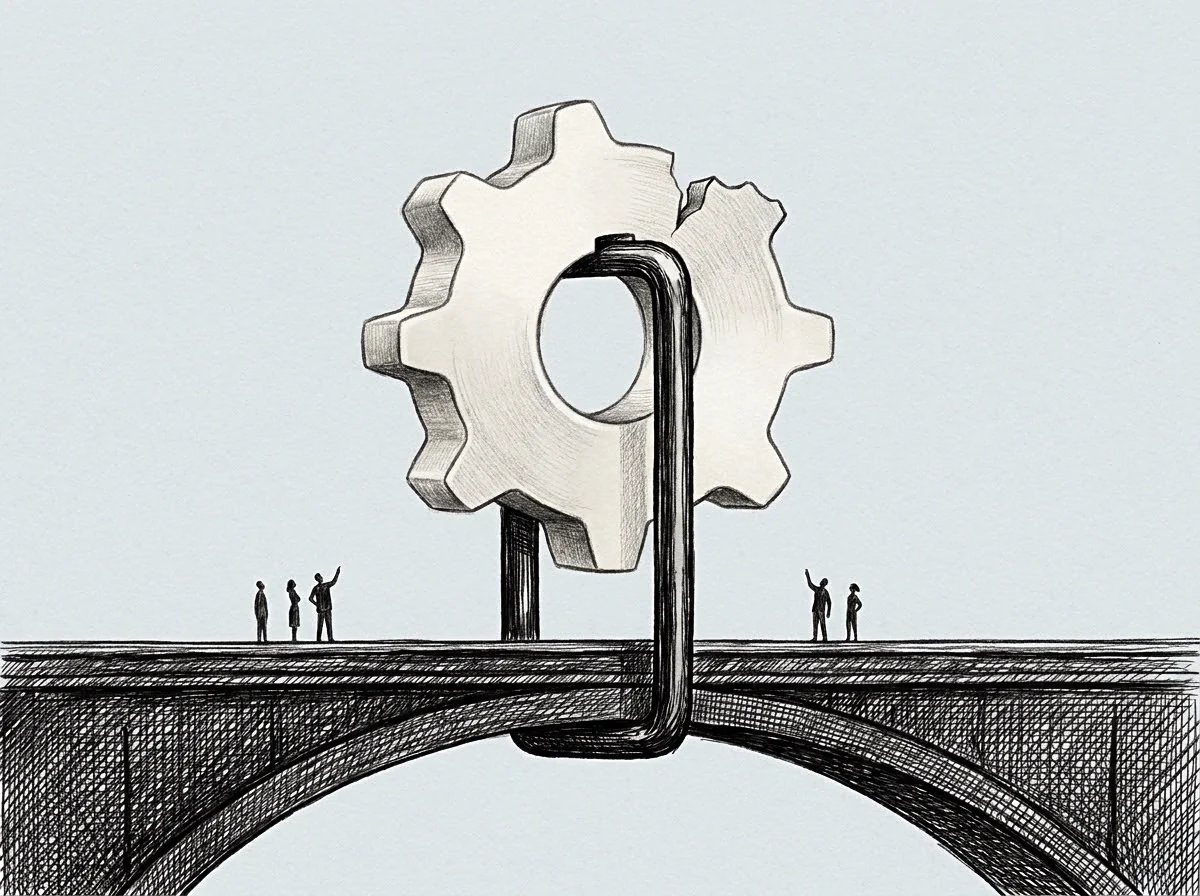
Re-Coupling Governing Interfaces
True coregulation requires structural parity. An executive cannot achieve nervous system down-regulation through interactions with direct reports, paid subordinates, or external advisors whose compensation depends upon the executive seat remaining intact. Coregulation functions exclusively across lines of mutual exposure, where both individuals share downside vulnerability and hold comparable decision authority.
Without equal skin in the game, relational interactions remain an extraction of the leader’s regulatory stability.
Metabolic debt accumulates uninterrupted.
The threshold drops downward.
Practical governance requires hard firewalls around operational intake. The executive introduces explicit terms governing project commencement: no major client delivery begins without explicit capital allocation, signed legal scopes, and a named co-owner who carries operational responsibility for failure. Parking unresolved initiatives outside working memory frees occupied cognitive slots instantly.
Once an issue is bounded by date and operational ownership, the central executive system drops threat surveillance on that node.
Capacity collapses under silence.
Recovery stalls out completely.
When an executive re-establishes baseline parity, operational velocity may temporarily dip while the organization learns to absorb its own variance. Team members who relied on the central seat for emotional grounding will experience friction as that free metabolic subsidy disappears. The executive system gradually reclaims prefrontal headroom, restoring associative problem solving, long-term predictive acuity, and physiological durability across subsequent multi-year operating horizons.
What remains unsettled is how an executive determines whether an existing operating partner possesses the innate autonomic capacity to coregulate under existential corporate threats, or whether that baseline resilience can only be discovered after catastrophic systemic failure occurs.