
The Biological Ceiling of Unshared Executive Regulation in High Stress Corporate Leadership
Unshared executive regulation causes autonomic throttling, down-regulating decision capacity when chronic co-regulatory load exceeds human biological limits.

Throttle
Four messages arrive between midnight and two in the morning during a distressed debt restructuring. The chief operating officer requests immediate intervention in a vendor dispute, the general counsel sends an unredacted liability memo without recommendations, the head of investor relations forwards a hostile inquiry from a major shareholder, and the chief technology officer reports a critical infrastructure failure. None of these communications contain proposed solutions or bounded choices.
Each message functions as a raw transfer of anxiety, expecting the chief executive officer to stabilize the sender’s physiological distress before operational decisions can execute within biological limits.
When an executive operates as the sole co-regulator for an entire senior leadership team, the biological substrate of governance breaks down. Social baseline theory establishes that the human nervous system defaults to sharing regulatory load with proximate conspecifics. When secondary leaders disown emotional regulation, the central leader’s autonomic nervous system carries the metabolic burden of the entire entity.
Chronic exposure to high-uncertainty signals forces the hypothalamus-pituitary-adrenal axis to maintain elevated cortisol and catecholamine secretion, consuming glucose rapidly, depleting prefrontal cortex reserves, and degrading executive function.
Autonomic throttling protects cardiovascular and metabolic tissue by down-regulating executive output whenever chronic co-regulatory demand exceeds physiological restoration.
A persistent state of excessive regulatory demand causes the autonomic nervous system to initiate safety protocols through systemic conservation down-regulation. This protective mechanism reduces neural sensitivity to incoming stressors, dampens emotional reactivity, and slows decision speeds. Corporate boards routinely misinterpret this autonomic dampening as clinical depression, loss of ambition, or executive disengagement.
The physiological state represents a structural dampening designed to prevent myocardial or neural injury under unmanaged allostatic load. Treating autonomic dampening with psychological motivation protocols accelerates systemic exhaustion.
The misreading of biological throttling carries explicit operational costs. When an organization treats autonomic protection as a personal performance failure, the executive faces pressure to override physiological signals using chemical stimulants or forced cognitive exertion. Override strategies exacerbate catecholamine surges, elevate resting heart rate variability suppression, and hasten total systemic collapse, keeping cortisol elevated.
Gauge
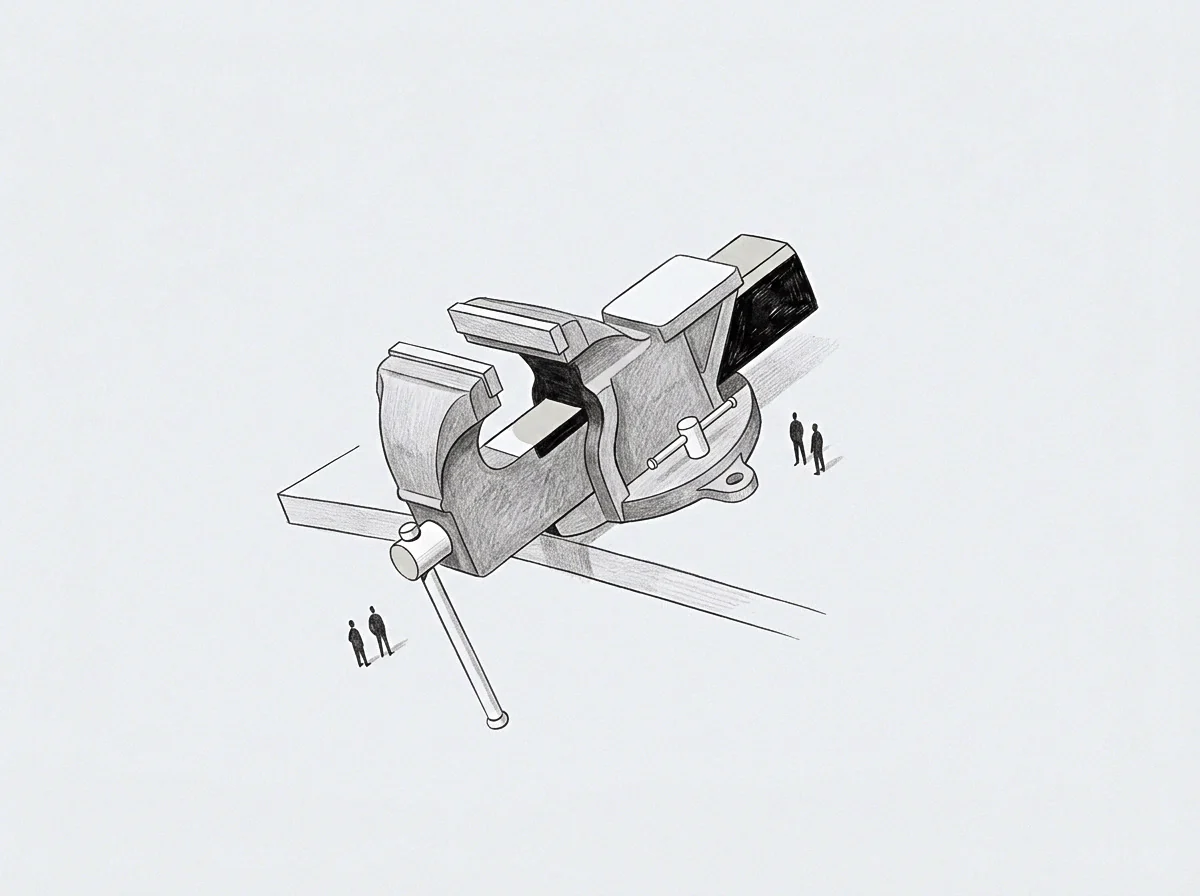
Measuring executive capacity requires tracking open neural loops rather than hours spent at a desk. An open loop represents any active operational thread lacking defined boundaries, clear terms, or assigned resolution dates. Every unmanaged thread occupies an active slot in working memory, consuming continuous metabolic fuel regardless of whether the executive actively works on the problem.
The concurrency limit defines the maximum number of un-gated threads an executive nervous system can hold before cognitive switching costs eliminate strategic headroom.

How Does Autonomic Throttling Alter Strategic Decision Headroom?
Cognitive load research confirms that multi-tasking across ill-defined domains introduces a switching cost that degrades analytical accuracy and reduces headroom to zero. When an executive holds twenty open operational loops alongside four un-gated interpersonal conflicts, working memory capacity saturates. The prefrontal cortex loses the capacity to construct long-term probabilistic scenarios, and decision-making shifts automatically to primitive subcortical structures, favoring immediate risk mitigation over long-term value creation.
| Operational Variable | Unshared Executive Model | Distributed Co-Regulatory Network |
|---|---|---|
| Primary Regulation Source | Single Chief Executive Officer | Shared Leadership Core |
| Thread Allocation Strategy | Un-gated, continuous access | Bounded by scope, date, and terms |
| Autonomic State Under Stress | Sympathetic overdrive leading to throttling | Balanced autonomic regulation |
| Decision Horizon Range | Immediate mitigation (0 to 30 days) | Strategic planning (1 to 5 years) |
| Mean Recovery Requirement | Extensive medical or career sabbatical | Integrated daily metabolic restoration |
Consider a founder managing a series B enterprise experiencing a thirty percent quarterly revenue drop. Assume the executive holds twelve direct reports, each communicating through unfiltered direct messaging channels where open loops consume memory slots. When revenue drops, all twelve reports broadcast untethered concern directly to the founder.
If the founder attempts to process all twelve co-regulatory demands individually, total daily thread switches exceed four hundred events. Available strategic headroom degrades within fourteen business days, leaving the founder unable to evaluate term sheets or direct capital reallocation.
The system reaches a boundary where raw operational volume ceases to predict executive collapse. Standard administrative metrics fail to capture the invisible drain of emotional containment for anxious board members or key investors. Whether an executive can consciously detect allostatic accumulation before cardiac or neurological markers force an operational pause remains undetermined.

Relay
Co-regulation functions as an energy transaction between distinct nervous systems. In established social baseline models, human beings conserve individual metabolic resources by leaning on the perceived stability of surrounding figures. Within corporate hierarchies, subordinate officers export neural instability upward, using the chief executive as a regulatory sink.
When subordinate executives lack personal self-regulatory practices, unresolved operational fear travels upward to the primary leader.
An ungated communication channel converts every operational variance into an immediate neural load on the primary regulator.
The unshared regulation template establishes an unstable equilibrium within executive teams. Senior vice presidents obtain temporary relief after transferring ambiguous threats to the central leader, who absorbs the biological cost of that shift. Over time, the executive team loses the capacity for independent emotional regulation, developing a learned dependency on the leader’s presence to stabilize operational anxiety while the channel remains open.
Systemic failure manifests through distinct operational patterns when executive regulation remains completely unshared across an enterprise:
- Unfiltered Escalation Cascades occur when subordinate managers pass early-stage operational anomalies directly to the top seat without preliminary analysis or mitigation strategies.
- Regulatory Parasitism emerges as secondary leaders rely entirely on the primary executive’s presence during high-stakes negotiations to maintain emotional equilibrium.
- Executive Isolation Sync develops when the chief executive cuts off external social touchpoints to protect remaining biological headroom, accelerating cognitive fatigue.
- Asymmetric Boundary Erosion forces the central regulator to accept round-the-clock availability demands while subordinate schedules remain protected.
Subordinate leaders facing an absent primary regulator experience acute directional panic and operational paralysis, unable to finalize simple tactical decisions without receiving verbal stabilization from the central seat.

Harness
Protecting the executive nervous system requires structural gates rather than personal resilience training. Relying on willpower or mindfulness practice while maintaining un-gated operational exposure fails to reduce allostatic load. Structural gates modify how operational data enters the executive environment, converting high-cost open loops into low-cost closed transactions to save headroom.
The conversion of un-gated threads into structured operational units follows a strict sequential protocol designed to preserve neural bandwidth:
- Channel Containment requires isolating all operational communications into asynchronous, scheduled intake points while eliminating continuous direct messaging streams.
- Triage Gatekeeping assigns an chief of staff or senior operator to screen incoming communications, ensuring every item carries explicit options, financial trade-offs, and clear recommendations.
- Temporal Allocation restricts strategic decision-making to specific biological windows when prefrontal cortex glucose availability sits at peak levels.
- Co-Regulatory Distribution trains secondary executives to use peer-level coregulation networks, forcing emotional stabilization to occur prior to operational reporting.
A thread bounded by explicit delivery dates and bounded exposure stops drawing on central regulatory capacity between updates.
The primary mechanism for saving executive headroom is the implementation of strict boundary conditions on every internal initiative. Every active project must specify an explicit owner, a rigid update cadence, clear decision triggers, and a defined sunset clause. Stating explicit scope, dates, and terms prevents projects from lingering as ambient mental debt.
Inserting a formal governance clause requiring all capital requests above two hundred thousand dollars to undergo a seventy-two-hour asynchronous review period instantly eliminates panic-driven emergency meetings.
Cost
Ignoring the biological ceiling of executive regulation damages institutional capital and governance integrity. When an organization runs its primary regulator into autonomic throttling, strategic decision quality drops, leading to defensive capital allocation errors, misaligned replacement hires, and overlooked market threats.
Board members typically react to executive throttling by demanding increased operational reporting or imposing intrusive oversight metrics. These interventions compound existing allostatic load, pushing the executive from functional dampening into total systemic shutdown. When the primary leader inevitably steps down or takes medical leave, the enterprise incurs massive transition costs, market cap erosion, and organizational instability requiring months of restoration.
The organization routinely replaces the throttled executive only to subject the successor to the identical unshared regulatory architecture.
Long-term institutional survival requires treating executive regulatory capacity as a finite biological asset. Sustainable governance models integrate shared co-regulation architectures, explicit communication gates, and bounded operational threads directly into corporate charter agreements. Structural protection of executive headroom maintains systemic health, protects enterprise valuation, and prevents the predictable physical breakdown of leadership capital.