
Quantifying Social Baseline Regulation Costs Within Multi Thread Executive Environments Under Persistent Demand
Missing social baseline regulation increases executive energy expenditure by forcing neural capacity to fund autonomic balance under load.

Seat
Four messaging feeds run down one side of the screen while a capital allocation spreadsheet sits open in the primary window. Each incoming line brings an emotional signal from an operator, a board member, or an investor, requiring quick reassurance before any practical business can move forward. The executive works through the queue, softening phrasing, swallowing physical tension, and keeping an even pulse across four different channels at once.
Real strategic analysis stops while biological attention goes entirely toward steadying the people on the other end of those exchanges.
Social baseline theory demonstrates that the brain treats physical and emotional proximity as its baseline resting state. With predictable partners nearby, the nervous system hands off environmental tracking and autonomic stability to the surrounding group. In a multi-thread operating role under constant market pressure, that arrangement reverses.
Rather than drawing stability from the team, the executive becomes the sole shock absorber for the rest of the company. Energy expenditure spikes because self-control and external stabilization are both funded from the same internal supply.
Four uncalibrated messaging channels transform executive attention from continuous strategic processing into fragmented baseline stabilization.
Running four simultaneous conversations without fixed parameters drains working memory much faster than technical work. Each conversation forces the brain to model the other person’s state, gauge the tone of the exchange, and weigh what happens if a response waits an hour. Those relational loops run on the identical cognitive slots needed for capital decisions and risk modeling.

The Shift From Mutual Support to Structural Supply
In early-stage companies, informal contact provides natural mutual stabilization during shared problem solving. As headcounts expand and commercial stakes rise, staff members feel sharper personal threat and turn upward for reassurance. The executive seat turns into an emotional utility, feeding continuous stability to the company while getting little back.
This dynamic creates a quiet, persistent energy drain that never shows up in standard operational reports.
If commercial pressure stays elevated over several quarters, the maintenance cost outstrips personal physical reserves. An executive might keep a calm public demeanor, answer messages within five minutes, and hit every reporting date, but internal bandwidth disappears. The energy needed to design fresh strategy, work through abstract models, or absorb normal operational friction is already spent keeping the team settled.
Quick responsiveness looks like low organizational friction from the outside, but it usually signals severe systemic strain.

Drain
The brain budgets metabolic expenditure through strict conservation pathways. Research into social baseline mechanics shows that blood-oxygen-level-dependent responses in the anterior cingulate cortex and hypothalamus drop markedly when an individual encounters a threat beside a dependable companion. Proximity to a steady partner tells the nervous system that vigilance can safely drop.
These imaging findings come primarily from laboratory trials pairing physical stressors with immediate personal presence, leaving open how cleanly delayed text messaging provides the same metabolic relief.
Under heavy operational concurrency, that social baseline flips entirely. The executive does not experience the organization as a buffer against shared friction. Instead, the surrounding personnel present an unending series of requests for calm and direction.
An unstructured message from a founder, an investor, or a team lead registers as an operational threat, pulling on prefrontal structures to manage personal stress while drafting a composed reply.
| Regulatory Mode | Neural Energy Source | Autonomic Cost Profile | Executive Capacity Impact |
|---|---|---|---|
| Baseline Co-Regulation | Shared social network load distribution | Low resting cardiac sympathetic activity | Full working memory available for strategy |
| Isolated Self-Regulation | Individual prefrontal metabolic expenditure | Moderate autonomic vigilance and elevated cortisol | Working memory split between task and state |
| Regulatory Inversion | Single executive funding network stabilization | High sympathetic tone and chronic baseline wear | Severe capacity reduction; strategic stalling |
Physical costs mount directly with thread volume and irregular delivery times. Without agreed boundaries, designated review hours, or defined scopes, the brain maintains constant vigilance. Power grids redirect sudden surges onto regional reserves to keep substations from blowing out under load.
The human nervous system has no secondary path; every burst of interpersonal friction has to be absorbed directly through prefrontal effort.
Proximity to a predictable neural partner shifts the baseline cost of environmental monitoring directly onto shared biology.
Allostatic load describes the physical wear that accumulates under continuous demand. In executive positions, this strain rarely stems from technical complexity. It comes instead from the constant effort of curating emotional reactions to steady the people around the desk.
Absorbing that organizational friction while depleted shows up physically as elevated resting heart rates, fragmented sleep, and reduced immune resilience.
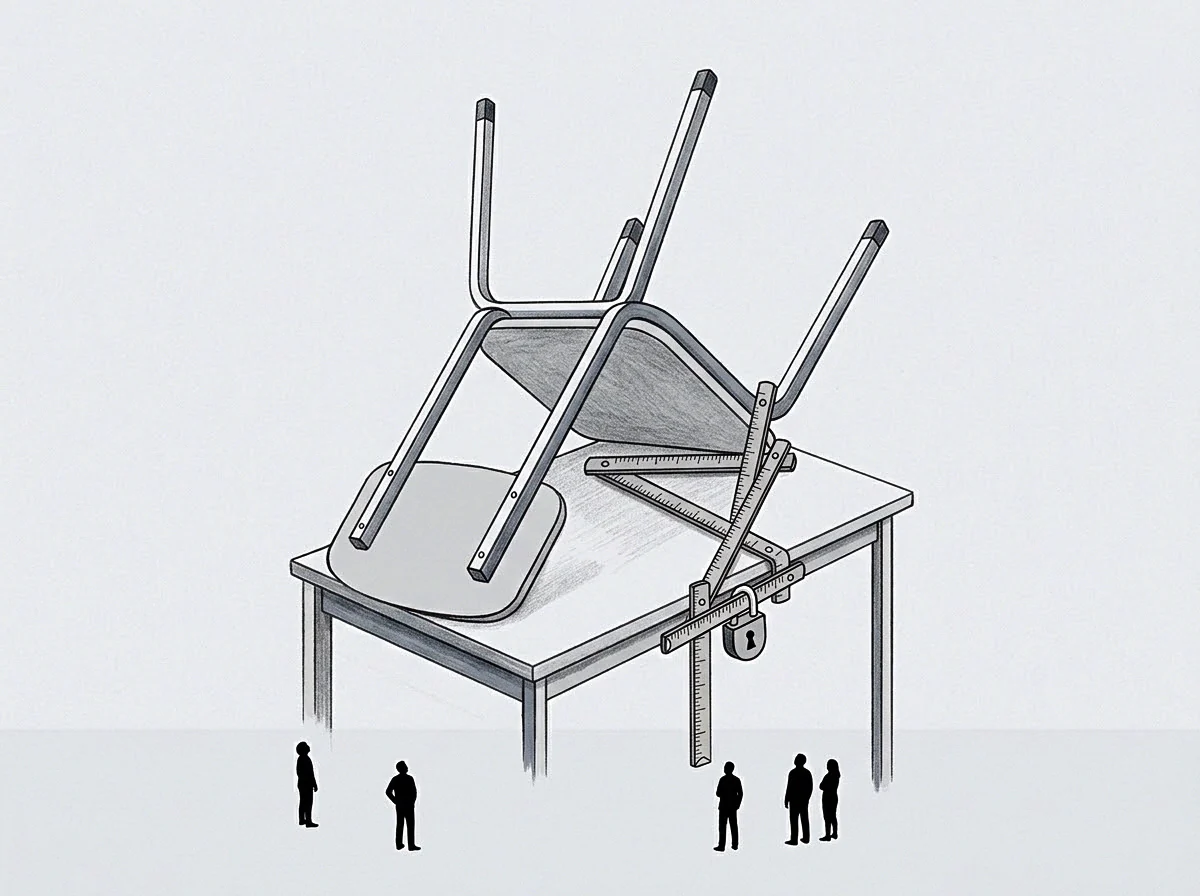
Quantifying the Physiological Cost of Relational Grounding
Tracking autonomic activity through heart rate variability reveals that managing interpersonal friction demands more physical effort than solving structural or quantitative problems. Holding back irritation or apprehension during an emergency requires deliberate inhibitory control from the ventromedial prefrontal cortex. That suppression burns glucose and oxygen at rates that rapidly exhaust cellular reserves.
After ten straight hours of managing interpersonal fires across chat, video calls, and messages, evening fatigue is an organic physical reality. The brain has spent its daily glucose quota keeping everyone calm. Strategic headroom collapses to zero, wiping out the energy needed for long-range planning, deep reflection, or complex operational design.
A competent strategist ends up reduced to a simple message filter.

Concurrence
A thread is any active interpersonal loop that can interrupt attention without a negotiated boundary, rather than just an assigned task or open project. A technical objective, such as writing an engineering spec, takes up a defined functional slot with clear constraints. An open direct message with a co-founder about equity friction functions as an unbounded relational loop, draining prefrontal energy continuously even when no new text arrives on screen.
Cognitive concurrency limits sit far below what modern software assumes. A leader may claim to oversee ten initiatives at once, but biological hardware tracks only a couple of active loops before synthesis breaks down. Every open relational thread occupies a slot in working memory, leaving that much less capacity for actual operations.
An ungated relational thread continuously draws upon executive headroom regardless of active message volume.
Ungated communication channels set up an environment of permanent expectation. The constant possibility of an urgent inbound ping keeps the sympathetic nervous system on alert, preventing real focus and blocking physical recovery.
- Unbounded Relational Loops incoming messages from core stakeholders that mix personal emotional distress with operational updates, forcing immediate regulatory calibration before business terms can be addressed.
- Unscheduled Interruption Channels real-time chat spaces where team members post unstructured issues without prior troubleshooting, shifting the immediate burden of synthesis directly onto leadership.
- Unresolved Terms Threads negotiations regarding equity, role titles, or compensation left without clear decision dates, creating continuous background anxiety that consumes cognitive slots day and night.
- Co-Founder Calibration Pings casual check-ins meant to test alignment or emotional safety, which require the receiver to carefully manage tone and warmth despite existing high workload.
Working memory capacity is strictly bound by the total number of open loops. When unresolved relational threads fill four out of five active slots, only one remains for operational choices, core analysis, and strategy. Basic decisions suddenly feel paralyzing because the underlying hardware is already maxed out.
Addressing the deficit requires turning unbounded interpersonal conversations into structured, gated interactions. A conversation bounded by clear parameters, an explicit decision date, and a tight scope requires very little baseline monitoring. Without those constraints, the thread burns working memory around the clock until definite boundaries are set.

Margin
Systemic throttling represents the body’s defense against sustained metabolic deficit. When ongoing regulatory demands exceed total physical reserves, the central nervous system dials back independent drive, curiosity, and forward planning. That downshift curtails expensive cognitive processing to protect core organs from deeper damage.
Outside observers, investors, and clinicians frequently misdiagnose this protective slowdown as clinical depression.
Throttling separates cleanly from major depression across distinct operational and biological markers. Depressive conditions involve generalized emotional flattening, pervasive helplessness, and across-the-board cognitive deceleration. Throttling is an adaptive brake deployed by a system operating at its absolute ceiling.
An executive in this condition continues delivering on existing obligations, answers urgent queries, and hits commitments, but lacks the surplus capacity to initiate new directions or take on more emotional noise.
When metabolic expenditure exceeds available autonomic recovery, systemic throttling suppresses non-essential executive initiative to preserve central stability.
Depletion tends to follow a distinct physiological pattern when external demands stay elevated without structural buffers.
- Initial compensatory effort where prefrontal structures increase glucose intake to maintain emotional warmth and strategic output across all threads.
- Autonomic elevation marked by elevated resting heart rate, suppressed heart rate variability, and selective sleep architecture disruption.
- Loss of voluntary strategic initiation, resulting in an executive who responds flawlessly to inbound demand but cannot initiate long-term strategic design.
- Systemic cognitive throttling where the central nervous system enforces immediate affective flattening and severe boundary enforcement to preserve baseline biological stability.

Why Does Systematic Throttling Mimic Clinical Depression?
Overlapping symptoms between chronic regulatory strain and clinical depression generate costly organizational mistakes. Routine medical assessments often mislabel an overextended executive with an affective disorder, prescribing therapy or medication to elevate mood. If thread concurrency and relational strain remain untouched, clinical treatments produce little improvement because the core issue is physiological depletion rather than an internal mood disturbance.
Current empirical evidence reaches a clear boundary regarding the exact biological threshold where adaptive systemic throttling turns into irreversible biological burnout. Long-term studies tracking blood inflammation alongside live message loads remain scarce. Given that gap in the literature, a sensible operator treats ongoing throttling as evidence of missing communication boundaries rather than a private psychological shortcoming, reducing active thread counts before physical health deteriorates permanently.
As an executive hits this threshold, colleagues often misread the resulting flatness and strict availability as personal indifference or disloyalty. That reaction triggers requests for reassurance, creating fresh interpersonal friction and compounding the regulatory cost.
A key unanswered question in organizational physiology is how quickly autonomic baseline recovers once unbounded threads are shut down. Whether the nervous system rebuilds its strategic bandwidth within weeks of setting hard communication gates, or whether prolonged allostatic strain leaves a biological imprint requiring months of downtime, remains unmeasured.

Anchor
Recovering operational headroom under sustained demand requires replacing continuous personal availability with clear structural gates. A team cannot simply be ordered to supply emotional stability to a depleted leader; that stability has to be built through clear operational guardrails. The executive has to define the terms for when, how, and through which paths operational queries enter their field of attention.
The first structural priority is setting a hard ceiling on concurrent open threads. No one can track endless active interpersonal loops without triggering biological throttling. Establishing firm boundaries around live discussions and deferring secondary issues to specific calendar dates drops the active loop count at once.
The brain stops maintaining background vigilance over postponed items, freeing up working memory for immediate priorities.
Replacing instant chat channels with structured, asynchronous updates removes the hypervigilance created by unpredictable interruptions. When staff know that questions receive attention during set daily or weekly windows, the requirement for constant mutual reassurance falls away. The executive seat stops functioning as an emotional sponge and returns to deliberate operational analysis.
Restricting relational communication through explicit terms, firm review dates, and clear scopes protects personal autonomic reserves. Once colleagues know the parameters of availability and when decisions will occur, ambient anxiety across the organization drops. Clean structure removes the need for constant verbal grounding, letting the entire organization work within realistic physiological limits.
An explicit operational boundary protects personal neural capacity, turning unstructured demands into predictable, manageable workflows.