
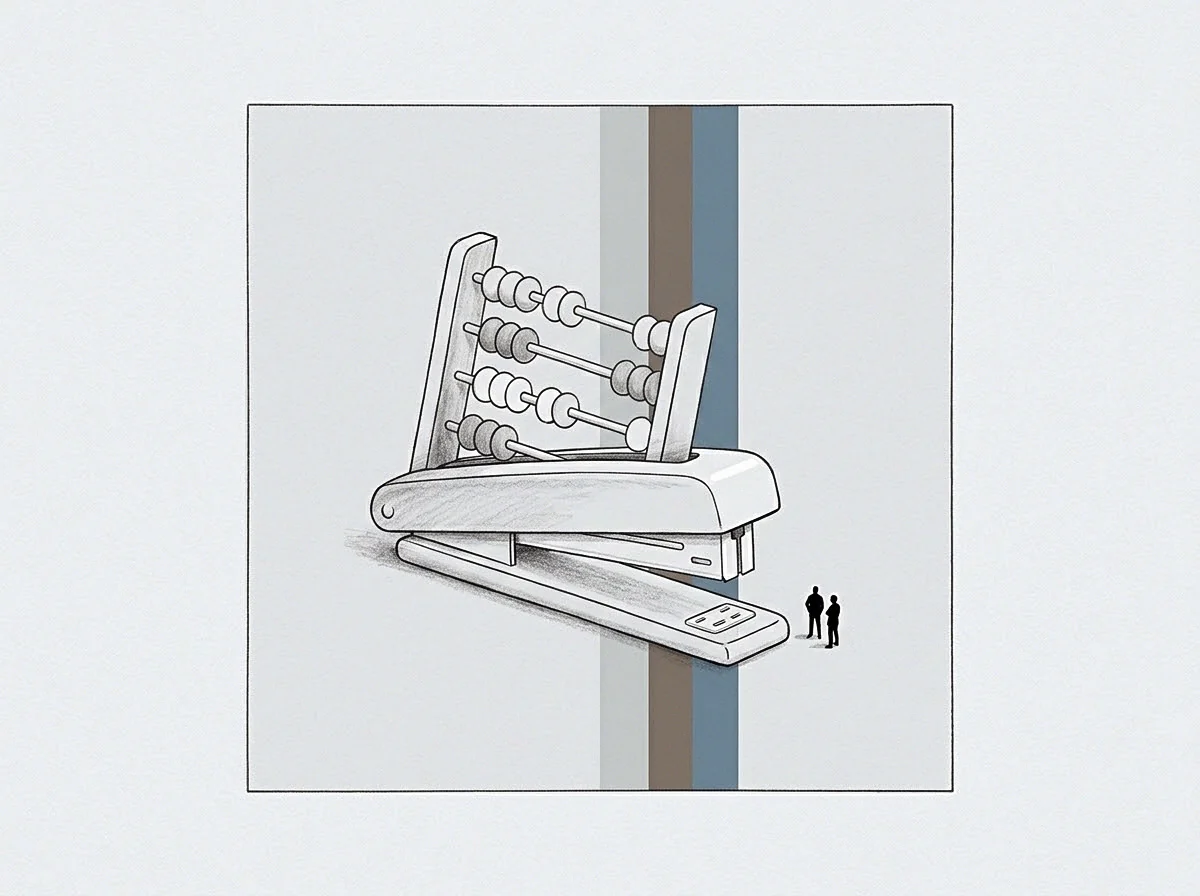
Structural Mechanics Of Decision Thresholds In Scaling Enterprise Operations
Operational scaling succeeds when enterprise decision thresholds shift from personal executive approval to hard structural setpoints anchored in stated operational cost.
Operational scaling succeeds when enterprise decision thresholds shift from personal executive approval to hard structural setpoints anchored in stated operational cost.

Founder coregulation fails when executive systems exceed baseline biological capacity, shifting operational stabilization from personal presence to explicit terms.

Unspoken relational load transfers across executive seats until explicit terms transform personal endurance into structural operational limits.

A stated limit acts as a structural wall that forces an operational system to triage work rather than exhausting the personal capacity of the person in the seat.

Structural terms act as low-pass filters that attenuate high-frequency demands during organizational allostatic overload.

Reciprocal safety cues recalibrate threat budgets so an isolated regulator can rebuild neural receptivity for shared regulation.

Operating limits derived from fixed positional rules eliminate continuous relational bargaining, forcing counterparties to calculate access from observable terms.

Stated limits replace person-level regulation with structural terms, stopping load transfer before operational capacity fails under sustained systemic demand.

Concurrent burnout destroys the social baseline subsidy, turning shared presence into sensory overhead until extended allostatic clearance restores receptor capacity.

Rigid intake constraints preserve downstream enterprise velocity during surges by converting external commercial pressure into perimeter qualification friction.

Stated intake conditions enforce strict parameter validation at entry, preventing malformed tasks from consuming cognitive capacity during asynchronous execution.

Stated intake terms filter operational load by enforcing objective submission standards before unrefined tasks enter executive processing channels.

Automated authority handovers fail under extreme load because algorithmic shedding transfers dynamic instability faster than human cognitive recovery permits.

Dynamic boundary throttling caps incoming operational escalations at fixed setpoints, preserving cognitive headroom by enforcing asynchronous intake latency.

Automated backpressure and state-gated escalation routing protect engineering capacity during unexpected volumetric spikes by shedding non-critical operational load.
Structural governance protocols shield executive cognitive bandwidth by establishing strict escalation thresholds and mediated interfaces that deflect operational load.

A mechanical communication filter intercepts and batches incoming organizational demands to prevent continuous working memory disruption at the executive desk.

Delegated authority latency increases non-linearly under volume pressure when synchronous human verification gates process high-frequency operational requests.

Stated authorization caps transfer routine commitments to perimeter operators, eliminating runtime approvals and shielding executive regulators from overload.

Explicit decision thresholds transfer variance management to local operators by defining autonomous authority setpoints based on capital and reversibility.

Rigid governance creates operational latency that forces personnel to use informal workarounds when control delays exceed execution thresholds.

Dynamic enterprise autonomy scales through explicit state-gated decision ceilings that substitute automated retrospective auditing for central pre-approval gates.

Autonomous monetary thresholds require separating single-transaction cash caps from aggregate multi-year liabilities and contingent exit terms.

Delegating operational decision rights replaces centralized executive sign-offs with structural setpoints, eliminating latency and recovering executive bandwidth.

Autonomous subsystems transfer tail risk to central governance when execution authority expands without dedicated monitoring capacity under heavy operational load.
Contractual stated terms transform subjective capacity boundaries into objective operational walls that regulate incoming operational load automatically.

Explicit allocation limits establish hard operational capacity ceilings for executive seats, forcing systems to delegate, defer, or drop non-essential load.

Solitary executive threat processing forces the brain to spend local prefrontal energy without social baseline subsidies, raising metabolic costs.

Automated governance gates maintain artificial equilibrium when invisible human interventions absorb upstream schema errors, hiding structural decay until human capacity reaches exhaustion.
The terms are written where they belong. Each field holds three desks, and every entry a desk writes raises the terms it uses, each term given a meaning, a mechanism and the places it appears. The record on these pages stays first person and hand made; the fields grow the nomenclature.