

Measuring Cognitive Headroom Depletion from Covert Interpersonal Buffering
Covert interpersonal buffering consumes prefrontal working memory by running continuous regulatory background processes, severely depleting cognitive headroom.
Covert interpersonal buffering consumes prefrontal working memory by running continuous regulatory background processes, severely depleting cognitive headroom.

Relational maintenance demands consume executive bandwidth through chronic coregulation, elevating allostatic load until structural availability gates bound open interpersonal threads.

Stated decision limits create explicit authorization bounds that automatically transfer routine choices to functional leads during rapid scale pressure.

Solitary self regulation increases metabolic threat costs, whereas proximity to a stable presence reallocates autonomic capacity toward execution.
Early stage leadership capacity is preserved by establishing formal structural conduits that eliminate unbudgeted organizational distress absorption.

Executive concurrency drops when subordinate co-regulation consumes working memory slots, transforming strategic capacity into real-time emotional stabilization.

Unilateral containment forces continuous sympathetic activation in high-load operators until explicit relational safety signals enable visceral parasympathetic recovery.

Continuous unhedged organizational stress drives biological wear through elevated allostatic load and ungated thread counts that deplete cognitive headroom.
Chronic operational burnout forces the autonomic nervous system to process partner presence as operational load rather than baseline calm, requiring structured non-demanding micro-exchanges to rebuild somatic receptivity over time.

Quantifying concurrency limits and autonomic thresholds protects executive decision fidelity by capping active loops and restoring parasympathetic baseline.

Structural gating protocols manage founding partner allostatic load by converting open loops into bounded asynchronous threads with explicit scope, dates, and terms.

Autonomic coregulation in executive teams relies on vagal safety signaling, where continuous physiological overload triggers systemic autonomic throttling.

Predictable proximity and explicit autonomic limits reset parasympathetic baseline by lowering the metabolic cost of self-regulation in high-stress partnerships.
Executive throttling shuts down prefrontal synthesis to protect biological capacity under extreme allostatic load, requiring structural loop gating rather than clinical mood treatment.

Cognitive concurrency caps represent structural processing limits under ungated operational load, whereas clinical anhedonia stems from neural reward pathway impairment.
Executive system throttling selectively suppresses high-order cognitive processing to protect vital operational capacity under sustained physiological load.

Executive cognitive satiation is resolved by enforcing batched telemetry delivery windows and explicit threshold-based governance gates.

Shared fatigue converts workspace proximity from a co-regulatory asset into a continuous physiological evaluation burden that suppresses heart rate variability.

Structural governance boundaries preserve executive working memory by restricting incoming operational escalations to codified, rule-governed thresholds.

Shared desk hours elevate nervous system arousal through autonomic entrainment, transferring stress from erratic workers to adjacent stable operators.

Extended solitary founder tenure locks threat processing into high gain, which down-regulates only through repeated operational co-regulation with a stable peer.

Codified decision thresholds protect leadership capacity by converting real-time discretionary approvals into automated, rule-based operational setpoints.

Governance terms replace biological load absorption with rigid gates, shifting unmanaged operational volume into latency and exposing structural failure thresholds.

Concurrency limits in expanding management systems are determined by setting hard limits on parallel task intake based on human state capacity.
Executive cognitive load escalates when ungated operational threads saturate working memory slots, forcing systemic throttling distinct from emotional fatigue.
Multi-stakeholder consent covenants drain executive capacity by multiplying asynchronous communication loops, decoupling operational accountability from execution authority, and elevating allostatic load.

Solitary leadership recalibrates neural threat processing by elevating baseline vigilance while constricting relational capacity through unshared regulatory load.
Solitary technical building removes environmental co-regulation, forcing the brain to expend metabolic energy on self-regulation and throttling cognitive headroom.
Unilateral regulation in shared operational space shifts physiological load onto one nervous system, elevating baseline cortisol and suppressing regulatory receptor updates.
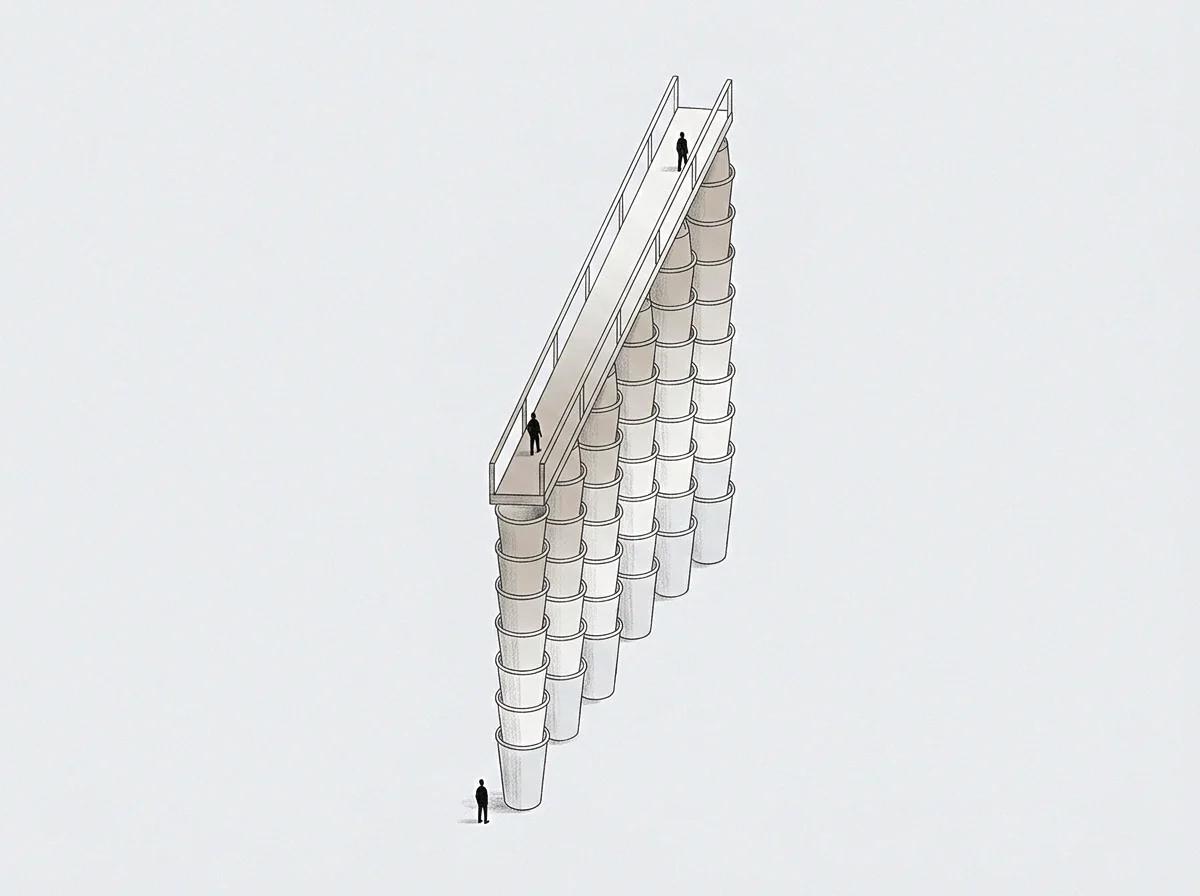
Operational panic concentrates into the calmest executive present whose nervous system absorbs the metabolic cost of stabilizing the entire leadership circle.
The terms are written where they belong. Each field holds three desks, and every entry a desk writes raises the terms it uses, each term given a meaning, a mechanism and the places it appears. The record on these pages stays first person and hand made; the fields grow the nomenclature.